Introduction
Welcome back! In our last lesson, you learned how to analyze your content's performance data to identify a "core asset"—a high-impact piece that resonates with your audience and aligns with business goals. This was a crucial step in shifting from simply creating content to strategically managing a content portfolio.
Now that you have your core asset, what's next? A single great article or webinar, no matter how effective, has a limited reach. The key to scaling your impact without scaling your workload is content repurposing. This lesson will equip you to do just that.
Today, we'll focus on the learning outcome: Map a single core content asset to multiple repurposed formats (e.g., blog post to social thread, video clips, infographic). We'll introduce the concepts of "Pillar Content" and "Content Atomization," moving from the idea of a single asset to a connected ecosystem of content that meets your audience on multiple channels.
1. The Strategic Framework: Pillar, Atomize, Distribute
Effective repurposing is not random; it's a system. The most successful B2B marketers think about this from the very beginning. The content you identified in the last lesson is your Pillar. Now, we need to Atomize it—break it down into its core components and reassemble them into new formats.
The article "Content Repurposing: B2B Strategy, Templates & Examples" by Cognism introduces an excellent framework for this called P → A → D → R (Pillar → Atomise → Distribute → Refresh). This provides a clear, repeatable operating system for turning one high-value asset into weeks or even a quarter's worth of content.
Content Repurposing: B2B Strategy, Templates & Examples
To build a systematic process, we need a framework. This article from Cognism provides a simple but powerful one designed specifically for B2B marketing. We will focus on the first two steps: Pillar and Atomise.
Please read the section titled 'The framework: P → A → D → R'. Pay close attention to the descriptions and 'Do this' tips for steps 1 (Pillar) and 2 (Atomise). This will form the conceptual basis for our work today.
The concept of "atomization" is central to this process. You are deconstructing a large, complex piece of content into its fundamental particles—key ideas, statistics, quotes, and frameworks—which can then be reconfigured for different channels and formats.
This diagram provides a clear visual of what content atomization looks like in practice.

2. A Practical Workflow: From One to Many
Now that we have the strategic framework, let's look at a practical, high-speed demonstration of how this works. The following video from HubSpot shows a content creator turning a single 15-minute video into over 20 different content assets in one hour.
While the video uses a specific set of AI-powered tools like Descript, the workflow itself is universal and showcases the incredible potential of atomization. Given your background, the use of text-based video editing might be particularly interesting, as it treats video as a manipulable document.
The Latest AI-Powered Content Creation Workflow for Business (Speed Challenge!)
This video is a masterclass in execution. It demonstrates how to rapidly transform a single video into a vast array of content formats, from social media clips to blog posts and even lead magnets.
Watch the following segments to see the transformation in action: Video to Video Clips (07:49 - 10:09): See how the long-form video is cut into medium-length videos and short, vertical clips for social media. Content to Graphics (10:09 - 11:54): Observe how key ideas are turned into carousels and quote graphics using Canva. Video to Text (11:54 - 14:17): Note how the video transcript is repurposed into a blog post, email newsletter, and various LinkedIn/X posts. Content to Funnel Assets (14:17 - 17:05): Pay attention to how the core ideas are transformed into a downloadable checklist (lead magnet), an ebook, and a course outline, directly connecting content to the sales funnel.
As you saw, a single pillar asset can be atomized into a wide variety of formats, each tailored to a specific channel and audience preference. Here’s a summary of the key transformations:
- Pillar Video → Micro Videos: The original video is clipped into shorter highlights, topic-specific segments, and vertical videos for platforms like YouTube Shorts, Instagram Reels, and LinkedIn.
- Pillar Video → Written Content: The video transcript becomes the raw material for a full blog post, a newsletter, multiple LinkedIn posts, and an X (Twitter) thread.
- Pillar Video → Visual Graphics: The main points and impactful quotes are extracted and designed into shareable assets like LinkedIn carousels, infographics, and quote graphics.
- Pillar Video → Lead Generation Assets: The core framework or advice is condensed into a downloadable lead magnet (like a checklist or template) to capture email addresses, and can even be expanded into a low-cost product like an ebook.
This systematic process is the heart of a content engine.
3. Activity: Create Your Repurposing Map
Now it's time to apply this framework to your own work. You will take the core asset you identified in the previous lesson and create a plan to atomize it.
The Cognism article you read earlier contains a "Content Repurposing Matrix." This is a perfect tool for planning your work. It forces you to think systematically about how each "atom" of your pillar can be repurposed.
Here is a visual example of a similar repurposing plan, showing how one recording can fuel an entire month of content across multiple channels.
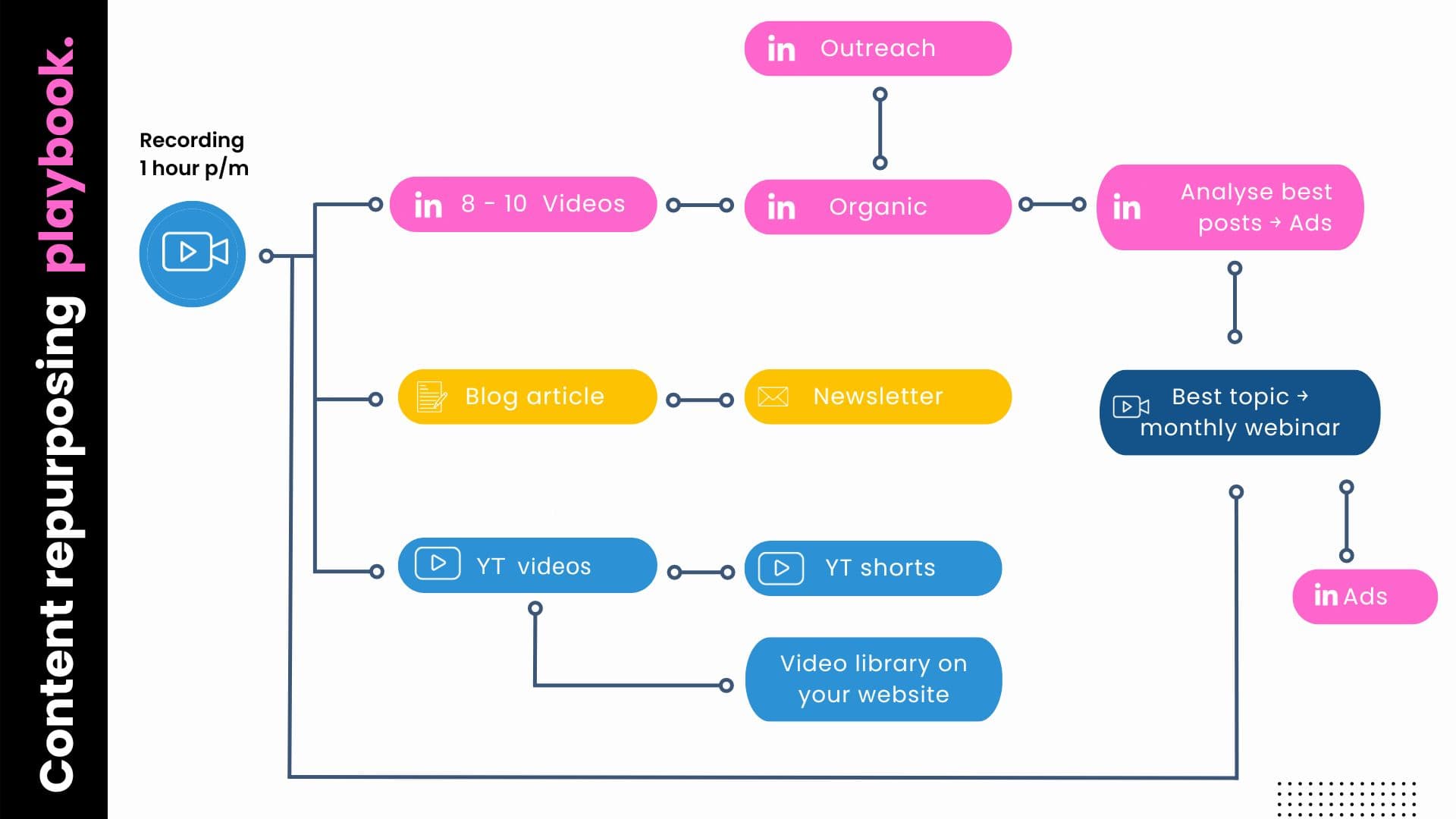
Your Task (20 minutes):
Take the core asset you identified in the last lesson (e.g., "The Ultimate Guide to X") and create a repurposing map for it. Use a simple document or spreadsheet to build a table with the following columns:
| Pillar Asset | Atom Idea (Key takeaway, stat, or quote) | Format 1 | Format 2 | Channel(s) |
|---|---|---|---|---|
| [Title of your asset] | [e.g., "Key Stat: 75% of..."] | [e.g., Infographic slide] | [e.g., X (Twitter) post] | [e.g., LinkedIn, X] |
| [Title of your asset] | [e.g., "Framework: The 3-Step Process for..."] | [e.g., LinkedIn Carousel (3 slides)] | [e.g., 60-second video clip] | [e.g., LinkedIn, YouTube Shorts] |
| [Title of your asset] | [e.g., "Customer Quote: 'This changed how we..."] | [e.g., Quote graphic] | [e.g., Section in sales one-pager] | [e.g., Instagram, Sales Enablement] |
Instructions:
- List your Pillar Asset.
- Identify 3-5 distinct "Atom Ideas" from your core asset. These should be the most impactful statistics, compelling arguments, actionable tips, or powerful quotes.
- For each atom idea, brainstorm at least two different formats you could turn it into.
- List the primary channel(s) where you would publish these new formats.
This exercise will give you a tangible, actionable plan for multiplying the impact of your best content, moving you one step closer to building a true content engine.
Conclusion
In this lesson, you've bridged the gap between identifying high-value content and strategically amplifying it. You now have a framework and a practical plan for transforming a single pillar asset into a multi-format, multi-channel content campaign.
Key Takeaways:
- Pillar and Atomize: The most effective content strategy involves creating high-value "pillar" content and systematically "atomizing" it into smaller pieces.
- One-to-Many Transformation: A single asset (like a blog post or video) can be repurposed into dozens of formats, including micro-videos, social media threads, infographics, and lead magnets.
- The Repurposing Matrix: Using a structured map to plan your atomization ensures you are strategic about matching formats and ideas to the right channels.
- System Over Effort: This approach allows you to scale your content's reach and impact without a linear increase in content creation effort.
Preview of the Next Lesson:
Now that you have systems for identifying and repurposing high-impact content, we need to ensure the engine is continuously supplied with the right fuel. The best source of high-impact content ideas is often your sales team, as they are on the front lines talking to customers every day. In our next lesson, we will learn how to design a feedback loop that incorporates sales team insights into future content planning, closing the loop and making your content engine even more powerful and aligned with revenue goals.