Introduction
Welcome back! In our last lesson, you built a content mapping framework, giving you a strategic blueprint that connects your content topics to specific buyer personas and their journey stages. You now have a plan for creating the right content for the right person at the right time.
Now, we'll answer the crucial follow-up question: "How will we know if it's working?" This lesson moves from planning to measurement. We will focus on how to set measurable content goals (SMART goals) that are directly tied to pipeline and revenue metrics.
Your goal is to build a content engine that demonstrates clear business impact. This means moving beyond "vanity metrics" like likes and page views and adopting goals that the C-suite and sales team understand and value—leads, pipeline, and revenue. By the end of this lesson, you'll be able to translate your content strategy into a set of precise, actionable objectives that prove the value of your work.
1. The SMART Goal Framework
Before we can tie goals to revenue, we need a reliable structure for defining them. The most effective framework for this is SMART:
- Specific
- Measurable
- Attainable
- Relevant
- Time-bound
A goal like "improve our blog" is a vague wish. A SMART goal transforms it into a clear target, like "Increase organic sign-ups from our blog by 15% in the next quarter."
To get a clear overview of this framework, let's watch a short video that breaks down each component.
SETTING MARKETING GOALS - How to set SMART goals in marketing
The video 'SETTING MARKETING GOALS' by Elif Hız provides an excellent introduction to the SMART framework. It clearly explains each component with a practical marketing example.
Watch the segment from 03:14 to 08:32. Pay attention to how a vague wish ('increase demo requests') is progressively transformed into a complete SMART goal by applying each of the five criteria.
As the video demonstrates, applying the SMART criteria forces you to think through the critical details: what you want to achieve, how you'll measure it, whether it's realistic, why it matters to the business, and when you'll do it by.
2. Tying Content Activity to Business Impact
Your content map from the last lesson organizes your efforts around educating buyers. But how does education turn into revenue? The key is to understand that only a small fraction of your market is ready to buy at any given moment.
This is a fundamental concept in B2B marketing. Most of your audience needs nurturing and education before they even consider a purchase. Your content's primary job is to guide them on that journey.
Content Marketing for B2B That Works (Stop Losing Potential Customers)
The video 'Content Marketing for B2B That Works' by TK Kader offers a powerful mental model for this. He breaks the market into two segments, which helps clarify the purpose of your content.
First, watch the section from 02:22 to 04:21, which introduces the '3% vs. 97%' concept. This explains why educational content is so critical. Then, watch the 'bonus' section from 16:57 to 19:16, which explains how to convert content consumers into actual leads using a 'manifesto' or guide. This is the mechanism that connects your content to the sales funnel.
The video highlights two critical takeaways:
- The 97/3 Rule: The vast majority (97%) of your potential market isn't actively buying. They need to be educated about their problem first. This is the role of your Awareness and Consideration stage content. The remaining 3% are actively looking for a solution—this is where your Decision stage content comes in.
- The Conversion Mechanism: Creating great educational content isn't enough. You must have a way to convert anonymous readers into known leads. This is typically done by offering a high-value asset (like a guide, template, or webinar—what the video calls a "manifesto") in exchange for their contact information.
This conversion point is where your content's ROI journey begins. It’s the first measurable step from content consumption to pipeline generation.
3. Identifying the Right Pipeline and Revenue KPIs
To make your goals "Measurable" and "Relevant," you must use the language of the business: Key Performance Indicators (KPIs). For a content strategist aiming to influence revenue, this means moving beyond content-specific metrics (like time on page) to sales and marketing funnel KPIs.
B2B Marketing KPIs: Metrics That Actually Drive Pipeline and Revenue
The article 'B2B Marketing KPIs: Metrics That Actually Drive Pipeline and Revenue' from In Motion Marketing is an excellent resource for this. It clearly distinguishes between strategic KPIs and tactical metrics.
Read the first two sections, 'What Are B2B Marketing KPIs (vs. Metrics)?' and 'Why Tracking B2B Marketing KPIs Is Critical for Growth.' Focus on the table that contrasts KPIs with metrics. This distinction is crucial for setting goals that command executive attention.
In essence:
- Metrics track activity (e.g., email open rates, click-through rates). They are useful for optimizing campaigns.
- KPIs track strategic outcomes (e.g., marketing-sourced pipeline, customer acquisition cost). They are used to measure business impact.
Your SMART goals should be built around KPIs. The following image of a sales pipeline visualizes how leads flow through the funnel and why conversion rates between stages are such important KPIs.

With that context, let's explore some of the most important B2B marketing KPIs you can build your content goals around. These are detailed further in the "Essential B2B Marketing KPIs to Track" section of the article you just reviewed.
Key Content Marketing KPIs
| Funnel Stage | KPI | What It Measures | Why It Matters for Content |
|---|---|---|---|
| Top/Mid-Funnel (TOFU/MOFU) | Website Conversion Rate | The percentage of website visitors who complete a key action (e.g., downloading an ebook). | Measures how effectively your content converts anonymous traffic into known leads (MQLs). |
| Marketing Qualified Leads (MQLs) | Leads who meet predefined criteria, showing they are a good fit and interested. | This is the primary output of your TOFU/MOFU content efforts. Your goal is to generate quality MQLs. | |
| Cost Per Lead (CPL) | The average cost to generate one lead from a specific channel or campaign. | Helps you measure the efficiency of your content marketing spend. | |
| Mid/Bottom-Funnel (MOFU/BOFU) | MQL-to-SQL Conversion Rate | The percentage of marketing-qualified leads that the sales team accepts as sales-qualified. | This is the single best indicator of lead quality. A high rate means your content is attracting the right audience. |
| Marketing-Sourced Pipeline | The total value of sales opportunities that originated from marketing's efforts. | This directly connects your content-generated leads to a dollar value in the sales pipeline. | |
| Bottom Line | Customer Acquisition Cost (CAC) | The total sales and marketing cost to acquire a single new customer. | Your content should help lower CAC over time by attracting qualified, educated leads. |
| Return on Marketing Investment (ROMI) | The revenue generated for every dollar spent on marketing. | This is the ultimate measure of marketing's financial contribution and the holy grail for a content engine. |
4. Writing Effective SMART Content Goals
Now, let's combine the SMART framework with these business-focused KPIs. A well-written SMART goal provides clarity and a direct line of sight between your content activities and business results.
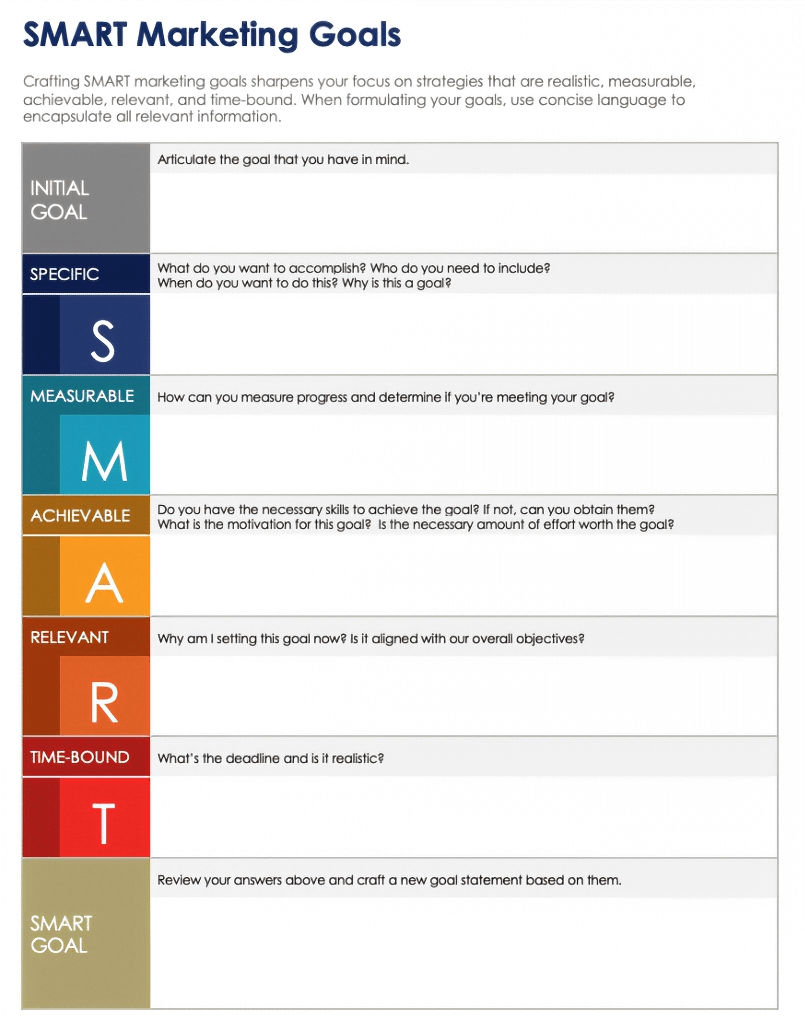
Here's a template you can use, based on the SMART Marketing Goals Template image.
Let's look at some examples of transforming a weak goal into a SMART one.
Example 1: Awareness/TOFU Goal
- Weak Goal: "Write more blog posts."
- SMART Goal: "Increase organic traffic to the blog by 20% (from 10,000 to 12,000 monthly unique visitors) by the end of Q2 by publishing eight new SEO-optimized articles targeting 'X' keyword cluster. This will support our goal of increasing new MQLs from the blog."
- S: Increase organic traffic by publishing 8 SEO-optimized articles.
- M: A 20% increase, from 10k to 12k monthly visitors.
- A: Assumes current resources and performance allow for this growth.
- R: Supports the larger business goal of generating more MQLs.
- T: By the end of Q2.
Example 2: Consideration/MOFU Goal
- Weak Goal: "Create a new ebook."
- SMART Goal: "Generate 150 MQLs in Q3 from a new downloadable guide on 'Choosing the Right B2B Marketing Automation Platform.' This will be achieved by promoting the guide through email, social media, and a homepage CTA. This goal supports the company's objective to generate $300k in marketing-sourced pipeline for the quarter."
- S: Generate MQLs from a new, specific guide.
- M: 150 MQLs.
- A: Assumes past campaigns have seen similar performance.
- R: Directly contributes to the marketing-sourced pipeline goal.
- T: In Q3.
5. Your Turn: Set Your First SMART Content Goal
It's time to apply this framework. Your background in computer applications lends itself well to this kind of logical, structured thinking.
Task (Allow ~15 minutes):
- Look back at the content mapping matrix you started in the last lesson.
- Choose one content idea from your map, preferably from the Consideration stage. (e.g., a white paper, webinar, or case study).
- Use the structure below (inspired by the template image) to formulate a complete SMART goal for that piece of content. Be ambitious but realistic.
Initial Goal: (e.g., Create a case study for Persona X)
S - Specific: What exactly will you do? What is the outcome?
Your Answer:
M - Measurable: What KPI will you use? What is the target number?
Your Answer:
A - Attainable: Is this realistic given your resources and historical performance? (A simple 'Yes' is fine, but consider why).
Your Answer:
R - Relevant: How does this goal support a larger business objective (e.g., pipeline generation, improving lead quality)?
Your Answer:
T - Time-bound: What is the deadline or timeframe?
Your Answer:
Final SMART Goal: (Combine the answers above into a single, clear sentence).
Your Answer:
Conclusion
You have now learned how to connect your content strategy to tangible business outcomes. This is a pivotal step in evolving from a content creator into a strategic leader who drives revenue.
Key Takeaways:
- The SMART framework (Specific, Measurable, Attainable, Relevant, Time-bound) is essential for creating clear, actionable goals.
- Effective B2B content marketing focuses on educating the 97% of the market that isn't ready to buy and converting them into leads.
- To prove value, your goals must be tied to business KPIs like MQLs, SQLs, pipeline value, and ROMI—not just vanity metrics.
- A well-written SMART goal serves as a north star for your content initiatives, aligning your efforts with sales and overall business objectives.
Preview of the Next Lesson:
With a content map in hand and a clear understanding of how to set goals, you are ready to create a tactical plan. In the next lesson, you will draft a one-month content plan for a single content pillar as a working prototype. This is where you'll schedule the creation, publication, and promotion of the content designed to hit the SMART goals you've just learned to set.