Introduction
Welcome back! In our last lesson, you developed your core content pillars by starting with your buyers' most significant pain points. This gave you the strategic "what"—the core themes your content will focus on to build authority and solve real business problems.
Today, we move from the "what" to the "who" and "when." This lesson is about creating a content mapping framework that aligns your topics to specific funnel stages and buyer personas.
A content map is the blueprint for your content engine. It's a system that ensures you deliver the right message, to the right person, at the right time. By the end of this lesson, you will have a practical framework—typically a matrix or spreadsheet—that visualizes your entire content plan, helps you identify critical gaps, and guides buyers systematically from initial awareness to a final purchase decision. This is the bridge between your high-level strategy and the individual assets you'll create.
1. The Core Components of a Content Map
A content map is a tool for organizing your content strategy. It functions by plotting your content assets against two primary dimensions:
- The Buyer Persona (The "Who"): This is your target audience.
- The Buyer's Journey Stage (The "When"): This represents where your audience is in their decision-making process.
By mapping content to these two axes, you ensure that every piece you create has a specific purpose and audience, transforming your content from a random collection of assets into a cohesive system.
To start, let's explore these two dimensions in more detail.
2. Dimension 1: The Buyer Persona
Since you already have formally defined buyer personas, we won't cover how to create them. Instead, we'll focus on how to use them as a strategic lens for your content map. In a B2B context, it's crucial to think beyond a single persona and consider the entire buying committee.
5 Steps to Map Content to Buyer Journey
The article '5 Steps to Map Content to Buyer Journey' provides excellent context for thinking about B2B personas. It highlights that decisions are rarely made by one person, which has significant implications for your content.
Read 'Step 1: Create Buyer Personas.' Pay close attention to the section 'Customizing Personas for B2B Manufacturing' and the concept of the 'buying committee' (technical evaluators, end users, financial gatekeepers, etc.). The principles apply broadly across B2B, not just manufacturing.
As the article notes, an engineer (technical evaluator) cares about detailed specs, while a CFO (financial gatekeeper) focuses on ROI. Your content map must account for these different needs. For example, a single topic from one of your pillars might need to be addressed with different angles and formats to persuade each member of the buying committee.
3. Dimension 2: The Buyer's Journey
Once you know who you're talking to, you need to understand when in their journey you're reaching them. The buyer's journey is typically broken down into three core stages.
5 Steps to Map Content to Buyer Journey
Let's return to the same article, which does an exceptional job of breaking down the mindset, questions, and needs of buyers at each stage.
Read 'Step 2: Map the Buyer Journey Stages.' Focus on the descriptions of the Awareness, Consideration, and Decision stages. The table summarizing the buyer's focus, key questions, and emotions at each stage is particularly important.
To summarize the key stages:
| Stage | Buyer's Focus | Key Questions | Content's Role |
|---|---|---|---|
| Awareness | Experiencing and naming a problem. | "Why am I having this problem? How can I describe it?" | Educate, build trust, and provide vendor-neutral insights. |
| Consideration | Exploring potential solutions or approaches. | "What are the different ways to solve my problem?" | Help buyers evaluate their options and position your category of solution as the best approach. |
| Decision | Choosing a specific vendor or product. | "Why is this specific solution the best one for me?" | Validate their choice with proof, build confidence, and remove friction from the purchase. |
Understanding these distinct needs is fundamental. Sending decision-stage content (like a pricing guide) to someone in the awareness stage is premature and ineffective. Conversely, offering a high-level educational blog post to someone ready to buy is unhelpful.
4. Constructing Your Content Mapping Framework
Now, let's combine these two dimensions into a practical framework. The most common and effective format is a content mapping matrix, usually built in a spreadsheet program like Google Sheets or Excel.
The structure is simple:
- Rows: Your buyer personas.
- Columns: The stages of the buyer's journey (Awareness, Consideration, Decision).
Each cell in this matrix represents a specific strategic slot to be filled with content ideas.
5 Steps to Map Content to Buyer Journey
This final reading from the same Provisors article will walk you through the practical steps of building and populating your matrix.
Read 'Step 4: Build a Content Mapping Matrix.' This section provides a clear, step-by-step guide on how to structure your spreadsheet and use it to identify gaps.
Mapping Content Formats to Stages
With your matrix structure in place, the next question is: what kind of content goes in each cell? Different formats are better suited to different stages.
Content Mapping: definition, creation stages and tools
The article from Plezi offers an excellent overview of how to associate content types with each phase of the journey. This will help you populate your matrix with effective formats.
Read 'Step 3: Associate content types with different stages of the journey.' Focus on the table that lists content ideas for the Discovery (Awareness), Evaluation (Consideration), and Purchase (Decision) phases.
Here is a visual example of how this looks for a single persona. Notice how the content format and topic change to match the stage.

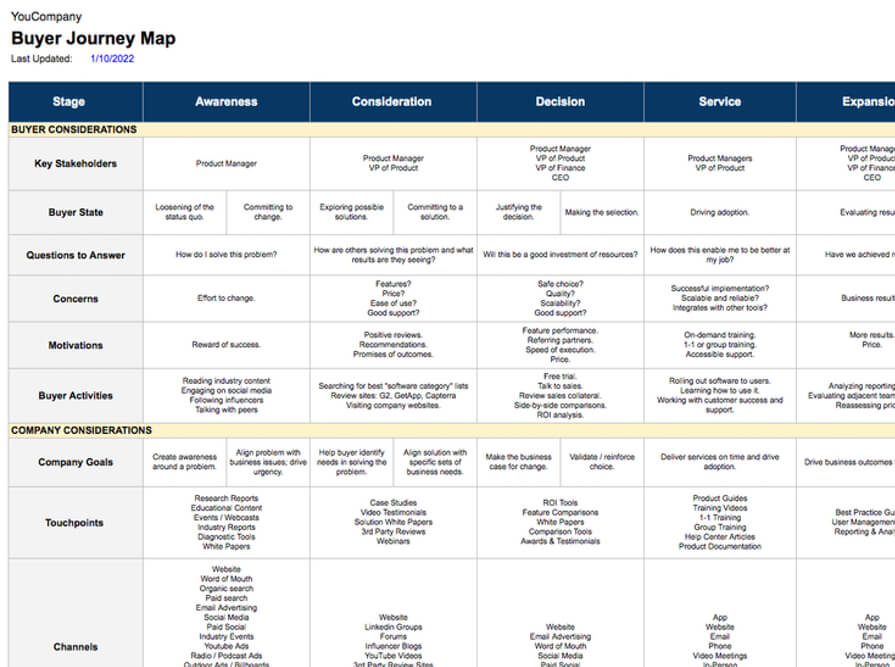
And here is a more comprehensive view of what a full journey map can encompass, including touchpoints and channels.
5. Your Turn: Create Your Content Mapping Framework
It's time to put this into practice. In this exercise, you'll create the skeleton of your content map and begin to populate it. Your experience with structured data and logic from your computer applications background will be very useful here.
Task (Allow ~20 minutes):
-
Set Up Your Matrix (~5 mins):
- Open a new spreadsheet in Google Sheets or Excel.
- In the first column (e.g., column A, starting from A2), list two of your key buyer personas.
- Across the first row (e.g., columns B1, C1, D1), enter the three journey stages: Awareness, Consideration, and Decision.
-
Map Topics from One Pillar (~15 mins):
- Choose one of the content pillars you developed in the last lesson.
- For the first persona on your list, brainstorm one specific content topic for each of the three journey stages (Awareness, Consideration, Decision). The topic should relate to your chosen pillar.
- Next to each topic, note a suitable content format. Use the resources as a guide.
Here is an example to guide you:
| Persona \ Stage | Awareness | Consideration | Decision |
|---|---|---|---|
| Marketing Mary | Topic: "5 Signs Your Content Isn't Contributing to Revenue" Format: Blog Post, Social Media Thread |
Topic: "The Marketing Leader's Guide to Content Attribution Models" Format: White Paper, Webinar |
Topic: "Case Study: How [Company] Used Our Platform to Prove Content ROI in 90 Days" Format: Case Study, Customer Testimonial Video |
| Sales Sam | (To be filled in) | (To be filled in) | (To be filled in) |
Your goal here is not to create a complete map, but to build the framework and practice the process of aligning topics and formats to a specific persona and journey stage.
Conclusion
In this lesson, you've constructed a critical component of your content engine: the content mapping framework. This tool moves you beyond just creating content to strategically deploying it where it can have the most impact.
Key Takeaways:
- A content map is a strategic framework, usually a matrix, that organizes content by buyer persona (the "who") and buyer's journey stage (the "when").
- In B2B, it's vital to consider the entire buying committee, as different roles have different needs and require different content angles.
- The three core journey stages—Awareness, Consideration, and Decision—each correspond to a distinct buyer mindset and require different types of content.
- Building this matrix helps you visualize your content strategy, identify critical gaps, and ensure you are creating a cohesive journey for your prospects.
Preview of the Next Lesson:
Now that you have a map of what content to create and for whom, the next logical question is: "How will we know if it's working?" In our next lesson, you will learn how to set measurable content goals (SMART goals) tied to pipeline and revenue metrics. This will connect your content plan directly to the business outcomes you aim to influence.