Introduction
Welcome to the final lesson in our module on Content Inventory and Gap Analysis. In our last session, you learned how to prioritize the creation of new content by focusing on revenue impact, using frameworks like the "Revenue-First" principle and the Value vs. Effort matrix. You now have a short, strategic list of high-impact content to develop.
Before we jump into creating new assets, we need to complete a critical foundational step: systematically organizing and evaluating your existing content. Today, you will apply the audit framework you designed in previous lessons to your existing content library to create a strategic inventory.
This process is the bedrock of a scalable content engine. It will help you rediscover valuable assets, identify underperformers, and ensure every piece of content has a clear purpose. By the end of this lesson, you will have a tangible, data-driven "database" of your content that will inform your strategy for months to come.
1. The Foundation: Content Inventory vs. Content Audit
In marketing, the terms "content inventory" and "content audit" are often used interchangeably, but they represent two distinct and sequential processes. Understanding this difference is key to executing this task effectively.
A content inventory is the quantitative part: a comprehensive list of all your content assets. An audit is the qualitative part: the process of evaluating those assets against specific goals and metrics.
To clarify this, let's start with a short, insightful video from the Nielsen Norman Group, a leader in user experience research.
How To: Content Inventory and Audit
The video 'How To: Content Inventory and Audit' clearly defines the two concepts and explains their purpose.
Watch the first 1 minute and 20 seconds of the video. Focus on how it distinguishes between the inventory (the 'what') and the audit (the 'how good').
As the video explains, you can't audit what you haven't inventoried. Our main goal today is to build this inventory. However, we will build it strategically, creating columns for the evaluative data you will use in your audit later. This creates a single, powerful tool for managing your content.
Let's reinforce this with a helpful analogy.
Content audit best practices: 10 Powerful Ways for Success 2025
The article 'Content audit best practices' from The B2B Mix uses a great analogy to explain the relationship between an inventory and an audit.
Please read the section 'Content Inventory vs. Content Audit: Know Your Starting Point'. The kitchen pantry analogy is a particularly effective way to frame this.
2. Designing Your Strategic Inventory Framework
Now, let's design the structure of your inventory spreadsheet. Given your background in computer applications, you can think of this as creating the schema for your content database. Each content asset is a record, and each column is an attribute we need to track.
A comprehensive B2B content audit requires collecting data across several categories. The following resource provides an excellent, detailed checklist.
The Ultimate B2B Content Audit Checklist | Blog - Lform Design
The Lform Design blog post, 'The Ultimate B2B Content Audit Checklist,' offers a fantastic breakdown of the data points you should collect.
Read 'Step 2: Collect Data' and review the detailed lists under the headings 'Content Data,' 'Technical Data,' 'Targeted Audience,' and 'Performance.' Don't worry about 'Action' for now; we'll add that column for later use.
Based on that resource and best practices, here are the essential columns for your strategic inventory. I've grouped them for clarity:
A. Basic Information (The Inventory)
URL: The live link to the content asset.Content Title: The public-facing title.Content Type: e.g., Blog Post, Case Study, Whitepaper, Video, Landing Page.Publication Date: When it was first published.Last Updated Date: When it was last modified.
B. Strategic Alignment (The Audit - Part 1)
Target Persona: The primary buyer persona this content is for.Funnel Stage: TOFU, MOFU, or BOFU.Buyer's Journey Stage: Awareness, Consideration, or Decision. (You can use this or the Funnel Stage, whichever you prefer, but be consistent).
C. Performance Metrics (The Audit - Part 2)
Pageviews (90 days): A recent snapshot of traffic.Time on Page: Average engagement time.CTA Conversion Rate: The percentage of visitors who completed the primary call-to-action.Focus Keyword: The primary SEO keyword it targets.Backlinks: Number of external links pointing to it.
D. Action Plan (The Audit - Part 3)
Action: Leave this blank for now, but create the column. This is where you will eventually putKeep,Update,Repurpose, orDelete.Notes: For qualitative observations (e.g., "Outdated stats," "Great customer quote," "Broken image").
Here is an example of what the raw data collection might look like in a spreadsheet.
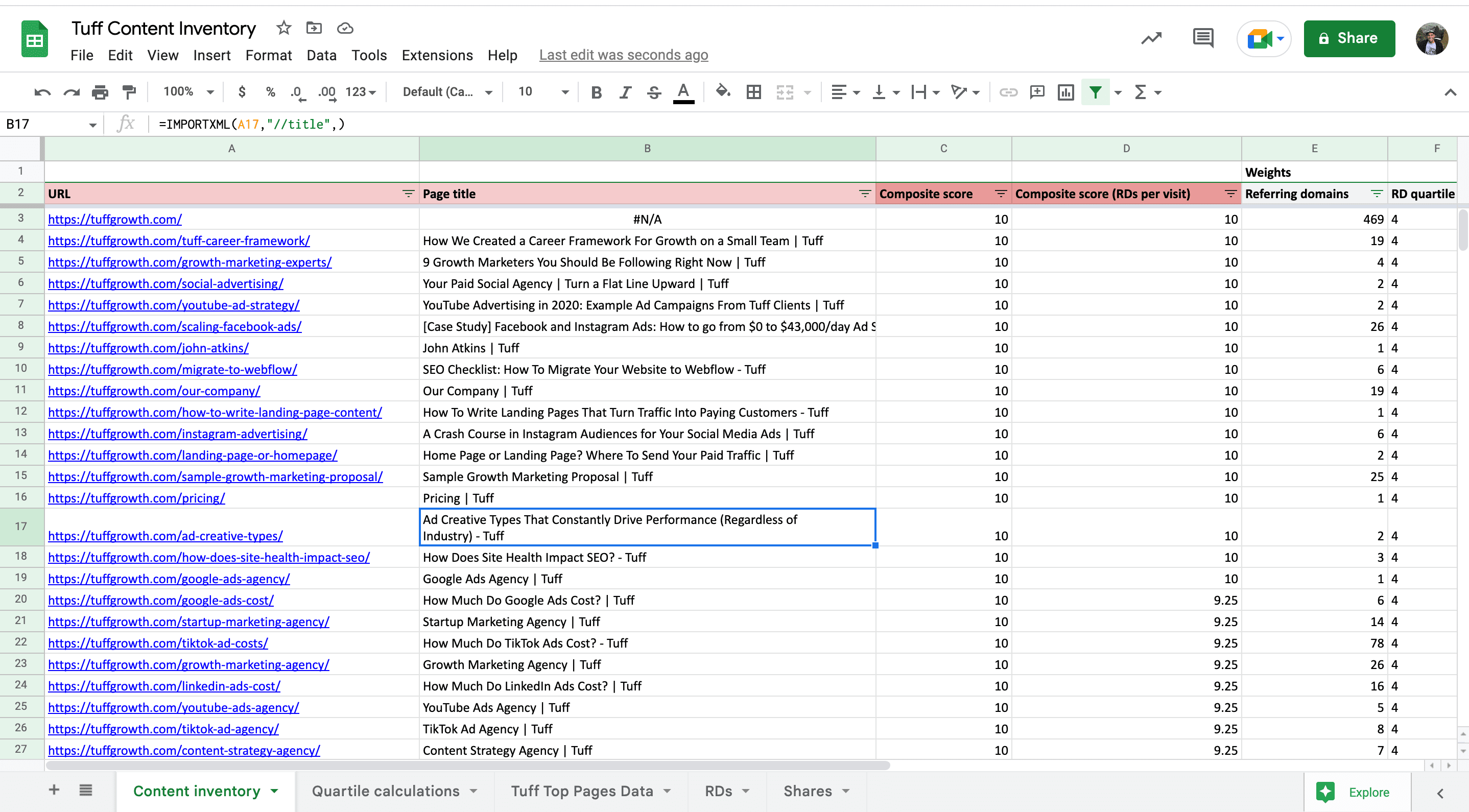
Once populated, this inventory allows you to create visualizations that reveal strategic insights, like the gap analysis you performed in a previous lesson.

3. Your Turn: Build Your Strategic Inventory
Now it's time to apply this framework to your own content library. You mentioned you have a large volume of existing content, so attempting to catalog everything at once would be overwhelming. The key is to start with a manageable, representative sample.
Task (Allow ~35 minutes):
-
Scope Your Project: Choose a specific subset of your content to inventory first. I recommend one of the following:
- The 20 most recent blog posts.
- All content related to a single product or service.
- All of your existing case studies and whitepapers.
-
Create Your Spreadsheet: Open a new Google Sheet or Excel file and create the columns listed in the "Designing Your Strategic Inventory Framework" section above.
-
Populate the Inventory: Begin filling in the data for your chosen content sample.
- Finding URLs: For a small sample, you can gather these manually. For larger projects in the future, you can use a tool like Screaming Frog to crawl your site and export all URLs.
- Strategic Data: Use your judgment to assign the
Target PersonaandFunnel Stage. This is a direct application of the strategic thinking you've been developing. - Performance Data: Pull basic metrics from your analytics platform (e.g., Google Analytics). Don't worry if you can't find every single data point for every asset. The goal is to build the framework and populate it with what is readily available. You can always enrich it later.
This hands-on task is the most important part of this lesson. It will transform the abstract concept of an audit into a concrete, valuable tool for your organization.
Conclusion
Congratulations on building the first iteration of your strategic content inventory. This spreadsheet is more than just a list; it is the foundational database for your entire content engine.
Key Takeaways:
- A content inventory catalogs what you have, while a content audit evaluates its quality and performance.
- A strategic inventory is built with the audit in mind, including columns for
Strategic Alignment,Performance Metrics, andAction Plan. - Starting with a manageable sample of content makes the process achievable and provides immediate insights.
- This inventory transforms your content from a collection of individual assets into a structured, measurable system.
Preview of the Next Lesson:
You have now analyzed your content from two critical angles: identifying what new content to prioritize and creating a strategic map of what you already own. With this clear, data-driven picture of your content landscape, you are perfectly positioned to define the overarching vision for your future efforts.
In our next lesson, we will begin Module 4, "Designing the Content Strategy." Your first task will be to define a content mission statement that aligns with overarching business objectives. This will serve as the north star for your content engine, ensuring every piece you create—whether it's net-new or an update to an existing asset from your inventory—drives toward a common, powerful goal.