Introduction
Welcome to Module 4, "Designing the Content Strategy." In the previous module, you did the essential groundwork of creating a strategic inventory of your existing content. That process gave you a clear, data-driven view of your assets—what you have, who it's for, and how it's performing.
Now, we shift from analyzing the past to architecting the future. The first and most critical step is to define a content mission statement that aligns with overarching business objectives.
Think of this mission statement as the constitution for your content engine. It's a simple, powerful declaration that will guide every decision you make about what content to create, for whom, and why. It ensures that your content isn't just a series of disconnected assets, but a cohesive program driving towards a strategic goal. This lesson will equip you with the frameworks and examples to craft a mission statement that provides focus for your team and clarity for your audience.
1. The Strategic Foundation: Mission, Vision, and Goals
Before we dive into the specifics of a content mission statement, it's helpful to understand where it fits within your company's broader strategy. A business operates with several guiding statements.

A company mission statement focuses on the business (e.g., "To be the leading provider of X solution"). A content mission statement, however, flips the perspective. It focuses on your audience: what value are you committed to providing them through your content?
Let's explore this distinction and the importance of documenting your strategy.
How To Create a Content Marketing Mission Statement
The Content Marketing Institute provides an excellent definition in 'How To Create a Content Marketing Mission Statement.' This article clearly explains the three essential elements of a content mission statement and distinguishes it from a company's mission.
Please read the first section of the article, titled 'What's a content mission statement?' Pay close attention to the three elements it outlines: core audience, what will be delivered, and desired outcome.
2. Why a Mission Statement Matters for Your Content Engine
You might wonder if taking the time to write a single sentence is truly necessary. Research and experience show it's one of the most powerful things you can do. It's the difference between being a reactive content creator and a strategic content leader.
The following short video from Orbit Media, a well-respected web strategy company, explains the high correlation between having a documented strategy and achieving content marketing success.
How to set your strategy with a content marketing mission statement
This video, 'How to set your strategy with a content marketing mission statement,' makes a compelling, data-backed case for why this is the essential first step.
Watch the first 1 minute and 46 seconds. The key takeaway is the research finding that marketers who document their strategy are significantly more likely to report success.
As Andy Crestodina explains, documenting your strategy sets the foundation for success. The content mission statement is that foundation. It provides:
- Focus: It helps you say "no" to off-strategy content ideas, saving time and resources.
- Consistency: It ensures a coherent message across all channels and formats.
- Clarity: It tells your audience exactly what to expect from you, building trust.
- Empowerment: It gives your team (and you) the confidence to make quick, effective content decisions.
3. The Anatomy of a Powerful Content Mission Statement
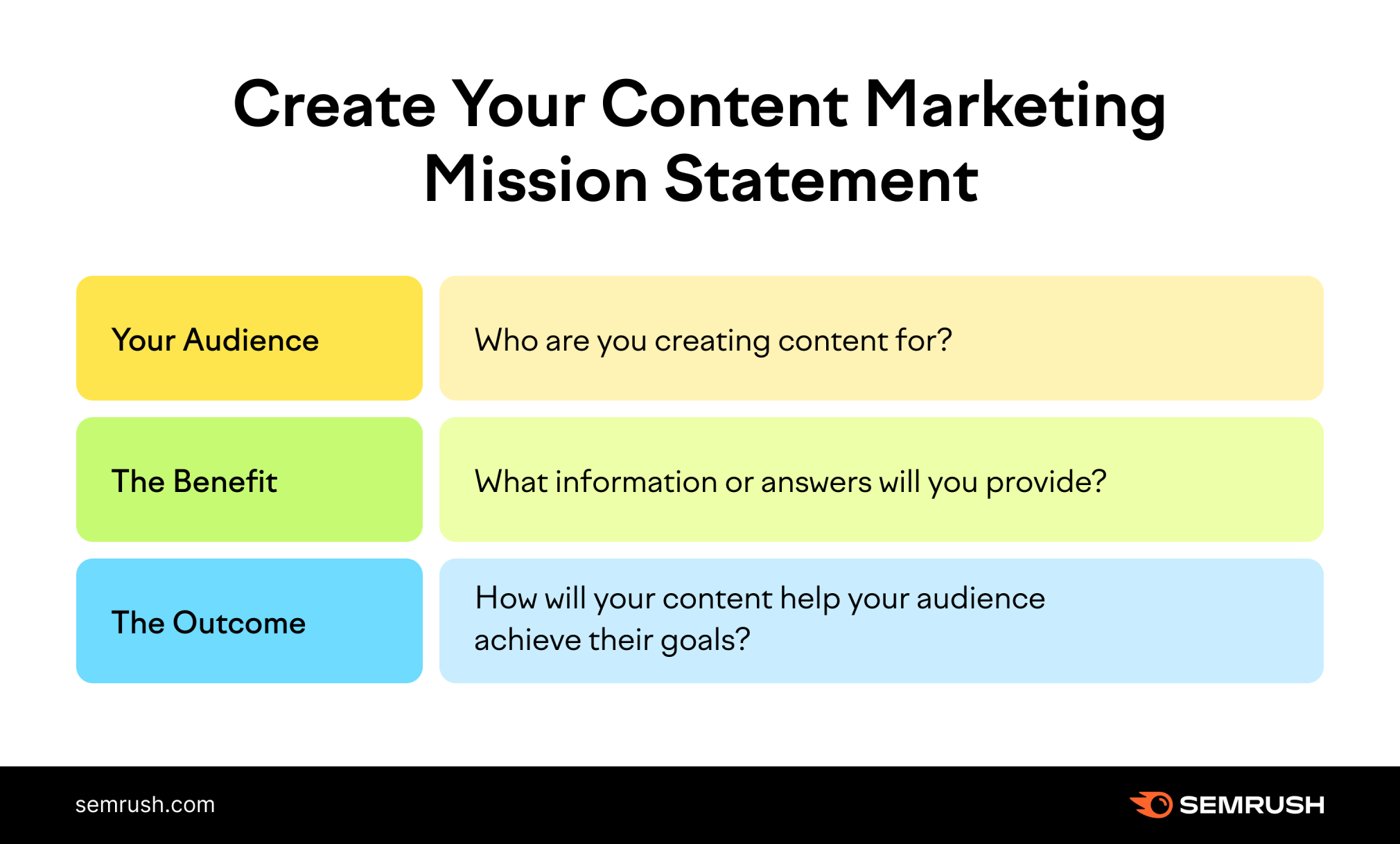
Most effective content mission statements can be broken down into a simple, three-part formula. Let's look at the template and then dissect each component.
How to set your strategy with a content marketing mission statement
The same video from Orbit Media provides a clear, fill-in-the-blanks template and breaks down each part with excellent examples.
Please watch from 01:46 to 06:41. Focus on understanding the X, Y, and Z of the template and how the various examples apply it.
To summarize the framework from the video:
Our content is where [Audience X] gets [Information Y] for [Benefit Z].
Let's break that down:
-
Audience (X): The "Who"
This is your core target audience. As you know from creating buyer personas, specificity is key. Don't just say "marketers." Instead, consider "B2B marketing managers at mid-size tech companies." The goal is to identify a group whose needs you are uniquely positioned to serve. -
Information (Y): The "What"
This defines the substance of your content. What will you provide? The video listed several types: tips, advice, insights, research, news, trends, stories. This forces you to define your editorial focus. -
Benefit (Z): The "Why"
This is the most critical component. It's the outcome for your audience. What's in it for them? Why should they invest their time with your content? The benefit should connect directly to their goals or pain points, like "to get better results," "to make their job easier," or "to advance their career."
Here is a simple visual that captures this three-part structure.
4. Aligning Your Mission with Business Objectives
A great content mission statement serves the audience, but it must also serve the business. This is how you build a true content engine rather than just a content library. Every piece of content should, directly or indirectly, support a larger business goal.
To ensure this alignment, you need to be clear on what those business goals are.
Everything you need to do content strategy
This post, 'Everything you need to do content strategy,' from Content Design London offers a practical, no-nonsense look at how to tie content activities to tangible business goals.
Please read the section titled 'Business goals.' Notice how it translates high-level goals like 'Double organic reach' into specific digital actions. This is the bridge between your content mission and business ROI.
As the article demonstrates, your content efforts don't happen in a vacuum. Before you finalize your mission statement, you must ask: "How will helping our audience in this specific way help us achieve our business goals (e.g., increase leads, improve customer retention, drive revenue)?"
For example, if a business goal is to "Increase income from enterprise clients," a supporting content mission might be: "Our content is where enterprise technology leaders get data-backed frameworks for digital transformation to drive measurable ROI and secure executive buy-in." This mission directly addresses an audience (enterprise leaders) and a need (proving ROI) that aligns with the business goal.
5. Your Turn: Draft Your Content Mission Statement
Now it's time to apply these concepts. Using the template and strategic principles we've discussed, you will draft the content mission statement for your organization.
Task (Allow ~30 minutes):
-
Identify Business Goals: Based on the Content Design London article, list 1-2 top-level business objectives that content can influence. (e.g., "Increase MQLs by 20%," "Improve customer retention by 10%").
-
Define Your Components (X, Y, Z):
- Audience (X): Who is the primary audience you need to reach to achieve those goals? Be specific.
- Information (Y): What specific type of information, insights, or tools will be most valuable to this audience?
- Benefit (Z): What valuable outcome will they achieve by engaging with your content? What's in it for them?
-
Draft Your Statement: Combine your answers into the
X-Y-Zformat. Write at least two different versions.- Template: Our content is where
[Audience X]gets[Information Y]to[Benefit Z].
- Template: Our content is where
-
Refine and Align: Review your draft statements.
- Is it focused on the audience?
- Is it specific and clear?
- Does it implicitly support the business goals you identified in Step 1?
- Could you use it to decide whether a potential blog post idea is "on-mission" or "off-mission"?
This exercise is the cornerstone of your entire content strategy. Take your time to think deeply about each component.
Conclusion
In this lesson, you've moved from the tactical work of inventorying content to the strategic work of defining its purpose. You have learned that a content mission statement is not a fluffy marketing slogan but a powerful tool for focus and alignment.
Key Takeaways:
- A content mission statement defines who your content helps, what you provide, and the benefit they receive.
- Unlike a company mission, it is audience-centric.
- The
Audience (X) - Information (Y) - Benefit (Z)formula provides a simple yet powerful framework for creating your statement. - To be effective, your content mission must align with and support overarching business objectives.
Preview of the Next Lesson:
With your content mission statement as your North Star, you are ready to build out the next layer of your strategy. In the next lesson, you will learn how to develop core content pillars based on buyer pain points and key business themes. These pillars will act as the main strategic topics your content engine will focus on, ensuring everything you create is on-mission and on-strategy.