Introduction
Welcome back. In our last lesson, you did the essential groundwork of populating your content audit spreadsheet with a sample of 15-20 assets. You now have a tangible, data-rich snapshot of your existing content library, combining quantitative metrics with your own strategic assessment.
This lesson focuses on the learning outcome: to analyze the content inventory to identify gaps and surpluses across the buyer journey. Think of the spreadsheet you created as a newly populated database. Today, you'll learn how to query that database to extract strategic insights. We're moving from data collection to data analysis to answer the critical question: "What's missing from our content engine?" Answering this question is fundamental to building a content strategy that systematically guides buyers from awareness to purchase.
1. The Strategic Lens for Gap Analysis
Before we dive into your spreadsheet, it's crucial to establish the right mindset. A content gap isn't just a missing topic. A strategic gap is an imbalance in how you serve your audience throughout their journey. Most organizations over-serve one part of the journey while neglecting others.
To frame this, let's watch a video that powerfully illustrates this common imbalance.
Content Marketing for B2B That Works (Stop Losing Potential Customers)
The video 'Content Marketing for B2B That Works' by TK Kader introduces a vital principle: only 3% of your market is actively buying at any given time. This highlights why analyzing your content against the entire buyer journey is critical for growth.
Watch from 02:22 to 09:45. As you watch, consider your own content library. Do you suspect it's primarily focused on the 3% who are 'buying now,' or does it also serve the 97% who are still identifying their problem and researching solutions?
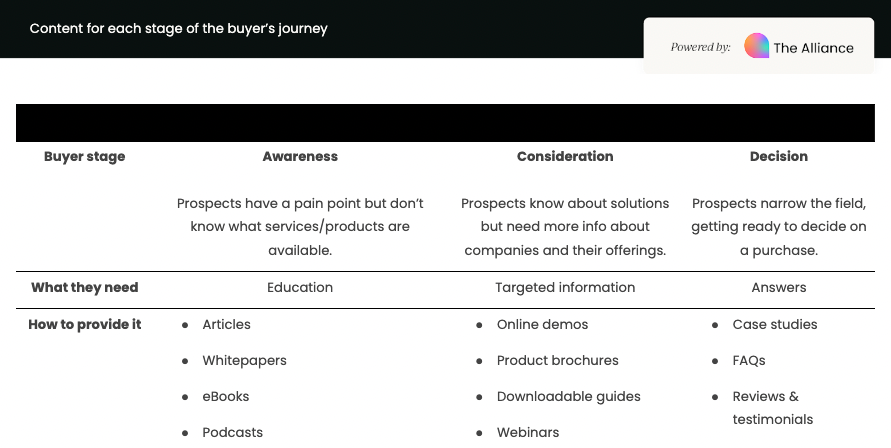
As the video explains, a robust content strategy needs to address three core stages:
- Identifying the Problem: Content that educates the audience about a challenge they may not even know they have.
- Researching Solutions: Content that helps them understand the different ways to solve that challenge.
- Choosing the Right Solution: Content that positions your product as the best choice among the alternatives.
Your content audit spreadsheet holds the key to seeing which of these stages you currently serve well and where your gaps lie.
2. How to Analyze Your Inventory for Gaps
With the strategic framework in mind, we can now turn to the practical analysis of your spreadsheet. We will use two complementary methods to visualize your content distribution.
Method 1: Funnel Stage and Persona Analysis
This is the most direct way to find gaps. Given your background in computer applications, the most efficient tool for this analysis is a pivot table. A pivot table allows you to quickly summarize and group your data to reveal patterns.
Create a simple pivot table from your audit data with "Funnel Stage" (TOFU, MOFU, BOFU) as the rows and "Count of Content" as the values. This will immediately show you the distribution of your content across the marketing funnel.
To take this a step further, create a two-dimensional pivot table:
- Rows: Funnel Stage
- Columns: Buyer Persona
- Values: Count of Content
This view is incredibly powerful. It will instantly reveal specific, high-impact gaps, such as a complete lack of MOFU content for a key persona, or an over-emphasis on TOFU content for another.
Method 2: The Content Marketing Matrix
While funnel analysis is essential, another framework can provide a richer understanding by considering the emotional and rational drivers behind content. The Content Marketing Matrix plots content on two axes:
- Horizontal Axis: Awareness → Purchase (similar to the funnel)
- Vertical Axis: Emotional → Rational
This creates four quadrants: Entertain, Inspire, Educate, and Convince. The following resource explains this matrix and its role in identifying gaps.
How To Perfect Your B2B Content Marketing In 2025
The article 'How To Perfect Your B2B Content Marketing In 2025' from RevenueZen provides an excellent overview of the Content Marketing Matrix.
Read the sections 'What Is the Content Marketing Matrix?', 'Why Do You Need a Content Matrix?', and 'How Do You Use a Content Marketing Matrix?'. Focus on understanding the four quadrants and how plotting your content on this matrix can visually expose where your strategy is lacking.
As you analyze your audit, mentally place each piece of content into one of the four quadrants. Are all your assets clustered in the "Educate" quadrant? Do you have anything that serves to "Inspire" or "Convince"? This perspective helps you see gaps not just in the journey, but in the intent of your content.
Your Turn: Find the Gaps
It's time to apply these analytical frameworks to the audit spreadsheet you created in the last lesson.
Task (Allow ~30 minutes):
- Open your content audit spreadsheet.
- Create Pivot Tables:
- Create a one-dimensional pivot table to show the count of content per Funnel Stage.
- Create a two-dimensional pivot table to show the count of content by Funnel Stage and Buyer Persona.
- Analyze and Document:
- Review the output of your pivot tables and consider your content through the lens of the Content Marketing Matrix.
- In a separate document or in a new tab in your spreadsheet, write down 3 to 5 specific observations about the gaps and surpluses you've identified.
For your observations, be as specific as possible. For example:
- Poor Observation: "We need more MOFU content."
- Good Observation: "Our audit shows we have 10 TOFU blog posts for our 'IT Manager' persona but only 1 MOFU asset (a webinar) and zero BOFU assets (like case studies or comparison guides). This is a major gap in the middle of our funnel for this key persona."
- Good Observation: "Over 90% of our audited content falls into the 'Educate' quadrant. We have a surplus of rational, top-of-funnel content but a significant gap in emotional 'Inspire' content and rational 'Convince' content needed to close deals."
This exercise is the core of this lesson and directly addresses your goal of closing funnel gaps. The first step is seeing them clearly.
Conclusion
You've now moved from simply listing your content to strategically analyzing it. By applying structured frameworks, you've transformed a simple inventory into a diagnostic tool for your content engine.
Key Takeaways:
- Strategic Gaps vs. Topic Gaps: The most important gaps are not missing keywords, but missing support for a specific persona at a critical stage of their journey.
- Analysis Reveals Imbalances: Most content libraries are not balanced. They often have a surplus of TOFU/Awareness content and significant gaps in the MOFU/Consideration and BOFU/Decision stages where conversions happen.
- Frameworks Guide Insight: Using tools like pivot tables for funnel/persona analysis and conceptual models like the Content Marketing Matrix allows you to systematically uncover weaknesses in your content portfolio.
Preview of the Next Lesson:
Identifying gaps is a huge step, but it can also be overwhelming. You might have found a dozen different areas that need content. So, what's next? In our next lesson, we will focus on prioritizing content creation needs based on their potential impact on funnel progression and business goals. We'll move from "What's missing?" to "What should we build first to make the biggest impact?"