Introduction
Welcome back. In our previous lesson, you learned how to analyze content performance using attribution models, which allowed you to connect specific content assets to pipeline generation and revenue. This was a crucial step in proving the past value of your work.
Today, we're shifting from looking backward to looking forward. Your learning outcome is to formulate a business case for content investment using ROI projections and performance data. This skill is the bridge between being a content creator and becoming a strategic content leader. You'll learn how to take the performance data you now know how to analyze and use it to build a persuasive, data-backed argument for future resources, budgets, and initiatives.
1. The Anatomy of a Business Case
First, let's clarify what a business case is. It's not simply a performance report that says, "Here's what we did." It's a formal, persuasive document that makes a proposal: "Here is what we should invest in, here is why, and here is the return we can expect." It's the primary tool for securing buy-in and budget from leadership.
To understand the standard structure and components of a compelling business case, please read the following resource from Asana.
The Beginner's Guide to Writing a Business Case [2025]
The article, 'The Beginner's Guide to Writing a Business Case', provides an excellent, structured overview of what a business case contains and how to build one. We will use it as our foundational framework.
Please read the following sections: 'What is a business case?' to understand its purpose. 'Outline financials and the return on investment' to see the core financial components. 'Preview project details' to learn about defining the scope and objectives. 'Discuss project risks' to understand how to address potential challenges proactively. Focus on how these general business case principles can be applied to a content marketing initiative.
As you can see, a strong business case tells a complete story, covering the financial justification, the project's scope, and potential risks. It transforms a good idea into a viable business plan.
2. Building the Case for Content: From Data to Dollars
Now, let's apply that framework specifically to content marketing. Your goal is to secure investment—for a new blog series, a high-production video, a research report, etc.—by proving it will generate a positive return. The credibility of your business case rests on the quality of your data and the logic of your projections.
This is where the analysis you learned in the last lesson becomes your foundation. You'll use historical performance data to make credible, forward-looking projections.
Key Components of a Content Business Case
- The Problem/Opportunity: Start with the "why." (e.g., "Our sales cycle for enterprise clients is 30% longer than average, and sales lacks assets to build trust with C-level executives.")
- The Proposed Solution: Detail the content initiative. (e.g., "We propose creating a series of three high-production video case studies featuring our top enterprise clients.")
- Project Details: Outline the scope, timeline, and deliverables as described in the Asana resource.
- Financials & ROI Projections: This is the heart of your case. It includes two parts:
- Cost of Investment: The total cost to create and promote the content. This includes freelance fees, ad spend, software costs, and even the time of internal team members.
- Projected Return (Gain): The estimated financial value the content will generate. This can be measured in influenced pipeline, attributed revenue, cost savings, or other key metrics.
- Risks & Mitigation: Acknowledge potential challenges and how you'll address them. Long B2B sales cycles, for example, are a common challenge that can delay seeing a return.
To ground this in reality, it's helpful to understand the common challenges and practical steps involved in measuring content ROI.
Content Marketing ROI Playbook: How to Prove Content ROI - Impact
The 'Content Marketing ROI Playbook' from Impact provides excellent context on the 'why' and 'how' of ROI measurement, which is essential for building your case.
Read the sections 'Why measuring content marketing ROI matters' and 'Common challenges in measuring content marketing ROI.' As you read, think about how you would use the 'why' to frame your argument and how you would address the 'challenges' in the risk section of your business case.
3. Calculating and Projecting ROI
The core of your financial argument is the projected Return on Investment (ROI). The formula is straightforward:
Here’s a practical, step-by-step method to formulate your projection:
-
Establish a Performance Baseline: Use your attribution data.
- Example: "Our analysis shows that each existing text-based case study on our blog influenced, on average, $200,000 in sales pipeline and was a touchpoint in deals contributing to $40,000 in closed-won revenue over 12 months."
-
Define the Investment (Cost): Calculate the total expected cost.
- Example: "The proposed project to create three video case studies will have a total cost of $30,000 ($25,000 for production, $5,000 for targeted promotion)."
-
Project the Return (Gain): Make a conservative, data-backed estimate.
- Example: "Given that video is a higher-impact format, we project each new video case study will influence at least 50% more pipeline than our text versions, totaling $900,000 in influenced pipeline ($300k x 3). We project this will contribute to $180,000 in closed-won revenue ($60k x 3) over 12 months."
-
Calculate Projected ROI:
- Example:
- Example:
Your final statement would be: "We are requesting a $30,000 investment to produce three video case studies, which we project will deliver a 500% return on investment by contributing $180,000 in revenue within 12 months."
This is the kind of clear, financially-grounded statement that executive stakeholders respond to. The image below shows a simple way to present these ROI calculations for various content pieces.
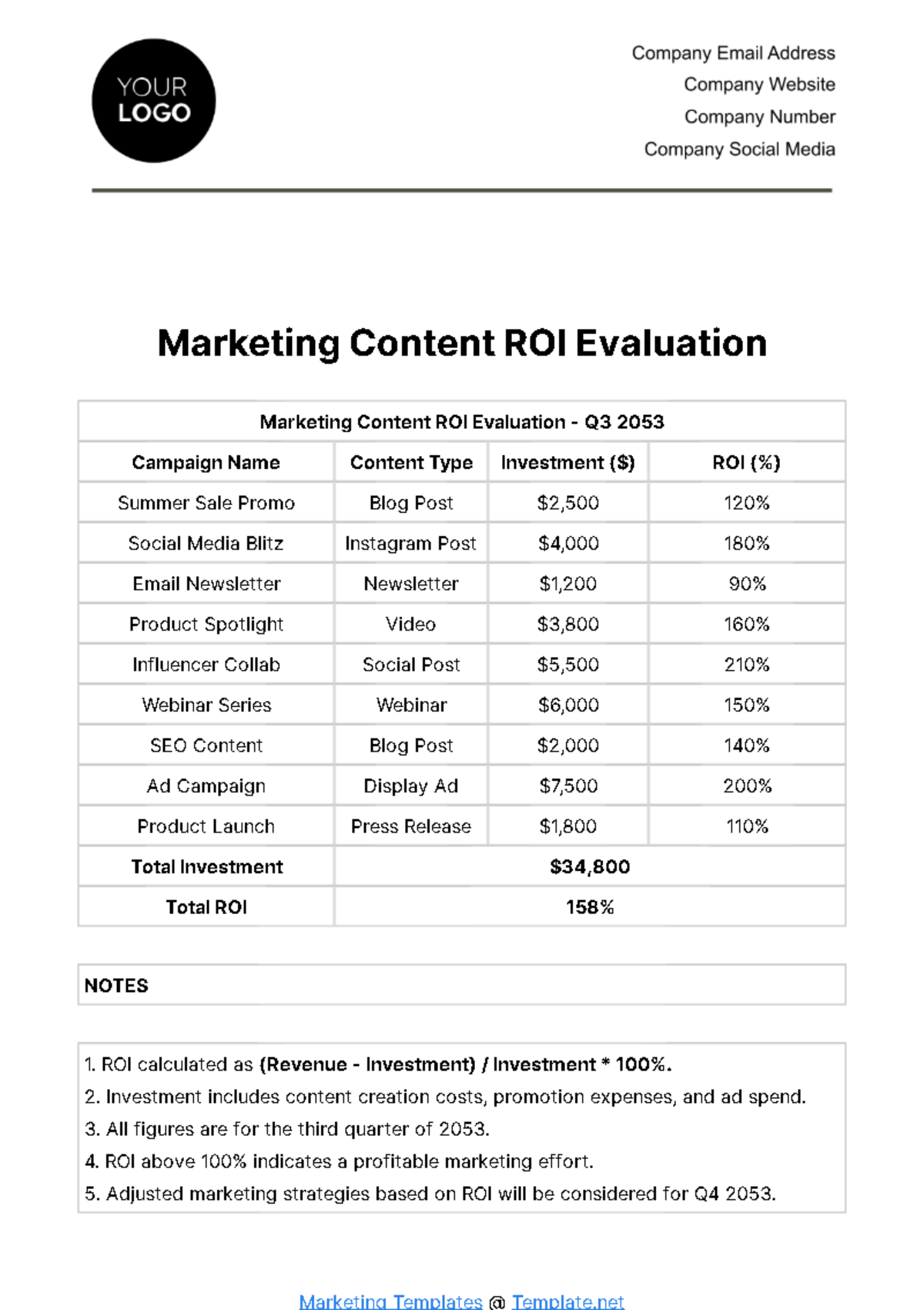
For a more comprehensive business case, these financial projections are often part of a larger summary that includes graphs and qualitative factors, as shown in the next example.

4. Activity: Draft a Mini Business Case
Let's apply these steps. Imagine you want to secure a budget for a new webinar program.
Scenario:
- Proposal: You want to launch a series of 3 webinars next quarter.
- Investment (Cost): The total budget request is $12,000 (for speaker fees, promotion, and platform costs).
- Historical Data: Last year, you ran a single, similar webinar that cost $4,000.
- It generated 400 MQLs.
- The MQL-to-SQL conversion rate for webinar leads is 10%.
- The average sales value (LTV) of a customer won from a webinar lead is $5,000.
- Your sales team's closing rate on SQLs from this channel is 20%.
Your Task (15 minutes):
-
Calculate Historical Performance:
- How many SQLs did the last webinar generate?
- How many closed deals did those SQLs result in?
- What was the total revenue generated?
- What was the historical ROI of that single webinar?
-
Formulate Your Business Case: Based on the historical ROI, write a short paragraph for the "Financials & ROI Projections" section of your new business case. State your budget request, the projected total revenue for the 3-webinar series, and the projected ROI. Assume the new webinars will perform similarly to the last one.
Take your time to do the calculations and structure your argument.
Click here to see a sample solution.
1. Historical Performance Calculation:
- SQLs Generated: 400 MQLs * 10% = 40 SQLs
- Closed Deals: 40 SQLs * 20% = 8 Deals
- Total Revenue: 8 Deals * $5,000/deal = $40,000
- Historical ROI:
(($40,000 - $4,000) / $4,000) * 100%= 900%
2. Sample Business Case Paragraph:
"We are requesting a budget of $12,000 to launch a strategic three-part webinar series next quarter. Based on the proven performance of our previous webinar, which delivered a 900% return on investment, we project this series will follow a similar model of success. We anticipate the series will generate approximately 120 SQLs, leading to 24 closed deals. At an average customer value of $5,000, this initiative is projected to generate $120,000 in revenue, delivering a projected ROI of 900% on the initial investment."
Conclusion
In this lesson, you have learned how to translate content performance data into a forward-looking business case for investment. This is a pivotal skill that elevates your role from content execution to content strategy, directly aligning your work with the financial goals of the business.
Key Takeaways:
- A business case is a persuasive proposal for future investment, not just a report on past performance.
- Strong business cases are built on a foundation of historical data, which you can gather using the attribution and analysis techniques from our previous lesson.
- The core of your argument is the ROI projection, which clearly states the investment required and the financial return expected.
- Framing your request in the language of business—costs, revenue, and ROI—is essential for gaining executive buy-in.
Preview of the Next Lesson:
You've now learned how to analyze past performance and use it to justify future investment. Once that investment is approved, you need to track progress against your projections. In our next lesson, we will focus on designing the key metrics, layout, and visualizations for a content ROI dashboard. This will enable you to report on the success of your initiatives in a clear, compelling, and continuous way.