Introduction
Welcome to the first lesson of our new module, "Targeted Account-Based Content Marketing." In previous modules, we focused on building a full-funnel content playbook designed to attract, nurture, and convert leads from a broad audience. You learned to create content for each stage of the buyer's journey, culminating in the creation of a sales enablement kit to help close deals.
Now, we're going to make a strategic pivot. Instead of casting a wide net and waiting for the right fish to swim into it, we're going to learn how to do precision spear-fishing. This is the essence of Account-Based Marketing (ABM).
In this lesson, you will learn to define account-based marketing (ABM) and how its content strategy differs from broad-based marketing. This is a fundamental shift in mindset from volume-based lead generation to value-based account engagement, and it's a critical step toward your goal of building a content engine that demonstrates clear revenue impact.
1. What is Account-Based Marketing (ABM)?
At its core, Account-Based Marketing is a strategic approach that coordinates personalized marketing and sales efforts to land and expand specific, high-value accounts. Instead of marketing to a wide industry segment, you treat an individual company (an account) as a market of one.
To get a clear, concise overview of this concept, let's watch a short video.
Account-Based Marketing (Explained)
This video from Zaryn Sidhu provides an excellent introduction to ABM, explaining it as a focused strategy rather than a simple tactic. Pay close attention to how he contrasts it with traditional B2B marketing.
Watch the video from the beginning to 03:57. Focus on these key points: The definition of ABM as a strategy. The difference between targeting a broad market vs. a specific list of accounts. Why ABM leads to a higher ROI. The critical need for close collaboration between sales and marketing.
As the video highlighted, ABM is not just another marketing channel. It's a fundamental change in strategy built on three pillars:
- Focus: Concentrating resources on a select list of high-potential accounts.
- Relevance: Creating highly personalized messaging and content that speaks directly to the needs of those accounts.
- Alignment: Requiring deep partnership between sales and marketing teams from start to finish.
2. The Flipped Funnel: ABM vs. Traditional Marketing
The most significant difference between ABM and the broad-based marketing we've discussed so far is the "funnel." Traditional marketing operates on a model where you attract a large number of anonymous visitors at the top and filter them down into qualified leads.
ABM inverts this funnel.
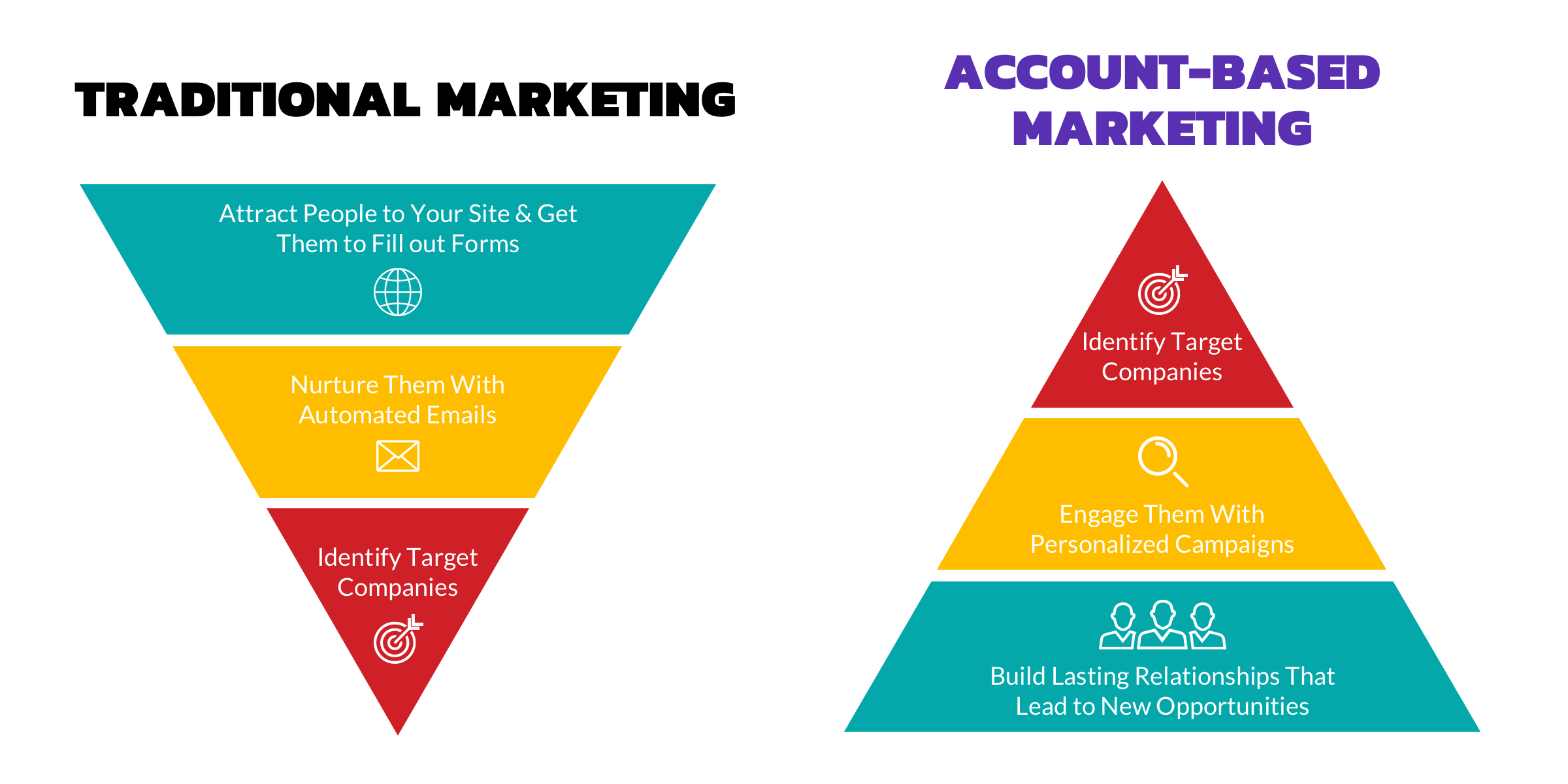
In the ABM model:
- You Identify your highest-value target accounts first.
- You Expand your reach within those accounts by engaging key decision-makers.
- You Engage them with personalized content and campaigns.
- You turn those relationships into Advocates and customers.
To dig deeper into this contrast, the following article provides a detailed breakdown.
Account-Based Marketing (ABM) vs Traditional Marketing - ZenABM
The article 'Account-Based Marketing (ABM) vs Traditional Marketing' from ZenABM offers a comprehensive comparison of the two approaches. It will solidify your understanding of this strategic shift.
Please read the following three sections: 'What’s Traditional Marketing?', 'What is Account-Based Marketing (ABM)?', and 'ABM vs Traditional Marketing: Key Differences'. As you read, focus on how the two approaches differ across Target Audience, Personalization, Funnel, Success Metrics, and Sales Integration.
To summarize the key distinctions from the article:
| Feature | Traditional (Broad-Based) Marketing | Account-Based Marketing (ABM) |
|---|---|---|
| Targeting | Wide net cast over broad personas (e.g., "Marketing Managers in SaaS"). | Laser-focused on a pre-defined list of named accounts (e.g., "The top 50 enterprise software companies"). |
| Goal | Generate a high volume of leads (MQLs). | Generate pipeline and revenue from specific target accounts. |
| Content | Generalized content to attract a large audience (blogs, ebooks). | Highly personalized content tailored to an account's specific pain points and stakeholders. |
| Sales Alignment | Often disconnected; marketing "hands off" leads to sales. | Deeply integrated; sales and marketing co-create the strategy and target list. |
| Metrics | Volume-based: MQLs, Cost Per Lead (CPL), traffic, conversion rates. | Value-based: Account engagement, pipeline velocity, deal size, revenue per account. |
3. How Your Content Strategy Evolves for ABM
As a content lead, this strategic shift has direct implications for your work. Creating content for an ABM strategy is fundamentally different from creating content for inbound marketing. Your goal is no longer just to attract anonymous visitors but to engage specific people within known accounts.
From Personas to People
Instead of writing for a generic "CFO persona," you're writing for "John Smith, the CFO of Acme Corporation," who you know is concerned about supply chain costs because of their latest quarterly report.
This requires a new level of personalization.
What account-based marketing means for thought leadership
This article from Longitude (a Financial Times company) explores what ABM means for content, particularly thought leadership. It provides a strategic view on tailoring your content.
Read the sections 'A new level of targeting' and 'A wider range of decision-makers'. Note the '80/20 rule' for content tailoring and the importance of addressing the entire buying committee, not just a single role.
Addressing the Buying Committee
As the article points out, B2B purchase decisions are rarely made by one person. They are made by a buying committee that includes various roles:
- Decision-Makers: The executives who give the final sign-off (e.g., CEO, CFO).
- Decision-Influencers: The managers or senior practitioners who will use the product and whose opinions heavily influence the decision (e.g., Head of Marketing, Senior Engineer).
- Users: The end-users who will interact with the solution daily.
Your content strategy must account for all of them. A CFO cares about ROI and total cost of ownership, while an end-user cares about ease of use and features that save them time.
The following video touches on this distinction and provides examples of content pillars that work well in an ABM context.
What is Account Based Marketing? How to setup for your B2B business (2024 version)
Let's return to the 'Senator We Run Ads' video to look at the practical side of creating ABM content.
Watch the segment from 05:48 to 08:44. Focus on the distinction between 'decision-makers' and 'decision-influencers' and the three recommended content pillars for B2B ABM: testimonials, USPs, and ease of migration.
In summary, your content strategy for ABM must be:
- Account-Specific: Addressing the unique challenges and goals of the target company.
- Role-Specific: Tailored to the different priorities of each member of the buying committee.
- Trust-Focused: Centered on building credibility through case studies, testimonials, and ROI-driven proof points, rather than broad, educational content.
4. Your Turn: A Quick Reflection
Let's connect this back to your own work. Take a few minutes to think about your existing content library through the lens of ABM. This is a thought exercise; you don't need to create anything new.
Activity (Allow ~10 minutes):
Consider a piece of broad-based content you've created, like a blog post about an industry trend. Now, pick a real company you'd love to have as a customer.
In a document, jot down your answers to these questions:
- The Original Asset: What is the title and goal of your broad-based content piece? (e.g., "Blog Post: 5 Trends Shaping B2B Marketing in 2024," Goal: Attract marketing managers).
- The Target Account: Name the specific company you want to target.
- Adapting for the CEO: If you were to adapt this content specifically for the CEO of that company, what would you change? What is the one key message they need to hear? (Think about their likely focus: revenue growth, market share, competitive advantage).
- Adapting for a Department Head: Now, how would you adapt the same content for a relevant department head (e.g., VP of Sales or Marketing)? What is their key message? (Think about their likely focus: team efficiency, hitting targets, operational challenges).
- The Strategic Shift: Briefly describe the main difference between the original, broad piece and the adapted, account-specific versions.
This exercise will help you internalize the mindset shift from creating one piece of content for many, to creating many variations of content for one high-value account.
Conclusion
In this lesson, you've learned the fundamentals of Account-Based Marketing and, crucially, how it transforms your role as a content strategist. You've moved from thinking about funnels to thinking about pyramids, and from targeting broad personas to engaging specific people at high-value companies.
Key Takeaways:
- ABM is a Focused Strategy: It treats high-value accounts as individual markets, demanding deep sales and marketing alignment.
- ABM Flips the Funnel: Instead of attracting and filtering a wide audience, you identify target accounts first and then work to expand your influence within them.
- Content Strategy Shifts from Volume to Value: Success is no longer about generating thousands of leads. It's about creating hyper-personalized, trust-building content that engages the entire buying committee within a target account.
- Metrics Follow Strategy: ABM success is measured by account engagement, pipeline generated, and revenue impact, not MQLs and website traffic.
Preview of the Next Lesson:
The first step of any ABM program is deciding who to target. In our next lesson, we will focus on how to collaborate with sales to identify and prioritize high-value target accounts. This is where the crucial sales-marketing partnership truly begins.