Introduction
Welcome back! In our last lesson, you learned the strategic foundations of Account-Based Marketing (ABM), particularly how it "flips the funnel" to focus on high-value accounts first. We established that this approach requires a profound shift in content strategy, moving from broad appeal to deep personalization, and necessitates a strong partnership between sales and marketing.
Today, we put that partnership into action. The very first step in any ABM program is deciding which accounts to target. This is arguably the most critical decision you'll make, and it cannot be made in a marketing silo. This lesson is dedicated to the collaborative process of identifying and prioritizing the accounts that hold the most promise for your business.
Your goal for this lesson is to learn how to collaborate with sales to identify and prioritize high-value target accounts. Mastering this will be a significant step toward building a content engine that is not only aligned with sales but is also laser-focused on driving revenue.
1. The Foundation: Sales and Marketing as Equal Partners
In traditional marketing, the relationship with sales can sometimes feel like a relay race, with marketing handing off a "lead baton" and hoping for the best. In ABM, sales and marketing are more like partners in a three-legged race—tied together from the start, sharing the same goal, and needing to move in perfect sync to win.
This collaboration isn't just a "nice-to-have"; it's a core principle of successful ABM. To understand why, let's hear from an expert who was instrumental in defining the field.
How to use Account-Based Marketing to drive enterprise sales | Bev Burgess
In this clip from the Growth Manifesto Podcast, Bev Burgess, one of the pioneers of ABM, explains why partnering with sales is a non-negotiable principle of the strategy.
Watch the segment from 05:44 to 08:07. Pay close attention to her description of the 'traditional gap' between sales and marketing and how ABM is designed specifically to close it.
As Bev Burgess explains, ABM fails when it's treated as a purely marketing-led initiative. When marketing selects accounts based on data alone and hands them to sales, it often leads to a classic pitfall: sales doesn't buy into the strategy, and marketing doesn't understand the on-the-ground realities of the accounts.
To avoid this, the selection process must be collaborative from day one. Look at how this collaborative feedback loop is visualized in a typical ABM workflow.
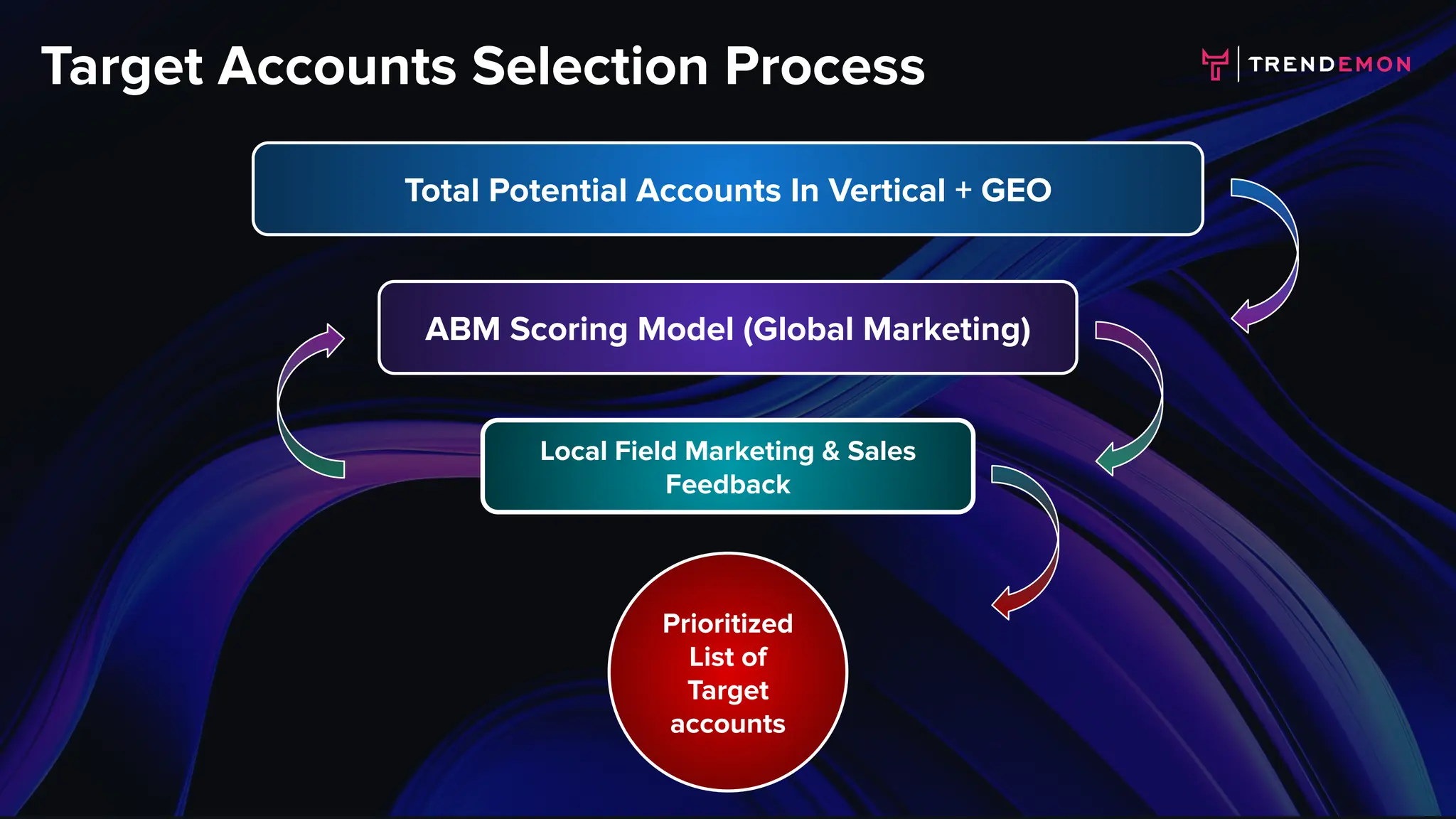
This chart shows that marketing's data-driven scoring and sales' real-world intelligence are not separate inputs; they inform and refine each other to produce a target list that both teams are invested in.
2. The "Who": Defining Your Target Account List
The collaborative process begins by building a master list of potential accounts. This isn't just a marketing task of pulling data or a sales task of listing dream clients; it's a joint effort to merge data with human intelligence.
Start with Sales
The most practical first step is to talk to your sales team. They are on the front lines and often have a list of accounts they are already pursuing or wish they could.
What is Account Based Marketing? How to setup for your B2B business (2024 version)
This short clip from 'Senator We Run Ads' offers a straightforward, practical take on where to begin.
Watch from 03:56 to 04:47. The key takeaway is the emphasis on going to the sales team first, as they often already possess the foundational list you need to start.
Building the Selection Criteria
Once you have this initial list from sales, you'll work together to refine it and identify new targets by establishing clear selection criteria. A strong target account list balances three key areas:
-
Fit (Your Ideal Customer Profile - ICP): Does this account match the profile of your best customers?
- Firmographics: Industry, company size, annual revenue, geography.
- Technographics: Do they use technologies that are compatible with or complementary to your solution?
- Strategic Alignment: Does your solution solve a core business problem for them?
-
Opportunity (Revenue Potential): Is the potential return worth the significant investment of an ABM approach?
- Deal Size: Can this account deliver a large contract? As a rule of thumb, ABM is best for high-value deals.
- Growth Potential: Is there an opportunity for up-selling or cross-selling in the future?
- Competitive Landscape: What is your ability to win? Are they locked into a long-term contract with a competitor, or is there an opening?
-
Readiness (Intent & Relationship): Is this account ready to engage?
- Intent Signals: Is the account actively researching solutions like yours? (e.g., visiting your website, downloading content, searching relevant keywords).
- Relationship Status: Is this an existing customer with expansion potential? A past customer? A cold account? Starting with existing, happy customers is often the easiest way to pilot an ABM program.
- Sales Buy-in: Crucially, is the assigned salesperson or account director enthusiastic and willing to partner on the ABM effort? As Bev Burgess noted in the first video, a great account with an unwilling sales partner is a recipe for failure.
Marketing typically brings the "Fit" and "Readiness" data (from your CRM, marketing automation, and intent data tools), while Sales brings the "Opportunity" and relationship intelligence. The magic happens when you combine them.
3. The "How": A Framework for Prioritization
With a list of potential accounts and agreed-upon criteria, the next step is to prioritize. Not all target accounts are created equal. You need a systematic way to decide where to focus your most intensive efforts.
A highly effective method is to create a tiered system.
5 Steps to Prioritise High-Value Accounts in ABM
The article '5 Steps to Prioritise High-Value Accounts in ABM' provides a simple yet powerful framework for tiering and scoring accounts. It's a great practical guide for this stage.
Please read three sections from this article: Start with 'Step 3: Create a Three-Level Account Rating System.' Focus on the table that defines Tiers 1, 2, and 3. Next, read the 'Account Scoring Formula' section to see how to quantify this prioritization. Finally, read the FAQ at the bottom titled 'How can sales and marketing teams work together to prioritise high-value accounts in ABM?' for a concise summary of the collaborative process.
As the article explains, a tiered approach allows you to match your investment to the potential of the account:
| Tier | Priority | Characteristics | Engagement Approach |
|---|---|---|---|
| Tier 1 | Immediate | Highest revenue potential, strong fit, clear intent. | Highly personalized, 1-to-1 engagement. Deep research. |
| Tier 2 | Medium-term | Moderate revenue potential, good fit. | Scaled personalization, 1-to-few campaigns by cluster. |
| Tier 3 | Long-term | Lower initial value, may fit ICP but show low intent. | Automated, 1-to-many tactics (similar to traditional marketing). |
This tiering decision is made during a joint sales-marketing alignment session. This isn't just a meeting; it's a dedicated workshop where both teams review the data, share insights, and come to a consensus on the final, prioritized list.
For an extremely detailed look at how to structure these sessions and the entire selection process, the "Strategic 1 to 1 ABM Account Selection Framework & Guide" (LINK) is an excellent resource you can bookmark for future reference. It outlines agendas for alignment sessions, templates for account reviews, and detailed scoring criteria—perfect for when you are ready to implement this in your organization.
4. Your Turn: Draft a Target Account Profile
Let's apply these concepts. Imagine you are preparing for your first sales-marketing alignment session to select your Tier 1 accounts. Your task is to build a profile for one ideal target account.
Activity (Allow ~10 minutes):
Choose a real company you believe would be a perfect customer. In a document, create a "Target Account Profile" by answering the following questions. Be as specific as possible.
Target Account Profile Template
- Account Name:
- 1. Fit Analysis (The Data Story):
- Industry & Size:
- Why they fit our ICP: (What makes them a perfect match on paper?)
- Recent Engagement/Intent Signals: (e.g., "Visited pricing page twice this month," "Multiple employees from their IP address downloaded our latest whitepaper.")
- 2. Opportunity Analysis (The Sales Story):
- Estimated Revenue Potential: (Is this a large, strategic deal?)
- Known Business Pains: (What challenges do you think they are facing that we can solve?)
- Competitive Situation: (Who is the incumbent? Is their contract up for renewal?)
- 3. Proposed Tier:
- Based on your analysis, would you propose this as a Tier 1, 2, or 3 account? Justify your choice in one sentence.
This exercise will prepare you for the kind of evidence-based discussion you need to have with your sales counterparts.
Conclusion
You've now covered the critical first step of executing an ABM strategy: selecting and prioritizing your targets through deep collaboration with sales. This process transforms the sales-marketing relationship from a disjointed handoff to a unified partnership focused on the same business outcomes.
Key Takeaways:
- Collaboration is Non-Negotiable: Account selection is a joint exercise where marketing's data and sales' intelligence are combined.
- Use a Multi-faceted Criteria: Evaluate accounts based on Fit (ICP), Opportunity (revenue potential), and Readiness (intent and relationship).
- Prioritize with Tiers: Not all accounts deserve the same level of investment. A tiered system (Tier 1, 2, 3) allows you to allocate resources effectively.
- Formalize the Process: Use structured alignment sessions and joint account reviews to ensure both teams are invested in the final target list.
Preview of the Next Lesson:
Now that you've identified who you're targeting, the next question is what you should say to them. In the next lesson, you will learn how to develop a personalization matrix mapping content ideas to specific account needs and decision-maker roles. This is where you'll begin designing the bespoke content that makes ABM so effective.