Introduction
Welcome back! In our previous lesson, you designed a Top-of-Funnel (TOFU) lead magnet to convert anonymous visitors into known leads. This was a crucial first step in building your content engine's pipeline. Now that you have a way to attract an audience, your next challenge is to convince them that you are the right partner to solve their problems. This happens in the Middle of the Funnel (MOFU).
Today's lesson focuses on one of the most powerful assets in your MOFU toolkit: the case study. Our learning outcome is to develop a complete case study (problem, solution, results) to build mid-funnel credibility and trust.
A case study is more than just a long testimonial; it's a strategic narrative that combines storytelling with hard data to prove your value. For your goal of building a content engine that demonstrates ROI and aligns sales and marketing, mastering the case study is non-negotiable. We'll explore its strategic purpose, deconstruct its classic narrative structure, and outline a process for creating one from start to finish.
1. The Strategic Role of a B2B Case Study
Before diving into the "how," let's establish the "why." Why are case studies so critical for B2B marketing, especially in the consideration stage of the buyer journey? They serve as powerful social proof, moving beyond what you say you can do to what you have actually done for a client.
To understand the business impact of a case study, watch this short segment from the Visme video 'How to Make a Case Study 101'. It clearly explains their strategic value in a B2B context.
Watch the sections from 00:19 to 01:49 and from 05:52 to 07:08. Pay close attention to how case studies: Build credibility and trust. Differentiate your business from competitors. Provide concrete data for decision-making. Serve as powerful sales enablement tools.
As the video highlights, case studies are uniquely persuasive because they appeal to both logic (with data and results) and emotion (through storytelling). They aren't just marketing assets; they are sales tools that equip your sales team with the evidence they need to close deals, directly connecting your content efforts to revenue.
2. The Psychology of a Great Case Study
The most effective case studies aren't just lists of facts; they are compelling stories. The reason this works so well is rooted in psychology. When a prospect becomes absorbed in a story, it's a phenomenon known as "narrative transportation," which can significantly influence their beliefs and attitudes.
The classic structure of a story—a hero facing a challenge, finding a solution, and achieving a transformation—maps perfectly onto the business narrative of a case study.
How to Write Better B2B Case Studies: 2 Lessons from Psychology
The article 'How to Write Better B2B Case Studies' from CXL explores this concept in detail. It explains how to leverage storytelling to create assets that truly persuade.
Please read the section '2. Embrace narrative transportation'. Focus on how the simple three-act structure (Challenge, Solution, Results) can be used to create an emotionally engaging narrative that builds trust.
This structure—Problem, Solution, Results—is the backbone of every effective case study. It creates a logical and persuasive flow that guides the reader from a relatable business pain to a desirable outcome.

3. Gathering the Raw Material: The Customer Interview
You can't write a great story without great source material. The foundation of any authentic case study is a thorough interview with the customer. Sending a form or survey won't capture the nuance, emotion, and specific details that make a story compelling.
9-Step Formula For Writing The PERFECT Case Study
In this video, '9-Step Formula For Writing The PERFECT Case Study,' Alex Cattoni explains why a live interview is essential and what kind of questions to ask to get the 'juicy takeaways' you need.
Watch from 02:23 to 04:04. Notice the emphasis on asking open-ended questions about their feelings and experiences before, during, and after working with you. This is how you uncover the real story beyond just the metrics.
Your role as a content strategist during the interview is to be a journalist. Dig deeper by asking follow-up questions like:
- "Can you tell me more about that?"
- "What did that challenge feel like for the team?"
- "What was the moment you realized your old approach wasn't working anymore?"
- "What other solutions had you considered, and why did you choose us?"
Remember to get permission to record the interview. A transcript is the single most valuable asset for crafting the case study narrative.
4. Crafting the Narrative: A Modern B2B Template
With your interview transcript in hand, you're ready to structure your story. While the classic "Problem, Solution, Results" flow is essential, modern B2B buyers are time-poor and data-hungry. The best case studies present the most important information upfront.
Let's look at an up-to-date template that blends storytelling with scannability.
B2B Case Study Template (+ 10 Examples & 2025 Best Practices)
The article 'B2B Case Study Template' from The Logonaut provides an excellent, modern framework designed for busy decision-makers. It emphasizes leading with the outcome.
First, study 'The 2025 Case Study Template'. Pay close attention to the 'Customer Snapshot' box and the 'Before/After' table. These elements deliver key information quickly. Then, review the best practices in the section 'What “Good” Looks Like (and How to Implement It)'. Note the emphasis on an outcome-focused headline, a 'proof pack' (quote, diagram, table), and specifying the Time-to-Value.
Let's break down how to build this narrative:
- The Headline & Snapshot: Start with the single most impressive result. Your headline should be something like: "How [Customer] Achieved [Primary KPI] with [Your Product]." The snapshot box provides skimmable context: industry, company size, and key results.
- The Challenge (Problem): Use the "before" details from your interview to describe the business pain point. What was the frustrating status quo? What constraints were they facing?
- The Solution: Explain how your product was implemented. This isn't a feature list. It’s a story about the process of change. Who used it? How did it fit into their workflow? Why did they choose you over others?
- The Results: This is the "after." Showcase the transformation with quantifiable data. Use the "Before/After" table format suggested in The Logonaut article to make the impact undeniable. Pair the numbers with a powerful customer quote that adds emotional weight and credibility.
Throughout the writing process, apply the principle of cognitive fluency.
How to Write Better B2B Case Studies: 2 Lessons from Psychology
Let's revisit the CXL article to focus on a second psychological principle: making your content easy to process.
Read the section '1. Write and design for cognitive fluency'. The key takeaway is: the easier your case study is to understand, the more credible and trustworthy it becomes. Use simple language, get to the point, and use design (headings, bullets, pull quotes) to make it scannable.
5. Your Turn: Outline a B2B Case Study
It's time to apply these principles. Your task is to create a detailed outline for a B2B case study. You can base this on a real customer or create a realistic, hypothetical scenario based on one of your company's buyer personas.
The goal is to structure the story and identify the specific information you would need to create the full asset. Use the template below, which is adapted from the resources we've reviewed.
Task (Allow ~20 minutes):
Complete the following blueprint in a document.
Case Study Blueprint
1. Headline (Outcome-first): (e.g., How Acme Corp Reduced Server Downtime by 98% in 3 Months with SolutionX)
2. Customer Snapshot:
- Customer:
(Company Name) - Industry:
(e.g., Financial Services) - Size:
(e.g., 500-1,000 employees) - Product(s) Used:
(List the specific product/service) - Top KPIs:
Metric 1: (e.g., -98% server downtime)Metric 2: (e.g., +40% team productivity)Metric 3: (e.g., 6-week time-to-value)
3. The Challenge (The "Before"):
- Business Problem:
(Describe the core pain point in 1-2 sentences. What wasn't working?) - Business Impact:
(What were the consequences? e.g., Lost revenue, customer complaints, wasted engineering hours.) - Constraints:
(What made it hard to solve? e.g., Legacy systems, limited budget, lack of in-house expertise.)
4. The Solution (The "During"):
- Why Us?:
(Why did they choose you over alternatives?) - Implementation:
(Briefly describe the process. How did they get started? How did your solution integrate into their workflow?)
5. The Results (The "After"):
- Key Results (Bulleted List):
[Quantifiable Result 1][Quantifiable Result 2][Operational Improvement, e.g., simplified workflow, better collaboration]
- Before/After Table:
| Metric | Before | After | Impact |
|---|---|---|---|
(e.g., Avg. Downtime/Month) |
(e.g., 48 hours) |
(e.g., <1 hour) |
(-98%) |
(e.g., Engineer Hours on Maint.) |
(e.g., 80/week) |
(e.g., 10/week) |
(-87.5%) |
- Key Customer Quote:
(Write a powerful, specific quote that captures the value. e.g., "SolutionX didn't just fix our downtime; it gave our engineering team back a full day each week to focus on innovation." - Jane Doe, VP of Engineering)
6. Call to Action (CTA): (What's the next logical step? e.g., "Book a demo," "See pricing," "Talk to sales.")
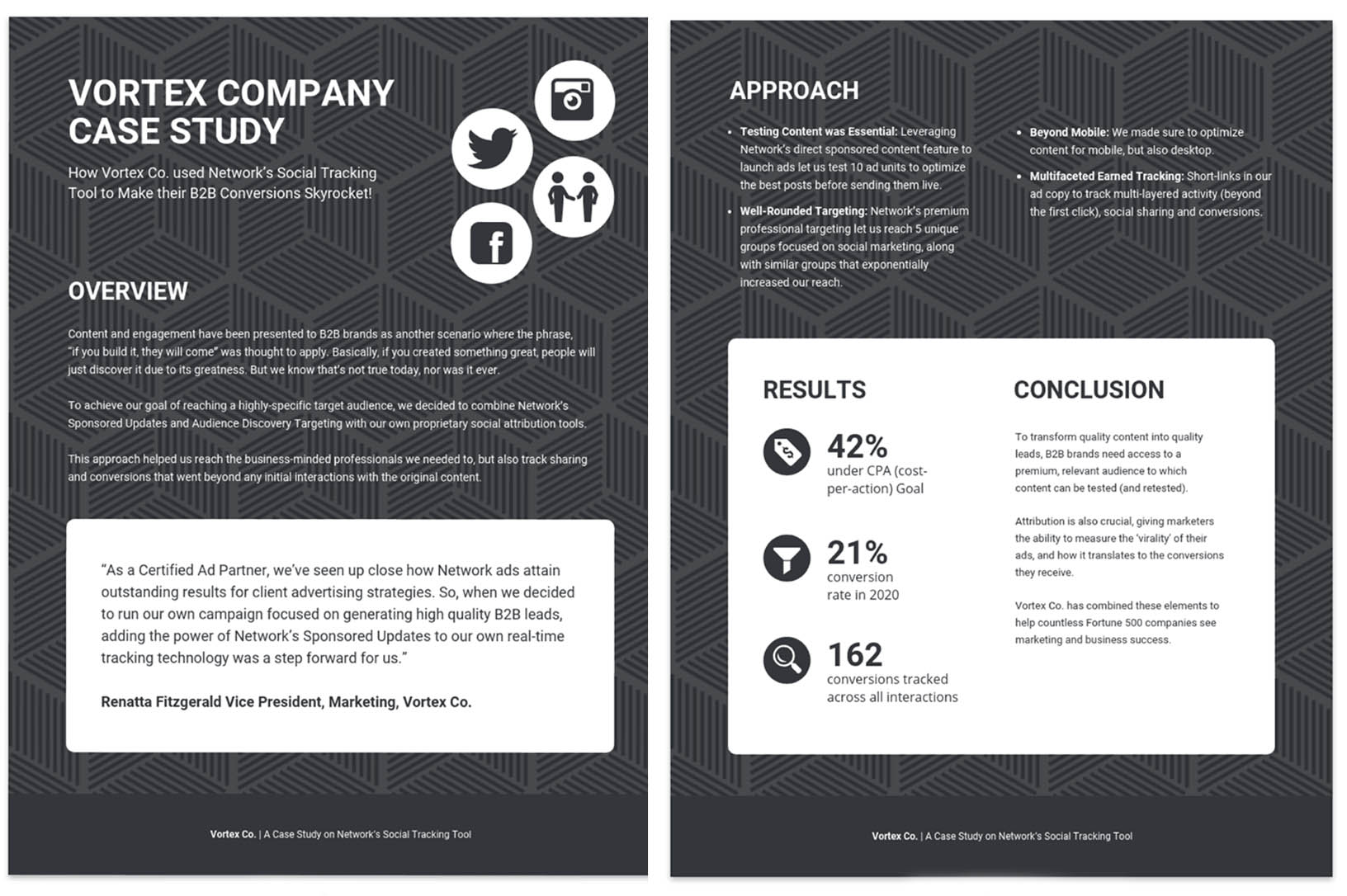
For inspiration on what a finished, well-designed case study looks like, examine this example.
Conclusion
Excellent work. You have now deconstructed the case study and created a blueprint for one of the most vital assets in your content engine. By mastering this format, you are building a direct bridge between your marketing efforts and the sales conversations that drive revenue.
Key Takeaways:
- Strategic Purpose: Case studies are MOFU assets designed to build trust and provide social proof, serving as critical sales enablement tools.
- Core Structure: The most effective case studies follow a Problem → Solution → Results narrative, grounded in storytelling principles.
- Data is King: Modern B2B case studies lead with quantifiable outcomes (KPIs) and present results in scannable formats like snapshot boxes and before/after tables.
- Authenticity Matters: The entire process begins with a genuine customer interview to capture the details and emotion that bring the story to life.
Preview of the Next Lesson:
A case study is a powerful piece of proof. But how do you deliver it to the right person at the right time? In our next lesson, we will move further into nurturing qualified leads. You will learn to outline a MOFU lead nurturing asset, such as a webinar or comparison guide, to educate qualified leads, often using the case studies you've just learned to build as key evidence.