Introduction
Welcome to Module 5! In our last lesson, you created a one-month prototype plan for a content pillar, transforming your strategy into a concrete, week-by-week schedule for research, creation, and activation. This provided the "what" and "when" for your content engine.
Now, we'll focus on the "why." This lesson kicks off our journey into building the full-funnel content playbook. The learning outcome is to define the strategic role and primary KPIs for Top-of-Funnel (TOFU), Middle-of-Funnel (MOFU), and Bottom-of-Funnel (BOFU) content.
Understanding this is the key to elevating your work from content creation to strategic influence. Every piece of content you produce must have a specific job. Is it attracting new audiences? Is it converting visitors into leads? Or is it helping your sales team close deals? By the end of this lesson, you'll have a clear framework for defining that job and measuring its success, ensuring your content engine is purposefully designed to drive revenue.
1. A Quick Refresher: TOFU, MOFU, BOFU
You were introduced to the marketing funnel in Module 1. Now, let's look at it through the lens of a content strategist. The TOFU, MOFU, and BOFU stages aren't just abstract concepts; they represent the distinct mindset of your potential buyer as they move from being unaware of their problem to being ready to purchase your solution.
To quickly re-familiarize yourself with these stages, watch this short video.
What is ToFu, MoFu, BoFu? (Top, Middle and Bottom of Funnel Content Explained by a Content Marketer)
This video from Funnel provides a concise and memorable explanation of Top, Middle, and Bottom of the Funnel content, using a simple analogy to make the concepts stick.
Watch the video from the beginning to 3:28. Pay close attention to how the goal and content types change as a consumer moves from one stage to the next.
As the video explains, each stage requires a different approach. Your content's job is to meet the buyer where they are and guide them to the next step.
2. The Strategic Role of Content in the Funnel
To build an effective content engine, you can't just create content; you must create it with strategic intent. Each piece should be engineered to perform a specific "job" within the buyer's journey. Let's break down the primary job of content at each stage.
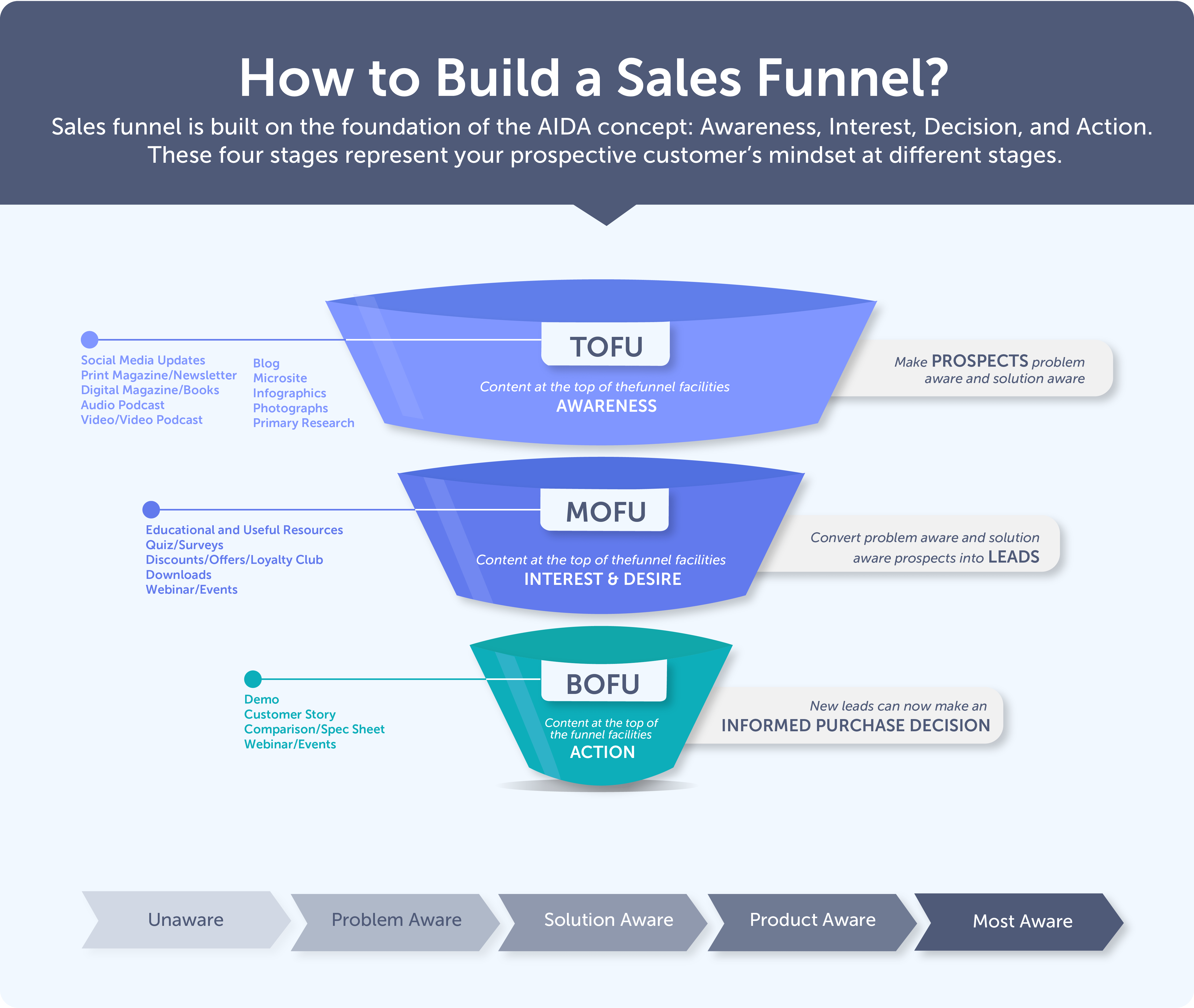
TOFU: Attracting the "Out-of-Market" Audience
Most B2B marketers focus all their energy on the tiny fraction of buyers who are ready to purchase right now. This is a strategic mistake. Research shows that at any given time, only about 5% of your potential market is actively looking to buy. The other 95% are "out-of-market"—they will buy in the future, but not today.
The primary strategic role of TOFU content is to build a relationship with that 95%.
- Goal: To attract, educate, and build trust with a broad audience that is "problem-aware" but not yet "solution-aware." You are not selling your product; you are selling your expertise.
- Buyer's Mindset: "I have a problem or question, and I'm looking for information and answers."
- Content Characteristics: Educational, informational, and accessible. It answers common questions, addresses pain points, and offers valuable insights without asking for anything in return.
- Examples: How-to blog posts, thought leadership articles, infographics, educational videos, industry reports.
MOFU: Nurturing the "In-Market" Audience
Once a prospect from the 95% becomes aware of potential solutions, they move into the 5% who are "in-market." This is the middle of the funnel.
The strategic role of MOFU content is to nurture these now-qualified leads, demonstrate why your solution is the best choice, and convert their interest into a tangible lead (like an MQL).
- Goal: To capture lead information and build credibility by showing how your approach or product solves the buyer's problem more effectively than alternatives.
- Buyer's Mindset: "I'm aware of different solutions, and now I'm evaluating my options to see which is the best fit for me."
- Content Characteristics: In-depth, practical, and persuasive. It often requires an exchange of value (e.g., an email address for a download). This content builds a case for your solution.
- Examples: Case studies, webinars, comparison guides, expert guides, interactive tools (like a benchmarker or grader), and templates.
BOFU: Closing the Deal and Enabling Sales
At the bottom of the funnel, the buyer is close to making a decision. They are no longer just considering options; they are actively seeking validation that they are making the right choice.
The strategic role of BOFU content is to convert a highly qualified lead into a customer and to equip your sales team with the assets they need to win the deal.
- Goal: To remove final barriers to purchase, build confidence in your specific product, and support the sales conversation.
- Buyer's Mindset: "I'm ready to buy, but I need to justify this decision. Why should I choose this specific product over its direct competitor?"
- Content Characteristics: Product-focused, detailed, and action-oriented. It should make it as easy as possible for the buyer to choose you.
- Examples: Free trials, live demos, pricing pages, implementation guides, and sales enablement assets like competitor battle cards or one-pagers.
3. Defining KPIs for Each Funnel Stage
To prove the value of your content engine, you need to measure what matters at each stage. Applying a BOFU metric (like sales) to a TOFU asset (like a blog post) will make your content look like a failure. The KPIs you choose must align with the strategic role of the content.
The following resource provides an excellent, strategic overview of how to connect high-level business goals to marketing KPIs.
[PDF] The Big, Beautiful B2B Blueprint | Velocity Partners
The 'Big, Beautiful B2B Blueprint' from Velocity Partners is a masterclass in strategic B2B marketing. We will focus on the section that connects revenue targets to funnel performance metrics.
Please read two sections from this PDF: Section 4: Goals and KPIs (Pages 18-22). Focus on the 'MooSoft' example (pages 20-21) to see how a company works backward from a revenue target to determine the required visits, MQLs, and opportunities. Section 10: Reporting (Pages 63-69). Read the subsections on 'Measuring creativity' and 'Custom metrics' (pages 64-66) to understand how to measure content's impact beyond standard metrics. Pay special attention to the 'Content Opportunity Rate' metric.
As the blueprint illustrates, effective measurement starts with the end goal (revenue) and works backward. Each stage of the funnel has its own set of primary metrics that indicate whether you're on track to hit that goal.

Here’s a breakdown of the primary KPIs for each funnel stage, informed by our resources:
| Funnel Stage | Strategic Goal | Primary KPIs | Why They Matter |
|---|---|---|---|
| TOFU | Reach & Awareness | • Traffic & Impressions • Keyword Rankings / CTR • Social Shares & Reach • Time on Page & Bounce Rate |
These metrics show if you are successfully attracting your target audience and if the content is engaging enough to hold their attention. This is about building an audience for the future. |
| MOFU | Lead Generation & Nurturing | • Conversion Rate (on forms, lead magnets) • Cost Per Lead (CPL) • Assisted Conversions • Email Open/Click-Through Rates |
These metrics measure your ability to convert anonymous visitors into known leads (MQLs) and effectively nurture their interest. This is the direct input for your sales pipeline. |
| BOFU | Sales Conversion & Revenue Impact | • Demo / Trial Requests • Lead-to-Opportunity Rate • Content Opportunity Rate (from the Blueprint) • Pipeline Generated / Revenue Influenced |
These are bottom-line metrics that connect content directly to sales activity and revenue, proving ROI and satisfying your goal of having a strategic impact. |
This table from "B2B SaaS Content Audit Checklist" provides another great summary.
This table breaks down primary metrics and recommended tools for auditing content performance at the TOFU, MOFU, and BOFU stages.
4. Your Turn: Map Your Content Plan to the Funnel
Let's apply this framework. Take the one-month content plan you created in the previous lesson and map its components to the funnel. This will ensure every piece has a clear purpose and a metric for success.
Task (Allow ~15 minutes):
- Refer to the content pillar and list of articles you outlined in the last lesson's exercise.
- Fill out the table below. For each piece of content (your pillar page and your cluster articles), assign a funnel stage, define its strategic job, and identify one primary KPI you would use to measure its success.
Full-Funnel Content Mapping
Content Pillar: (Your pillar from the previous lesson, e.g., B2B Social Media Marketing)
| Content Title | Funnel Stage (TOFU/MOFU/BOFU) | Strategic Job (What should this content achieve?) | Primary KPI |
|---|---|---|---|
| (e.g., Pillar Page: The Ultimate Guide to B2B Social Media) | MOFU | Capture leads by offering a downloadable strategy template in exchange for an email. | Lead Magnet Conversion Rate |
| (e.g., Cluster Post 1: How to Choose the Right Social Platforms) | TOFU | Attract organic traffic from people searching for foundational social media advice. | Organic Traffic / Keyword Rankings |
| (e.g., Cluster Post 2: [Your Product] vs. Hootsuite for B2B) | BOFU | Persuade prospects considering alternatives that our solution is superior. | Demo Requests from this page |
| Your Pillar Page Title: | Your Answer |
Your Answer |
Your Answer |
| Your Cluster Post 1: | Your Answer |
Your Answer |
Your Answer |
| Your Cluster Post 2: | Your Answer |
Your Answer |
Your Answer |
| Your Cluster Post 3: | Your Answer |
Your Answer |
Your Answer |
| ... (add more rows as needed) |
Conclusion
Excellent work. You have now established the strategic foundation for your entire content playbook. By defining the specific role and KPIs for your content at each stage of the funnel, you've ensured that your content engine will be built for performance, not just production.
Key Takeaways:
- Strategic Roles: TOFU content attracts and educates the 95% of future buyers. MOFU content nurtures and converts interested prospects into leads. BOFU content persuades and enables sales to close deals.
- Aligned KPIs: The success of your content must be measured against its specific job. TOFU is measured on reach and engagement, MOFU on lead generation, and BOFU on sales conversion and revenue.
- Revenue-Driven Thinking: By working backward from revenue goals, you can set meaningful targets for each stage of the funnel and prove the business impact of your content marketing efforts.
Preview of the Next Lesson:
Now that we've defined the strategy, it's time to start building. In the next lesson, we will focus on the critical transition point between the top and middle of the funnel. You will learn how to design and create a TOFU lead magnet (e.g., a checklist or template) to effectively convert anonymous visitors into the qualified leads your sales team needs.