Following our first lesson on Teaching Aptitude, we now shift our focus to another cornerstone of the UGC NET Paper 1: Research Aptitude. Mastering this unit is not just essential for scoring well, but it's also fundamental to your goal of securing a Junior Research Fellowship (JRF). This lesson will equip you with the foundational language and frameworks of academic inquiry.
Today, we will dissect the entire research lifecycle. You will learn to describe the various types of research, understand the systematic steps every researcher follows, grasp the non-negotiable principles of research ethics, and differentiate between the most common thesis writing and citation styles, specifically APA and MLA.
1. What is Research and What are its Types?
At its core, research is a systematic and scientific investigation to search for new facts or insights in any branch of knowledge. It's about moving from an unanswered question to a verifiable conclusion. For your exam, a significant number of questions will test your ability to differentiate between various types of research based on their purpose, process, and the nature of the data they handle.
Let's begin with a crash course video that provides a rapid and comprehensive overview of the key concepts, including the different classifications of research.
CRASH COURSE on Research Aptitude - Revision of Unit in 90 Minutes - UGC NTA Paper 1- Dr Triptii
This video from Global Online University is a fast-paced revision lecture, perfectly suited for our crash-course approach. Dr. Triptii covers the core definitions, objectives, and types of research in a manner that's directly aligned with the NET exam syllabus.
Please watch the following segments to build a strong conceptual map of the research landscape: Introduction & Objectives: Start with a brief overview of the unit and its objectives from 10:13 to 14:11. Fundamental vs. Applied Research: Watch the explanation from 15:11 to 18:26. Note the key difference: fundamental research builds theory, while applied research solves practical problems. Descriptive vs. Analytical Research: From 18:43 to 20:38, understand how descriptive research describes "what is" (think surveys), while analytical research uses existing facts to evaluate. Qualitative vs. Quantitative Research: This is a crucial distinction. Watch from 20:51 to 23:23. This dichotomy might feel familiar from your UI/UX work: qualitative research seeks to understand the 'why' and 'how' through non-numerical data (like user interviews), while quantitative research focuses on numerical data and measurement (like analytics dashboards). Conceptual vs. Empirical Research: From 24:26 to 25:50, grasp that conceptual research deals with abstract ideas, while empirical research is grounded in observation and verifiable evidence. Other Types & Cross-Sectional vs. Longitudinal: Watch the quick overview of other types from 25:50 to 27:19 and the detailed comparison of cross-sectional and longitudinal studies from 52:38 to 56:13. To solidify this knowledge, the following reading offers a structured text-based summary of these types.
To solidify this knowledge, the following reading offers a structured text-based summary of these types.
Research Aptitude for UGC NET Paper 1 (Unit 2)
This article from the iplawders blog provides clear, concise definitions for the key research types you'll encounter in the exam.
Please read the section Research Meaning, Types, and Characteristics. As you read, focus on the examples provided for each research type to help anchor your understanding.
2. The Research Process: A Step-by-Step Approach
Just like a well-designed algorithm or a software development lifecycle, the research process follows a logical and structured sequence of steps. Moving out of sequence can compromise the entire project. Understanding this flow is essential, as the NET exam often asks you to arrange these steps in the correct order.
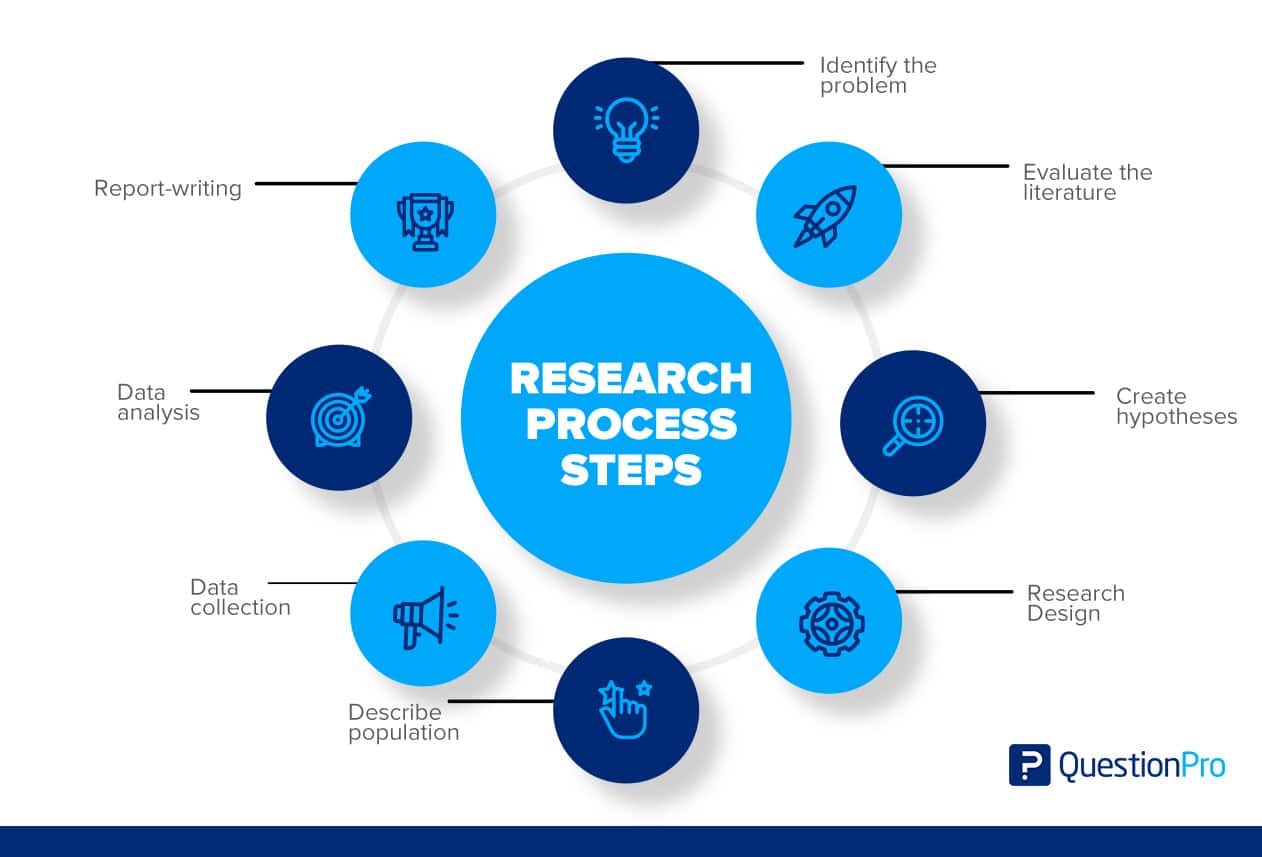
This diagram illustrates the cyclical and structured nature of the research process, beginning with problem identification and culminating in report writing.
The typical research process can be broken down into the following key stages:
- Identify the Research Problem: This is the starting point—finding a gap in existing knowledge or a problem that needs a solution.
- Review the Literature: A thorough review of existing studies and theories to understand what is already known and to refine the research question.
- Formulate Hypotheses: Creating a specific, testable prediction about the relationship between variables. A hypothesis is a tentative statement that the research will either support or refute.
- Prepare the Research Design: This is the blueprint for the entire study. It outlines the methodology, sampling strategy, and data collection tools to be used.
- Collect Data: The actual process of gathering information through methods like surveys, interviews, experiments, or observations.
- Analyze Data: Using statistical or qualitative techniques to interpret the collected data and identify patterns or relationships. Your Computer Science background gives you a strong foundation for understanding data analysis, whether it's statistical modeling or thematic analysis of textual data.
- Report Writing and Dissemination: Presenting the findings, conclusions, and limitations of the study in a structured format, typically a thesis, dissertation, or journal article.
For a more detailed explanation of this sequence, let's turn back to our iplawders article.
Research Aptitude for UGC NET Paper 1 (Unit 2)
This reading will walk you through the logic of the research process.
Find the heading "What are the Different Research Methods and Steps?". Read the sub-section 7 Step Research Process. Pay attention to why the sequence is so important.
3. Research Ethics: The Foundation of Integrity
Academic research is built on a foundation of trust. Research ethics refers to the moral principles that guide researchers to conduct and report their work honestly and with respect for all stakeholders. Violations are taken extremely seriously in academia. The NET exam frequently tests knowledge of key ethical principles and transgressions.
The most critical ethical issues include:
- Honesty: Truthfully reporting data, results, and methods.
- Objectivity: Avoiding bias in experimental design, data analysis, and interpretation.
- Confidentiality: Protecting private information and communications from participants.
- Informed Consent: Ensuring participants know the risks and benefits and willingly agree to take part.
- Plagiarism: Presenting someone else's work or ideas as your own without proper credit.
- Fabrication: Making up data or results.
- Falsification: Manipulating research materials, equipment, or processes, or changing/omitting data.
The University Grants Commission (UGC) has specific, strict regulations regarding plagiarism.
Research Aptitude for UGC NET Paper 1 (Unit 2)
This section covers the core tenets of research ethics and, crucially, the specific UGC guidelines on plagiarism, which are a high-yield topic for the exam.
Please read the entire final section of the article, Thesis Writing, ICT Tools, and Research Ethics. Focus particularly on the definitions of plagiarism, fabrication, and falsification, and memorize the UGC's four levels of plagiarism and their corresponding penalties.
4. Thesis Writing Styles: APA and MLA
Once research is complete, the findings must be presented in a standardized format. A crucial part of this is citation, or referencing, which gives credit to the sources you used. Different academic disciplines use different citation styles. Your syllabus highlights two of the most common: APA (American Psychological Association) and MLA (Modern Language Association).
- APA Style: Primarily used in the social sciences, education, and business. It emphasizes the date of publication, as currency of information is vital in these fields.
- MLA Style: Primarily used in the humanities (e.g., literature, languages). It emphasizes the author and the page number, as the specific location of a passage is often key to textual analysis.
For your exam, you won't need to be a master of either style, but you must be able to identify the key differences in how they format in-text citations and the final reference list.
Let's watch a practical video tutorial that walks through how to construct references in these styles and others.
UGC NET Dec 2025 Paper 1 | Research APA, MLA, Chicago, Harvard, Vancouver | Referencing Styles
In this video, Navdeep Kaur, a popular UGC NET educator, provides a hands-on guide to formatting references. Her method of comparing styles side-by-side is excellent for exam preparation.
Watch these segments to see the styles constructed in real-time: APA Style: This section breaks down the APA format for author, year, title, and journal details. Harvard Style: Watch this brief part to see how similar it is to APA, with one minor change. MLA Style: Here, notice the key differences from APA: full first names, the use of "et al.", title formatting, and the placement of the year. Chicago Style: This segment shows how Chicago style is similar to MLA but has its own unique rules for author lists.
To complement the video, this article from Scribbr provides an exceptionally clear text-based comparison with helpful tables.
APA vs MLA | The Key Differences in Format & Citation
This Scribbr article is a definitive guide to comparing APA and MLA. The tables are perfect for quick revision.
Please read the following sections: Which style to use, to understand the disciplinary context. In-text citations, focusing on the comparison table showing how to cite one, two, or three-plus authors. Reference lists, paying close attention to the detailed table that highlights differences in author names, title capitalization, and date placement.
Conclusion
In this lesson, we've covered the essential components of Research Aptitude, a critical unit for your JRF aspirations. You now have a framework for understanding how academic knowledge is systematically created, validated, and shared.
Here are your key takeaways:
- Types of Research: Research can be classified along several axes, such as Applied vs. Basic, Quantitative vs. Qualitative, and Descriptive vs. Experimental. Being able to identify the correct type from a scenario is a key exam skill.
- Research Process: Research follows a logical, seven-step process from problem identification to report writing.
- Research Ethics: Integrity is paramount. You must know the definitions of plagiarism, fabrication, and falsification, and be familiar with the UGC's plagiarism penalties.
- Citation Styles: APA and MLA are the two main styles you need to know. Remember their core differences: APA is author-date focused (social sciences), while MLA is author-page focused (humanities).
In our next lesson, we will move on to another practical skill for Paper 1: Reading Comprehension. We will work on strategies to efficiently read passages and accurately answer the questions that follow, a skill that will serve you across both Paper 1 and Paper 2.