Welcome to our third lesson. In our previous session, we established a strong foundation in Research Aptitude, covering everything from the types and processes of research to the critical importance of ethics and citation styles. Today, we shift gears to another guaranteed, high-scoring section of Paper 1: Reading Comprehension (RC).
Your goal is to clear the JRF in a limited time, which makes efficiency paramount. In a timed exam like the UGC NET, RC is not just a test of understanding; it's a test of strategy. This lesson is designed to equip you with a toolkit of practical approaches to read passages effectively, answer questions accurately, and, most importantly, manage your time so you can maximize your score across the entire paper. We will explore different strategic frameworks, master the core techniques of skimming and scanning, and learn a systematic process for eliminating incorrect answer choices.
1. Which RC Approach is Right for You?
There is no single "best" way to tackle a Reading Comprehension passage; the optimal strategy often depends on your personal reading habits. Are you a fast reader who can absorb a lot of information at once? Or do you prefer to have a clear target before you start reading?
Let's begin by using a simple diagnostic flowchart to help you identify a starting strategy based on your reading speed and ability to retain details.
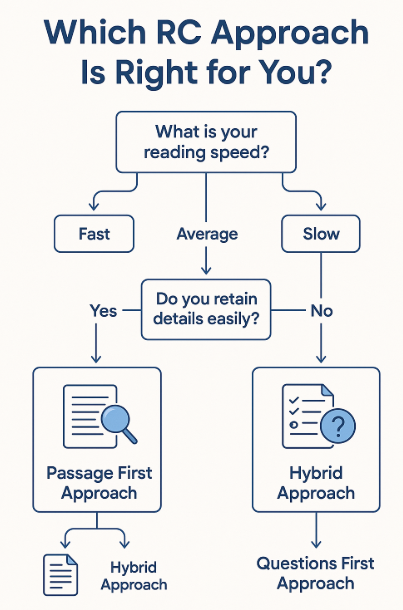
As you can see, the strategies fall into three broad categories:
- Passage First Approach: Ideal for fast readers who can quickly grasp the main ideas and structure of a passage without getting bogged down in details.
- Questions First Approach: Highly effective for those who need a clear purpose before reading. It turns reading into a targeted search mission.
- Hybrid Approach: A flexible method that combines elements of the other two. This is often the most practical and efficient approach for the NET exam.
Think about your own reading style as we explore these approaches in more detail. In a field like UI/UX design, you often choose a research methodology based on the project's specific goals. Similarly, here you'll learn to choose the right reading "methodology" for the task at hand.
2. Exploring the Core Strategies
Most RC strategies can be categorized into two main families: reading the paragraph first (PQ) or reading the questions first (QP). Let's break down the variations of each.
NTA UGC NET Paper 1 Notes 2026 on Reading Comprehension
This article from Eduncle provides a clear breakdown of the different strategic approaches to RC.
Please read the following sections to understand the pros and cons of each method: Start with the section titled "PQ (Paragraph First & Questions Later)". Read through the three different methods described, from reading the entire passage first to the skimming and incremental reading approaches. Next, read the section "QP (Questions First & Paragraph Later)". Pay close attention to the variations of this method, from reading all questions first to reading them one by one.
As the article suggests, the "Questions First" approach is often recommended for competitive exams because it prevents you from wasting time on parts of the passage that are not relevant to any question. However, the most powerful strategy is often a hybrid that combines the best of both worlds: getting a quick sense of the passage's structure before using the questions to guide a more detailed reading.
3. Mastering Skimming and Scanning
The foundation of any effective hybrid strategy lies in two complementary skills: skimming and scanning. Mastering these will allow you to process the passage with maximum efficiency.
- Skimming is the process of reading quickly to get a general overview of a text. The goal is not to understand every word but to identify the main idea, structure, and tone. You might read the first and last sentence of each paragraph to create a "mental map" of the passage.
- Scanning is searching for specific information, like keywords, names, dates, or phrases that you have identified from the questions. You let your eyes glide over the text until you find the target you're looking for.
How to Solve UGC NET Reading Comprehension in Limited Time PDF Download
This article from EduRev offers a concise explanation of how to apply these two techniques specifically for the NET exam.
Please read the section titled "Skimming and Scanning Techniques for UGC NET Paper 1 Passages". Focus on the distinction between the two skills and the tip about mentally summarizing paragraphs as you skim.
Now, let's see these techniques in action. The following video demonstrates a powerful hybrid method: skim the passage first to build a mental map, then read the questions, and finally scan the passage to pinpoint the answers.
3. Step-by-step Guide to Solve Reading Comprehension Questions | UGC-NET Paper 1 | Bharat Kumar
This video by Kumar Bharat provides an excellent step-by-step walkthrough of a previous year's RC question, applying the skim-then-scan method.
Please watch the following segments carefully: The Strategy: First, watch the instructor explain the core strategy from 3:53 to 4:58. He clarifies that you read the passage first, but through skimming, not a deep read. Skimming Demonstration: From 4:58 to 10:38, observe how he skims the passage. He highlights key phrases and creates short notes for each paragraph on a rough sheet. This is the "mental map" creation process. Scanning for Answers: From 10:38 to 16:04, watch how he uses his paragraph map to instantly know where to look for the answer to each question, demonstrating the power of scanning.
4. The Art of Elimination: Avoiding Common Traps
In a multiple-choice format, finding the right answer is often a process of systematically eliminating the wrong ones. The question setters for the NET exam are experts at creating tempting but incorrect options, known as "distractors." Learning to spot these traps is a crucial skill.
The following video provides a brilliant, structured checklist of ten common traps you'll find in RC options.
Reading Comprehension Tricks ➤ BEST Way to Solve Reading Comprehension 💯
In this video, educator Shweta Arora breaks down the science of eliminating wrong options with a list of 10 specific tricks.
Watch the core segment from 4:28 to 9:20, where she explains each of the ten elimination tricks, such as: Extreme Words: Options using words like "always," "never," "all," or "only" are often incorrect because passages are usually more nuanced. Unknown/Outside Information: An option might be factually correct in the real world, but if it's not supported by the passage, it's a wrong answer. Faulty Comparison: The option makes a comparison that is not explicitly made in the text. Replica: The option is a near-perfect copy of a sentence from the passage but changes one critical word (e.g., "and" to "but"), altering the meaning.
To remember the main categories of incorrect options, you can use the BANE mnemonic:
- Broad: The option is too general and goes beyond the scope of the passage.
- Alien: The option introduces an idea or information not mentioned in the passage.
- Narrow: The option is too specific and only covers a small part of the main idea.
- Extreme: The option uses absolute language that is not supported by the author's tone.
5. A Unified Strategy for Exam Day
Let's synthesize everything we've learned into a single, step-by-step process you can apply in the exam. This method integrates the hybrid approach with the elimination techniques we've discussed.
- Scan the Questions (Not the Options): Quickly read through the 5 questions to understand what you need to look for. Note the keywords in each question. (30-40 seconds)
- Skim the Passage for a Mental Map: Read the first and last sentence of each paragraph to understand the overall topic, flow, and where different sub-topics are located. Create a quick mental or written note for each paragraph's main point. (1-2 minutes)
- Tackle Questions Systematically: Address one question at a time. Use the keywords from the question to scan your mental map and the passage to find the relevant paragraph or sentences.
- Read with Precision: Once you've located the relevant section, read it carefully to fully understand what the author is stating.
- Eliminate and Select: Analyze the four options using the elimination checklist (BANE, extreme words, outside info, etc.). Eliminate the definite wrong answers and select the one that is most accurately supported by the text you just read. (3-4 minutes for all questions)
This structured workflow is a reliable way to manage time and improve accuracy under pressure.
Conclusion
In this lesson, we have transformed Reading Comprehension from a simple reading test into a strategic exercise. You now have a complete toolkit to tackle this section with confidence and efficiency, which is vital for your crash course preparation.
Here are the key takeaways:
- Choose Your Strategy: Start with an approach (Passage First, Questions First, or Hybrid) that suits your reading style, using the flowchart as a guide.
- The Hybrid Method is Key: The most effective approach for the NET exam is often a hybrid: skim the passage for a mental map, read the questions for purpose, and then scan the passage for answers.
- Master Skimming and Scanning: These are the core skills for speed. Skimming gives you the 'what' and 'where'; scanning helps you find the specific detail.
- Eliminate with Precision: Don't search for the right answer; eliminate the wrong ones. Use the checklist of common traps (extreme words, outside information, faulty comparisons) to avoid distractors.
In our next lesson, we will move to the Logical Reasoning component of Paper 1. We will practice solving problems involving syllogisms, number series, coding-decoding, and Venn diagrams, further sharpening the analytical skills needed for a top score.