Welcome to our next lesson. In our previous session, we constructed the scaffolding for a transformation program by designing a three-tiered governance structure, defining decision rights with RACI, and establishing clear escalation paths. We identified the Transformation Management Office (TMO) as the operational hub at the center of this structure.
Today, we will place that hub under a microscope. Your objective for this lesson is to define the mandate, operating model, and key functions of a Transformation Management Office (TMO). Given your extensive experience in project and product management, you're likely familiar with the Project Management Office (PMO). We will use that as a reference point to highlight the unique and more strategic role of the TMO, moving from a focus on project execution to orchestrating enterprise-wide value delivery.
From PMO to TMO: A Shift in Focus
Before we define the TMO, it's crucial to distinguish it from its more traditional cousin, the PMO. While both provide structure and oversight, their core purpose, scope, and measures of success are fundamentally different. A PMO is typically focused on ensuring projects are delivered efficiently—on time and on budget. A TMO, however, is focused on ensuring the portfolio of initiatives delivers strategic business outcomes and transformational value.
This chart clearly illustrates the key differences:
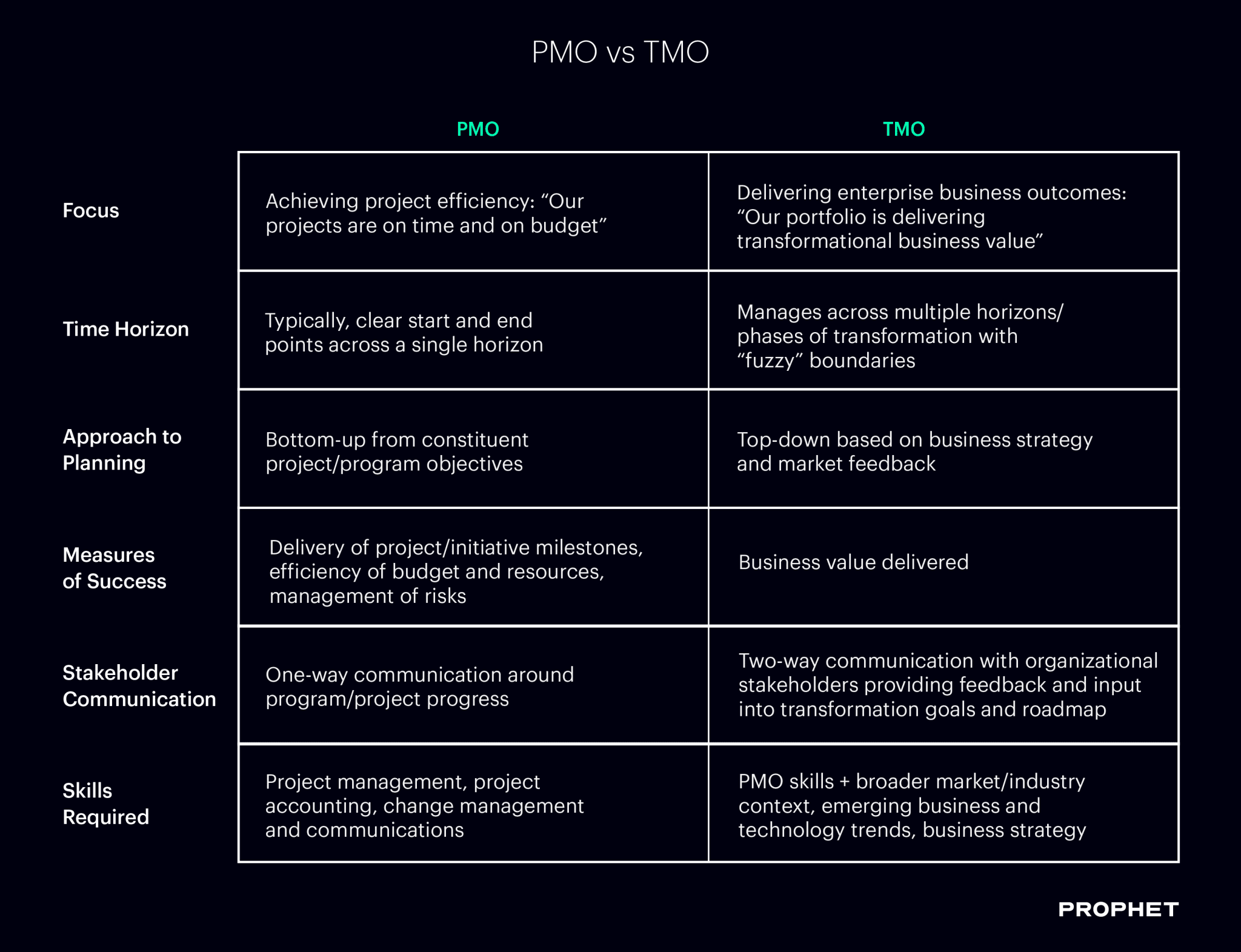
The TMO is not simply a "super-PMO." It is a strategic entity designed to orchestrate complex, interdependent changes across the entire organization, ensuring they align with a central vision.
The Mandate: Why a TMO is Essential
To understand the TMO's mandate, it's helpful to see it as a temporary but powerful bridge. During a transformation, the core line organization is itself changing. Its processes, roles, and even leadership are in flux. The TMO exists to guide the transformation across this gap, ensuring momentum is maintained until the "new" organization is ready to operate independently.
The following video provides a concise and powerful overview of the TMO's primary roles and its reason for being.
The Many Roles of a Transformation Office
This short video from Bain & Company explains the five key roles of a TMO and the fundamental logic for its existence during a period of intense organizational change.
Please watch the entire video; it is brief and highly relevant. As you watch, focus on these key concepts: The five roles of the TMO: Strategic Architect, Integrator, Controller, Operator, and Coach. The core reason for a TMO's existence: It serves as a bridge while the line organization is itself being transformed. The TMO's lifecycle, which ideally moves from a central function to being distributed and eventually dissolved once the new capabilities are embedded in the business.
As the video explains, the TMO's mandate is far broader than project tracking. It is the strategic engine of the transformation. We can crystallize this mandate, or "DNA" of the TMO, into three core components, as described in the Prophet article, "The Role of a Transformation Management Office."
The Role of a Transformation Management Office - Prophet
This section from the Prophet article breaks down the essential components of a successful TMO. We will focus on its "DNA" to define its core mandate.
Please read the first part of the section titled The DNA, Body, Mind and Soul of an Ideal TMO, which outlines the three elements of a TMO's "strong DNA."
The TMO's mandate, therefore, is to:
- Champion a clear vision: Continuously connect all transformation activities back to the strategic "North Star" of who the organization is striving to become.
- Enforce a specific timeframe: Drive the pace and urgency of the transformation to meet its ambitious goals.
- Ensure accountability to real metrics: Move beyond activity tracking to measure and report on the actual business value and outcomes being delivered.
The Operating Model: How the TMO is Structured and Run
With a clear mandate, we can now design the TMO's operating model—its structure, roles, and processes. Your work in organizational design will be very relevant here.
Governance and Organization
The TMO doesn't operate in a vacuum. As we saw in the previous lesson, it is the operational arm of the governance structure, reporting to the Executive Steering Committee and coordinating the various workstreams. This organizational chart illustrates a typical structure.

Most transformations begin with a centralized TMO to ensure consistency and strong top-down alignment. Over time, as new capabilities and mindsets become embedded in the business units, the model can evolve to become more federated, with the central TMO eventually dissolving.
Roles, Activities, and Processes
A TMO requires a dedicated team with a specific set of skills. It's not just a collection of project managers. The BCG article, "How to Create a Transformation That Lasts," provides an excellent breakdown of the key dimensions and roles within a TMO.
How to Create a Transformation That Lasts | BCG
This article outlines the practical steps for setting up a TO (Transformation Office), which is synonymous with a TMO.
Please read the two subsections under "Getting the Transformation Office Off the Ground": Start with Governance and Organization. Focus on how the TMO is staffed and integrated with existing processes. Then read Roles Within the Transformation Office, which details the different skill sets required, such as workstream liaisons, finance, and analytics staff.
As the article highlights, the operating model is defined by:
- A clear leader: A Chief Transformation Officer (CTO) with the authority to manage scarce resources and hold workstream leads accountable.
- A dedicated team: A core group of 10-12 full-time employees in a large company, comprising roles like workstream liaisons, financial analysts, communication specialists, and change managers.
- Standardized processes: A single way of working, with common reporting cadences, meeting rhythms, and tracking tools to ensure "one source of truth." This replaces the varied, ad-hoc project management styles that often exist in different departments.
The Key Functions: What the TMO Does
We've defined the TMO's mandate and operating model. Now, let's specify its core functions. These are the day-to-day activities that bring the operating model to life and enable the TMO to fulfill its mandate.
The Prophet article provides a clear and comprehensive list of five key domains that constitute the TMO's primary functions.
The Role of a Transformation Management Office - Prophet
We return to the Prophet article to explore the "Body" of the TMO, which details its core processes and functions.
Please find the section titled The DNA, Body, Mind and Soul of an Ideal TMO again. This time, focus on the five bullet points that describe the TMO's "strong Body."
These five domains are the essential functions of the TMO:
- Goals & Investments: Works with the steering committee to define the transformation's financial targets and oversee the allocation of capital and resources to the initiatives that will best achieve them.
- Portfolio & Governance: Acts as the gatekeeper for the transformation portfolio. This involves managing the intake of new initiatives, prioritizing them based on strategic value, and allocating resources accordingly. This function prevents the organization from getting bogged down in low-value projects.
- Education & Mobilization: Functions as an enabler and a problem-solver. The TMO doesn't just track progress; it actively supports workstream teams by providing coaching, removing roadblocks, and facilitating cross-functional collaboration.
- Reporting & Forecasting: Provides transparent, data-driven visibility into the transformation's progress. This goes beyond simple milestone tracking ("are we on schedule?") to focus on value forecasting ("are we on track to deliver the promised business benefits?").
- Change Management & Communications: Acts as the "air traffic controller" for all change initiatives. The TMO coordinates the timing and messaging of changes to prevent employee fatigue and ensure a coherent narrative, aligning all communication back to the transformation vision.
Conclusion
In this lesson, we have moved from a high-level view of governance to a detailed blueprint of its engine—the Transformation Management Office. We've established that the TMO is a fundamentally different entity from a traditional PMO, with a strategic mandate to deliver business value, not just project efficiency.
Key Takeaways:
- Mandate: The TMO's purpose is to champion the transformation vision against a clear timeframe and measurable business metrics, acting as a bridge while the organization itself is in flux.
- Operating Model: A TMO is typically a centralized, dedicated team led by a Chief Transformation Officer. It establishes standardized processes for tracking, reporting, and decision-making across all workstreams.
- Key Functions: The TMO's core functions include strategic portfolio management, investment oversight, roadblock removal, value-based reporting, and centralized change management and communication.
In our next lesson, we will delve into one of the TMO's most critical functions: mapping cross-workstream interdependencies and designing an integrated reporting and risk management process. We will build directly on the portfolio governance and reporting functions we outlined today to create the practical tools needed to manage a complex transformation at scale.