Welcome back to our course on leading B2B software transformation. In our last session, we developed a strategic approach for migrating your customer base to a new platform, focusing on segmenting customers into cohorts and designing tailored offers and pricing. Now, with a clear strategy in hand, we turn to the critical task of execution. How do you prepare your organization to carry out this new Go-to-Market (GTM) motion, and how do you support your customers through this significant change?
This lesson will equip you to answer those questions by focusing on two interconnected components: designing a GTM enablement plan for your internal teams and creating a robust support model for your customers. Your extensive background in Learning & Development and customer-facing product roles provides you with a powerful lens for this topic. You'll recognize that enabling your teams is an internal change management initiative, while supporting customers is about operationalizing the value you've promised them.
Part 1: Designing the Internal GTM Enablement Plan
A GTM transformation is only as strong as the teams executing it. Simply sending an email with the new pricing and messaging is a recipe for failure. You need a structured plan to ensure every customer-facing employee is aligned, confident, and competent. This is the role of enablement.
From Sales Enablement to Revenue Enablement
Traditionally, companies focused on "sales enablement." However, a modern B2B transformation, especially one involving a shift to microservices and AI, impacts the entire customer lifecycle. This requires a more holistic approach known as revenue enablement, which aligns marketing, sales, and customer success around a single, cohesive customer experience.
Revenue Enablement: A Complete Guide for Modern B2B Teams
This guide from Simtech Development clearly distinguishes between traditional sales enablement and the more strategic, cross-functional approach of revenue enablement.
Please read the introduction and the first two main sections. Start with the definition of revenue enablement and how it differs from sales enablement. Then, continue with the section Why Implement Revenue Enablement? to understand the strategic drivers, such as changing buyer behavior and the need for cross-functional collaboration.
Adopting a revenue enablement mindset means you're not just training salespeople to close deals; you're orchestrating the entire revenue engine—from marketing's initial messaging to sales' migration offers and customer success's post-migration support.
The Core Components of Your Enablement Plan
Your enablement plan should be a comprehensive program built on several pillars. Given your background in designing learning architectures, this structure will be familiar. The goal is to provide your teams with the knowledge, skills, content, and tools they need to succeed.
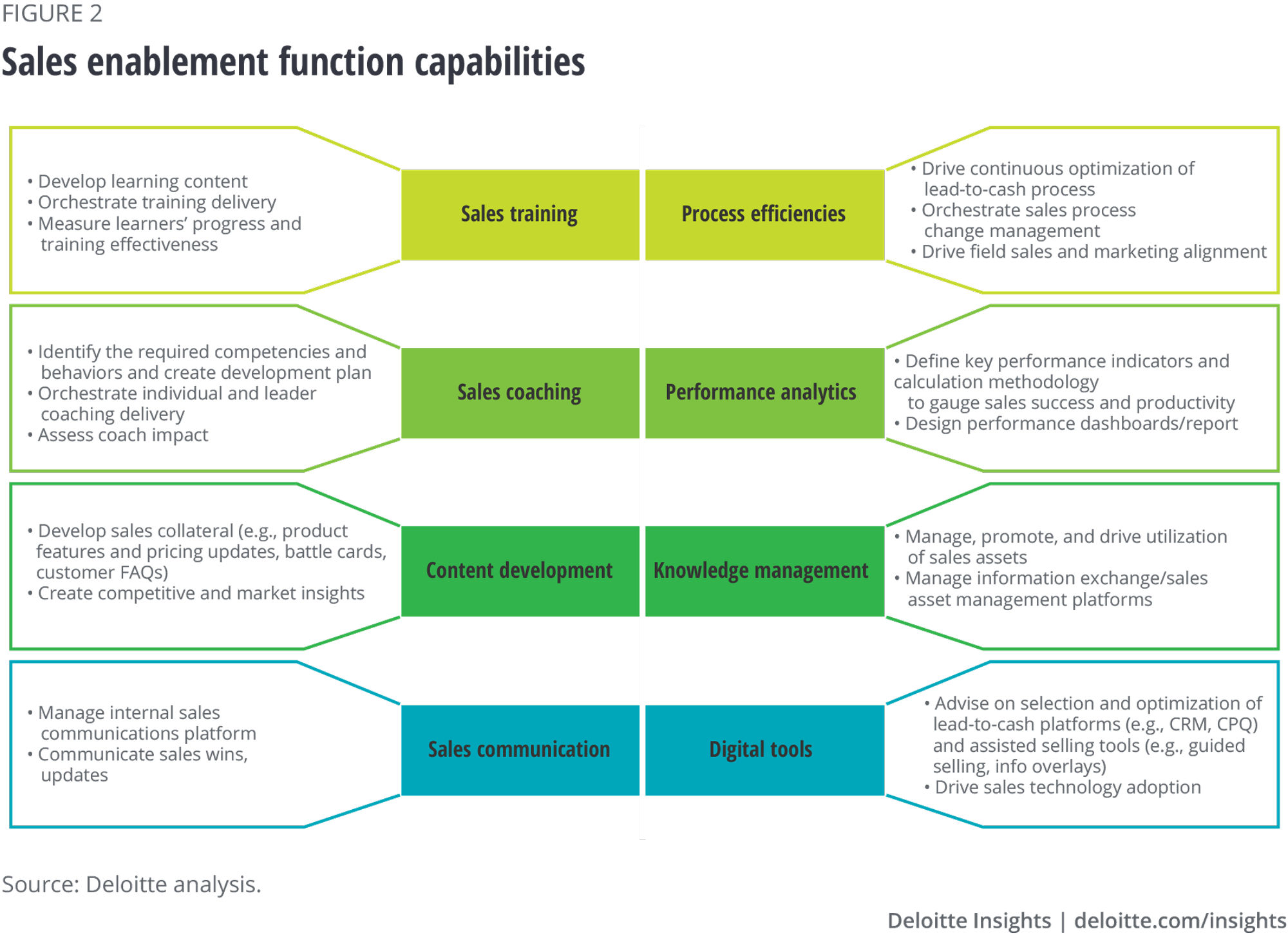
Let's break down what your plan must include for a GTM transformation:
-
Training and Coaching: This is the foundation. Your L&D experience is crucial here. Training must cover:
- The 'Why': The strategic rationale for the transformation and the new GTM model.
- New Product Value: Deep understanding of the modular, AI-enhanced portfolio and how to articulate its value.
- New Messaging and Positioning: Fluency in the narratives we developed in the previous lessons.
- Migration Playbooks: How to engage each customer cohort, present the tailored offers, and handle pricing discussions.
- Objection Handling: Role-playing common customer concerns about migration (cost, disruption, new technology).
-
Content and Collateral: Your teams need the right assets at their fingertips. This includes:
- Internal Playbooks: Detailed guides for sales and customer success on executing the migration strategy.
- Customer-Facing Decks: Presentations that clearly communicate the value of the new platform and the migration path.
- ROI Calculators and Business Cases: Tools to help customers justify the move internally.
- Battle Cards: Quick-reference guides for handling objections and positioning against competitors.
- Case Studies: Success stories from early adopters or pilot customers to build confidence and social proof.
-
Tools and Technology: Ensure your technology stack supports the new GTM motion. This might involve reconfiguring your CRM to track migration cohorts, updating your content management system with new collateral, and leveraging analytics to monitor progress. As technology becomes more central, we even see the emergence of roles like the "GTM Engineer," who uses AI and automation to make GTM processes more efficient.
-
Performance and Incentives: Your compensation and performance management systems must align with the transformation goals. Are you rewarding teams for successful migrations and customer retention on the new platform, or are your incentives still tied to old product sales?
Revenue Enablement: A Complete Guide for Modern B2B Teams
Let's revisit the guide to see how different teams benefit from a unified enablement approach.
Read the section Who Benefits?. Pay attention to the specific benefits outlined for Sales, Marketing, and Customer Success. This will help you tailor your enablement plan to each team's unique needs.
By creating a specific enablement track for each function, you ensure that marketing is generating the right leads, sales is having the right conversations, and customer success is prepared to onboard and retain customers on the new platform.
Part 2: The External Customer Support Model
While internal enablement prepares your team, the external support model ensures your customers have a positive and successful migration experience. A poorly handled migration can destroy trust and lead to churn, no matter how great your new product is.
Frame the Experience: GTM as a Product
A powerful way to think about your support model is to treat the migration journey itself as a product. The experience a customer has while being sold to and supported can be as much of a differentiator as the technology itself.
What world-class GTM looks like in 2026 | Jeanne DeWitt Grosser (Vercel, Stripe, Google)
In this clip from Lenny's Podcast, Jeanne DeWitt Grosser, a GTM leader from Vercel, Stripe, and Google, explains the concept of designing the customer buying journey as a series of unique, value-added experiences.
Please watch the segment from GTM as a product. She provides excellent examples, like Stripe's collaborative whiteboarding sessions, that transform a standard sales process into a valuable consultation for the customer.
Applying this mindset, your support model isn't just a reactive helpdesk. It's a deliberately designed journey that guides the customer from their legacy system to success on the new platform, adding value at every step.
Structuring the Migration and Onboarding Journey
A structured, phased approach is essential for managing a complex migration. The "Client Migration Playbook" offers a fantastic framework that aligns perfectly with a project management discipline.
Client Migration Playbook: Moving Service Clients to SaaS Products
This playbook provides a step-by-step process for moving clients from one service model to another, which is directly analogous to our platform migration.
Please read the section titled What's the Step-by-Step Migration Process?. Focus on the four phases described: Foundation and Communication, Pilot Programs, Systematic Rollout, and Optimization and Expansion.
This four-phase process gives you a clear roadmap:
- Phase 1: Foundation & Communication: Proactively educate clients about the upcoming changes and the value they will receive.
- Phase 2: Pilot Programs: Work with a small group of "early adopter" customers to test and refine the migration process. Their success becomes your first set of case studies.
- Phase 3: Systematic Rollout: Begin migrating the cohorts we defined in the previous lesson, providing dedicated support and training.
- Phase 4: Optimization: Once migrated, focus on driving adoption of advanced features and ensuring the customer realizes the full value of the new platform.
Visually, the customer-facing part of this journey can be represented by a standard B2B onboarding process, now adapted for migration.

The Linchpin: The Customer Success Manager (CSM)
The central figure in a modern B2B support model is the Customer Success Manager (CSM). Unlike traditional support, which is reactive and focused on fixing problems, the CSM is proactive and focused on driving customer outcomes.
Top 5 Activities of a Great SaaS Customer Success Manager
Entrepreneur and coach Dan Martell provides a crystal-clear breakdown of the five core activities of a great CSM. This will form the basis of your external support model's operating principles.
Please watch the key segments of this video that outline the CSM's responsibilities: Introduction to the CSM role. Create a Health Score: Quantifying customer engagement to proactively identify risks. Outcome Project Focused: Managing each customer's implementation like a project with a desired outcome. Engage the Renewal and Upsell: Driving the "land and expand" model. Escalate Value: Turning successful customers into advocates (testimonials, case studies). Voice of the Customer: Feeding crucial feedback back to the product team.
The CSM is your on-the-ground leader for the support model. They own the customer relationship through the migration, ensure the customer achieves their desired outcomes, and act as a vital feedback loop to your product organization—a concept that Jeanne DeWitt Grosser also emphasizes as critical for building a GTM organization that product and engineering teams value.
Finally, your support model must be prepared to handle the inevitable friction that comes with change.
Client Migration Playbook: Moving Service Clients to SaaS Products
Let's return to the playbook one last time to arm our support model with strategies for overcoming resistance.
Read the section How Do I Handle Different Types of Client Resistance?. It provides practical, value-based responses to concerns around budget, change management, and trust.
These response strategies should be built directly into your CSM's and sales team's playbooks, ensuring a consistent and empathetic approach across the board.
Conclusion
Successfully executing a GTM transformation requires a deliberate, two-pronged approach. You cannot simply announce a new direction and hope for the best. You must systematically prepare both your internal teams and your external customers for the journey.
Here are your key takeaways:
- Embrace Revenue Enablement: Move beyond siloed sales training to a holistic program that aligns Marketing, Sales, and Customer Success with a single, consistent GTM strategy.
- Build a Comprehensive Enablement Plan: Your plan must equip teams with the right training, content, tools, and incentives to execute the new GTM motion effectively.
- Design the Support Model as a Product: Treat the customer migration journey as a core part of your offering, designing it to be a positive, value-adding experience.
- Center Support Around the CSM: The proactive, outcome-focused Customer Success Manager is the key role for guiding customers through migration and ensuring their long-term success.
You now have a complete framework for both devising and executing a GTM transformation. In our next module, "Communicating Change and Fostering Resilience," we will step back from the GTM specifics and focus on the human side of change. We'll begin by learning how to craft a compelling change story that connects the entire transformation to your organization's purpose and inspires everyone involved.