Welcome to the next lesson in our journey through Go-to-Market Transformation. In our previous session, we focused on redesigning your product's positioning and messaging to articulate the new value of a modular, AI-enhanced portfolio. We established how to create a compelling narrative that sets your product apart. Now, with a powerful story defined, we face the crucial operational challenge: how do you guide your existing customer base from the old product to the new platform?
This lesson directly addresses that challenge. We will develop a comprehensive customer migration strategy, focusing on the three pillars of segmentation, tailored offers, and pricing. Successfully managing this transition is often the difference between a transformation that realizes its full potential and one that stalls, burdened by the costs of supporting legacy systems. Your background in product management and organizational design gives you a unique perspective on this, as you'll recognize it's as much about managing people and expectations as it is about technology.
The Migration Reality: An Organizational Challenge
Before diving into tactics, it's vital to frame the problem correctly. A major B2B product migration is rarely a simple technical upgrade. It is a complex organizational and political challenge, both for you and your customers. Your experience with large-scale system implementations in the BFSI sector has likely shown you that customer inertia and bespoke customizations are powerful forces.
Major Migrations Are An Organizational Challenge, Not Just a ...
This article by Rich Mironov provides a candid, real-world perspective on B2B migrations. It will help ground our strategy in reality.
Please read the first three parts of the article. Start with the introduction to understand the core premise. Review the Goals section to see the strategic drivers behind a migration, such as reducing engineering overhead and competing more effectively. Pay close attention to the section titled A Few Ugly Truths. This part is critical for setting realistic expectations about compatibility issues, customer resistance, and the long support tail of legacy products.
As Mironov highlights, the dream of a painless, 100% compatible migration is just that—a dream. The reality is that you will face customer resistance, technical incompatibilities, and the temptation to make exceptions for large accounts, which can derail the entire effort. Acknowledging these truths from the outset is the first step toward building a resilient strategy.
Step 1: Segment Your Customers with Migration Cohorts
With a realistic mindset, our first strategic action is to break down the monumental task of "migrating everyone" into manageable pieces. This is where customer segmentation comes in, but not in the traditional marketing sense. For a migration, we need a practical, action-oriented approach.

A highly effective method for this is identifying Migration Cohorts. Instead of trying to meet every unique customer need simultaneously, you group customers based on their technical and functional ability to migrate to the new platform as it exists today or with minimal additions.
Major Migrations Are An Organizational Challenge, Not Just a ...
Let's return to Rich Mironov's article to see how this cohort model works in practice.
Read the section Identify Migration Cohorts. The key idea is to "peel off large groups of migratable customers" based on common characteristics.
By identifying cohorts, you create a phased rollout plan. For example:
- Cohort 1: Customers whose current usage patterns are fully supported by the new platform. They can migrate now. Your GTM effort is focused on communication, incentives, and support.
- Cohort 2: Customers who need one specific integration (e.g., a particular single sign-on provider) before they can migrate. Your product team prioritizes that feature, and your GTM team prepares to engage this cohort as soon as it's ready.
- Cohort 3: Customers with deep, complex customizations that require significant re-architecture. These are your most challenging segment and are scheduled for the final phases of the migration.
This cohort-based approach transforms the migration from a chaotic scramble into an ordered, strategic sequence.
Step 2: Design Tailored Offers and Pricing
Once you have your cohorts, you need to give them a compelling reason to move. This involves crafting tailored offers that combine attractive pricing with clear value. The foundation of a strong offer is understanding the quantifiable benefit your new platform provides.
How To Price For B2B | Startup School
This clip from a Y Combinator lecture explains the "value equation," a simple yet powerful way to calculate the ROI your product delivers.
Watch the section from the beginning of the talk where the speaker walks through calculating the value equation for a customer service tool. This method of tying your product to cost savings, time savings, or revenue increases is the basis for justifying new pricing.
By calculating this value for each cohort, you can anchor your pricing to the ROI they will receive. For instance, if your new AI-powered platform saves a customer segment $500,000 annually in operational costs, pricing the new service at $100,000 is an easily justifiable proposition.
Now, we address the most sensitive part of any migration: what to do about existing customers' pricing. The practice of "grandfathering"—allowing existing customers to keep their old plan—is a common tool, but it comes with significant tradeoffs.
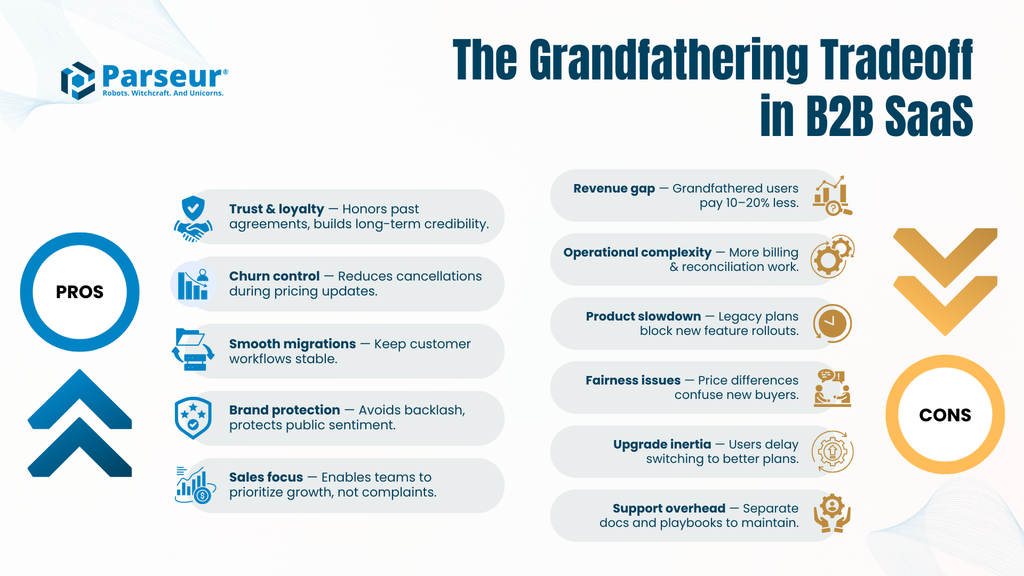
There are three main strategies for handling legacy pricing. Your choice will depend on your business goals, your relationship with your customers, and the scale of the price change.
A Product Leader's Guide to Winning with SaaS Pricing Models
This article provides a superb breakdown of the tactical options for grandfathering customers.
Please read the FAQ section titled What Is The Best Way To Grandfather Customers. It details the three primary approaches: "The 'Forever' Grandfather," "The Timed Grandfather," and "The Forced Migration."
Let's summarize these options:
- "Forever" Grandfather: Customers keep their price and features for life. This maximizes goodwill but creates long-term revenue and technical debt.
- Timed Grandfather: Customers keep their old price for a limited period (e.g., 6-12 months) before transitioning to the new plan. This is often the best compromise, offering fairness while ensuring all customers eventually move to the new model.
- Forced Migration: All customers are moved to new pricing at their next renewal. This maximizes revenue quickly but carries the highest risk of churn and customer backlash.
To make these offers more compelling and encourage proactive upgrades, you can combine them with new feature introductions.
B2B SaaS Pricing Strategy (Why You Shouldn't Be Afraid to Raise Prices)
TK Kader offers a practical, two-step approach for rolling out a price increase that you can adapt for your migration offers.
Watch the first two principles in this video: First, understand the concept of placing customers in a legacy tier, which freezes their price and features. Next, see how to introduce a new plan with a new, valuable feature that acts as a "carrot" to incentivize legacy customers to upgrade voluntarily.
This "carrot" approach is a powerful tool. By holding back significant new value (like your new AI features) for the new platform, you create a strong pull factor, turning the migration from something you are pushing on customers to something they are pulling from you.
Step 3: Enforce the Plan with Clear Deadlines
Incentives and offers form the "carrot" of your migration strategy. But to be effective, especially for hesitant customers, you also need a "stick." This comes in the form of clear, non-negotiable end-of-life (EOL) and end-of-support (EOS) dates for your legacy product.
Major Migrations Are An Organizational Challenge, Not Just a ...
Let's look at the final, crucial pieces of the migration puzzle from Rich Mironov's article. This is where strategic resolve is tested.
Please read the last two sections of the article: Focus on Set Hard, Non-Negotiable... End-of-Support Dates. This emphasizes the need for absolute executive commitment to deadlines. Then, read Plan to Fire the Last Stragglers, which addresses the difficult but necessary decisions about customers who refuse to migrate.
This is where your transformation leadership is truly tested. As Mironov argues, if your executive team is not prepared to stand firm on these dates and potentially lose a few laggard customers, the entire migration effort can stall, leaving you supporting multiple platforms indefinitely and failing to achieve the strategic goals you set out to accomplish.
Conclusion
In this lesson, we have constructed a complete framework for developing a customer migration strategy. This is a far cry from a simple communication plan; it is a strategic GTM initiative that requires careful planning, executive alignment, and disciplined execution.
Here are the key takeaways:
- Frame the Challenge Correctly: Treat migration as a complex organizational change, not just a technical project.
- Segment for Action: Use the "Migration Cohort" model to create a phased and manageable rollout plan.
- Lead with Value: Craft tailored offers based on the quantifiable value your new platform delivers, using this to justify new pricing.
- Balance Carrots and Sticks: Choose a grandfathering strategy that aligns with your business goals, but combine it with compelling incentives ("carrots") and firm, non-negotiable end-of-support deadlines ("sticks").
You now have a robust methodology for moving your existing customers to your new, transformed product portfolio. In our next lesson, we will focus on execution: "Design a GTM enablement plan for internal teams and an external support model for customers." We'll plan how to equip your sales and success teams to deliver these new offers and how to support your customers throughout their migration journey.