Welcome back to our exploration of biochemical energetics. In our last lesson, we established how to use the standard free energy change, ΔG°', to understand a reaction's intrinsic tendency to proceed under a defined set of standard conditions. We saw that ΔG°' is a constant, directly related to the equilibrium constant, K'eq.
However, the bustling, dynamic environment of a living cell rarely, if ever, mirrors these standard conditions. Metabolite concentrations can vary by orders of magnitude from the 1 M standard. This raises a critical question: how can we predict which way a reaction will actually proceed inside the cell?
In this lesson, you will learn to determine the spontaneity of reactions under the non-standard, physiological conditions that prevail in biology. We will introduce the mass-action ratio (Q), a measure of the current reactant and product concentrations, and use it to calculate the actual free energy change (ΔG), the true indicator of reaction direction in a living system.
1. Beyond Standard Conditions: The Mass-Action Ratio (Q)
The standard free energy change, ΔG°', is a valuable constant for comparing reactions, but it's like a lab benchmark. It doesn't tell you what's happening in the moment. The actual free energy change, ΔG, depends on the prevailing conditions, primarily the concentrations of reactants and products.
To capture these real-time concentrations, we use the mass-action ratio, denoted as Q. For a generic reaction aA + bB ⇌ cC + dD, the expression for Q is:
Notice that this expression has the exact same form as the equilibrium constant, K'eq. The crucial difference is:
- K'eq is the ratio of products to reactants at equilibrium. It is a constant for a given reaction.
- Q is the ratio of products to reactants at any given moment. It is a variable that changes as the reaction proceeds.
A reaction in a cell is a dynamic process. Its direction is a continuous "effort" to reach the state of equilibrium. The value of Q tells us how far the reaction is from that equilibrium state.
This short video segment provides a clear definition of the mass-action ratio and its role in determining reaction direction.
Bioenergetics | Principles of Metabolism 01 | Biochemistry | PP Notes | Lehninger 6E Ch.13
This video introduces the mass-action ratio (Q) and explains how it relates to the actual concentrations in a system.
Please watch the segment from the introduction of the mass-action ratio, which defines Q and illustrates how comparing it to K helps predict the reaction's direction.
2. Calculating the Actual Free Energy Change (ΔG)
Now that we have a way to describe the current state of a reaction (Q), we can modify the free energy equation we saw in the last lesson to calculate the actual free energy change, ΔG, under these non-standard conditions. The relationship is:
Let's dissect this fundamental equation:
- ΔG is the actual free energy change under the current conditions (what we want to find). Its sign tells us the true direction of the reaction right now.
- ΔG°' is the standard free energy change, a constant that represents the intrinsic energy difference between products and reactants.
- RT ln Q is the "correction factor." It adjusts the standard value based on the current concentrations of reactants and products. This term quantifies the energetic contribution from the concentration gradients.
The spontaneity of a reaction in vivo is determined by the sign of ΔG, not ΔG°':
- If ΔG < 0, the forward reaction is spontaneous.
- If ΔG > 0, the forward reaction is non-spontaneous (the reverse reaction is spontaneous).
- If ΔG = 0, the reaction is at equilibrium.
The following resource provides a detailed explanation and a worked example, which is excellent for solidifying your understanding of this calculation.
Gibbs Free Energy Explained: Definition, Examples, Practice & Video Lessons
This resource demonstrates how to calculate the actual free energy change (ΔG) for a glycolytic reaction under physiological conditions, contrasting it with the standard free energy change (ΔG°).
Please read the "Video Summary" for the section titled "Gibbs Free Energy (Physiological Conditions)". It walks through a complete calculation for the conversion of DHAP to G3P, a key step in glycolysis. Pay close attention to how they first calculate ΔG°' from K, and then use that value along with physiological concentrations (Q) to find the true ΔG.
As the example shows, a reaction that is endergonic under standard conditions (ΔG°' > 0) can be spontaneous and exergonic under physiological conditions (ΔG < 0) if the concentration of reactants is kept high relative to products. This is a common strategy in metabolic pathways.
3. The Driving Force: The "Distance" from Equilibrium
There's a more intuitive way to think about reaction spontaneity that connects directly to your analytical mindset. By combining the equations from our last lesson and this one, we can derive a powerful relationship.
We know:
Substituting the second equation into the first gives:
Rearranging this by factoring out RT yields:
This elegant equation reveals that the sign of ΔG is determined by the ratio of Q to K'eq. This ratio is often called the disequilibrium ratio, sometimes symbolized as Γ (Gamma) or ρ (rho).
Let's analyze this relationship:
- If Q < K'eq, then Q/K'eq < 1. The natural log is negative, so ΔG < 0. The reaction must proceed forward (creating more products) to increase Q until it reaches K'eq.
- If Q > K'eq, then Q/K'eq > 1. The natural log is positive, so ΔG > 0. The reaction must proceed in reverse (creating more reactants) to decrease Q until it reaches K'eq.
- If Q = K'eq, then Q/K'eq = 1. The natural log is zero, so ΔG = 0. The reaction is at equilibrium.
A reaction's driving force comes from the "distance" between the current mass-action ratio (Q) and the equilibrium ratio (K'eq). The cell can drive a reaction forward simply by ensuring Q is kept smaller than K'eq, typically by consuming the products rapidly in the next step of a pathway.

4. Application: Analyzing a Glycolytic Reaction
Let's apply these principles to a concrete biochemical problem. The image below presents a key regulatory step in glycolysis, the phosphorylation of fructose 6-phosphate by the enzyme phosphofructokinase-1 (PFK-1).
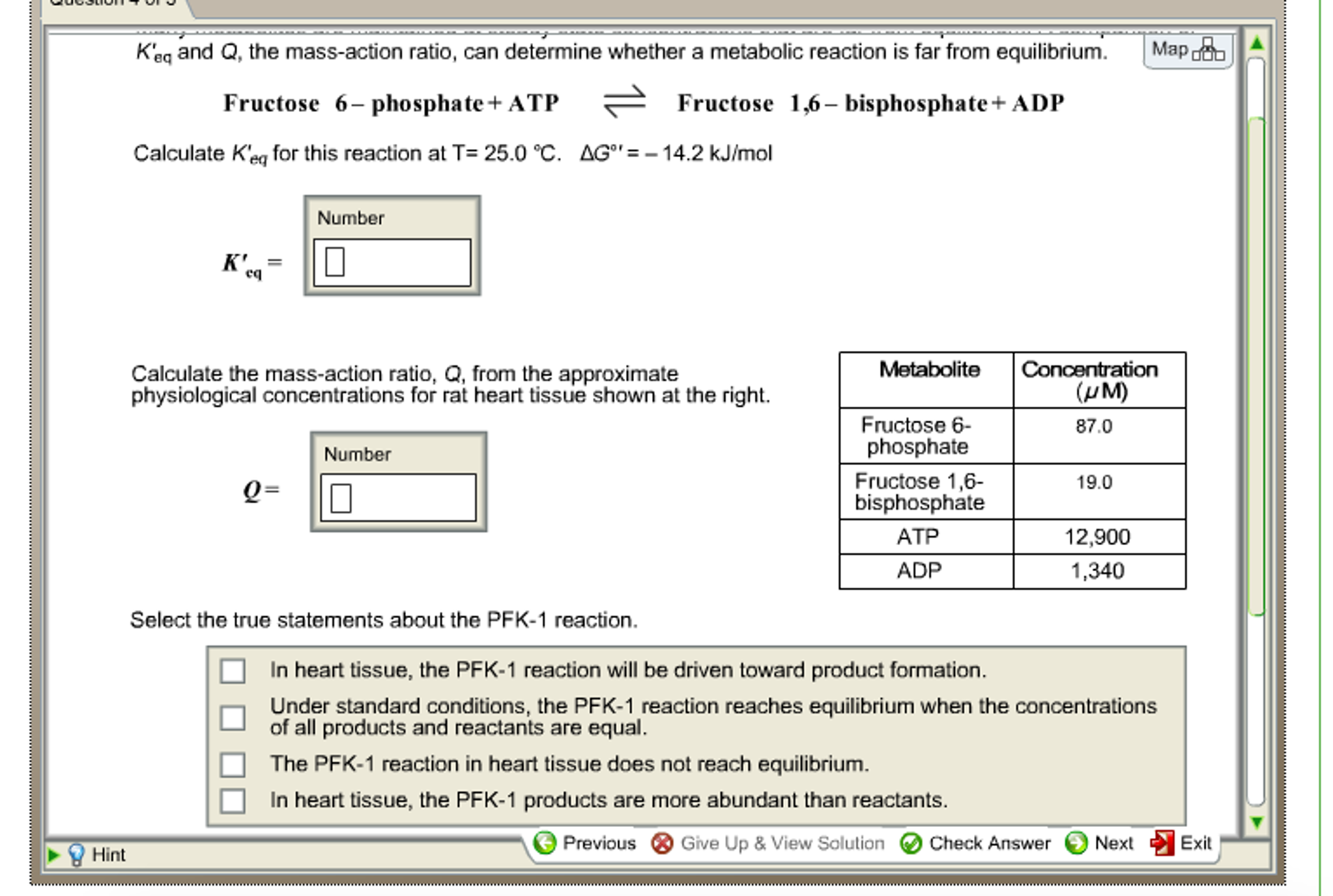
We are given the standard free energy change (ΔG°' = -14.2 kJ/mol) and the physiological concentrations of the metabolites in heart tissue. Let's work through this step-by-step.
Step 1: Calculate the equilibrium constant, K'eq.
This is a review of our last lesson. We use the equation .
First, convert ΔG°' to J/mol: -14,200 J/mol.
The temperature is 25.0 °C, which is 298.15 K.
The equilibrium for this reaction strongly favors the products.
Step 2: Calculate the mass-action ratio, Q, from physiological concentrations.
The reaction is: Fructose 6-phosphate + ATP ⇌ Fructose 1,6-bisphosphate + ADP.
The expression for Q is:
Now, plug in the values from the table (converting from μM to M is good practice, but since all units are the same, they will cancel out):
Step 3: Compare Q and K'eq to determine spontaneity.
We found that K'eq ≈ 308 and Q ≈ 0.0227.
Clearly, Q << K'eq.
Because Q is much smaller than K'eq, the ratio Q/K'eq is much less than 1. Therefore, the actual free energy change, ΔG, will be strongly negative (), and the reaction will be driven powerfully toward product formation in heart tissue under these conditions.
Based on this analysis, let's evaluate the statements in the image:
- "In heart tissue, the PFK-1 reaction will be driven toward product formation." — TRUE. (Since Q << K'eq)
- "Under standard conditions, the PFK-1 reaction reaches equilibrium when the concentrations of all products and reactants are equal." — FALSE. Under standard conditions, ΔG°' is negative, meaning K'eq > 1. Equilibrium is reached when [Products]/[Reactants] = K'eq ≈ 308, not when they are equal.
- "The PFK-1 reaction in heart tissue does not reach equilibrium." — TRUE. Because Q is so far from K'eq, the reaction is far from equilibrium and proceeding forward. In a living cell, metabolic pathways operate in a steady state where intermediates are held at relatively constant, non-equilibrium concentrations.
- "In heart tissue, the PFK-1 products are more abundant than reactants." — FALSE. Let's check the ratio Q = 0.0227. Since Q < 1, the reactants are actually more abundant than the products under these specific physiological conditions.
Conclusion
Today, we have bridged the gap between theoretical standard conditions and the reality of the cell. You've learned that the true spontaneity of a reaction is dictated by the actual free energy change (ΔG), which incorporates both the reaction's intrinsic properties (ΔG°') and the prevailing concentrations of substrates and products (Q).
Key Takeaways:
- The mass-action ratio (Q) measures the ratio of products to reactants at any given moment.
- The actual free energy change is calculated using the equation .
- A reaction is spontaneous (ΔG < 0) if Q < K'eq and non-spontaneous (ΔG > 0) if Q > K'eq.
- Metabolic pathways can drive thermodynamically unfavorable reactions forward by keeping the ratio of products to reactants (Q) very low.
Many reactions in metabolic pathways, even when driven forward by low product concentrations, still have a positive ΔG°'. They are inherently endergonic. How does life build complex molecules if the reactions are energetically uphill? In our next lesson, we will investigate the cell's primary strategy for overcoming this barrier: thermodynamic coupling, where a highly exergonic reaction, like the hydrolysis of ATP, is used to "pay for" and drive an endergonic one.