Welcome to our next lesson. In our previous session, we saw how the cell uses the high phosphoryl group transfer potential of ATP to drive energetically unfavorable reactions through direct chemical coupling. This transfer of a chemical group is one of the two fundamental ways cells manage energy. Today, we turn our attention to the second: the flow of electrons.
This lesson explores the thermodynamics of oxidation-reduction (redox) reactions, the electron-transfer processes that power everything from cellular respiration to metabolism. You'll learn how to quantify a molecule's affinity for electrons using standard reduction potential (E°') and how to predict the direction of electron flow. Most importantly, we will bridge the gap between electrochemistry and thermodynamics by deriving and applying the crucial equation that relates the standard free energy change (ΔG°') to the standard reduction potential change (ΔE°') of a redox reaction.
1. The Currency of Electrons: Reduction Potential
Just as some molecules have a high potential to transfer phosphoryl groups, others have a high potential to accept electrons. Redox reactions involve the transfer of electrons from a donor (the reductant, which becomes oxidized) to an acceptor (the oxidant, which becomes reduced).
To predict the direction of electron flow, we need a measure of a molecule's electron affinity. This is given by the standard reduction potential (E°'). It is a measure, in volts (V), of the tendency for a chemical species to be reduced, measured under standard biochemical conditions (1 M concentrations, pH 7, 25°C).
Every redox reaction can be conceptually split into two half-reactions, each with its own E°' value. By convention, these are written as reductions:
Oxidant + n e⁻ ⇌ Reductant
The following resource introduces this concept and explains how we use it.
Redox Reactions: Review – BIOC*2580: Introduction to Biochemistry
This text introduces the standard reduction potential (E°') and provides a clear, step-by-step method for using it to predict the direction of a redox reaction.
First, read the introductory section to understand the definition of E°'. Focus on the part that starts with "We can determine this...". Next, read the following section to see how to calculate the overall potential change (ΔE°') and predict spontaneity. Pay close attention to the example "Can fumarate oxidize cysteine?". Note the rule: electrons flow from the half-reaction with the lower (more negative) E°' to the one with the higher (more positive) E°'. The formula for calculating the change is: ΔE°' = E°'(electron acceptor) - E°'(electron donor) A positive ΔE°' indicates a spontaneous reaction under standard conditions.
To put this in context, let's look at the standard reduction potentials for some key players in metabolism.
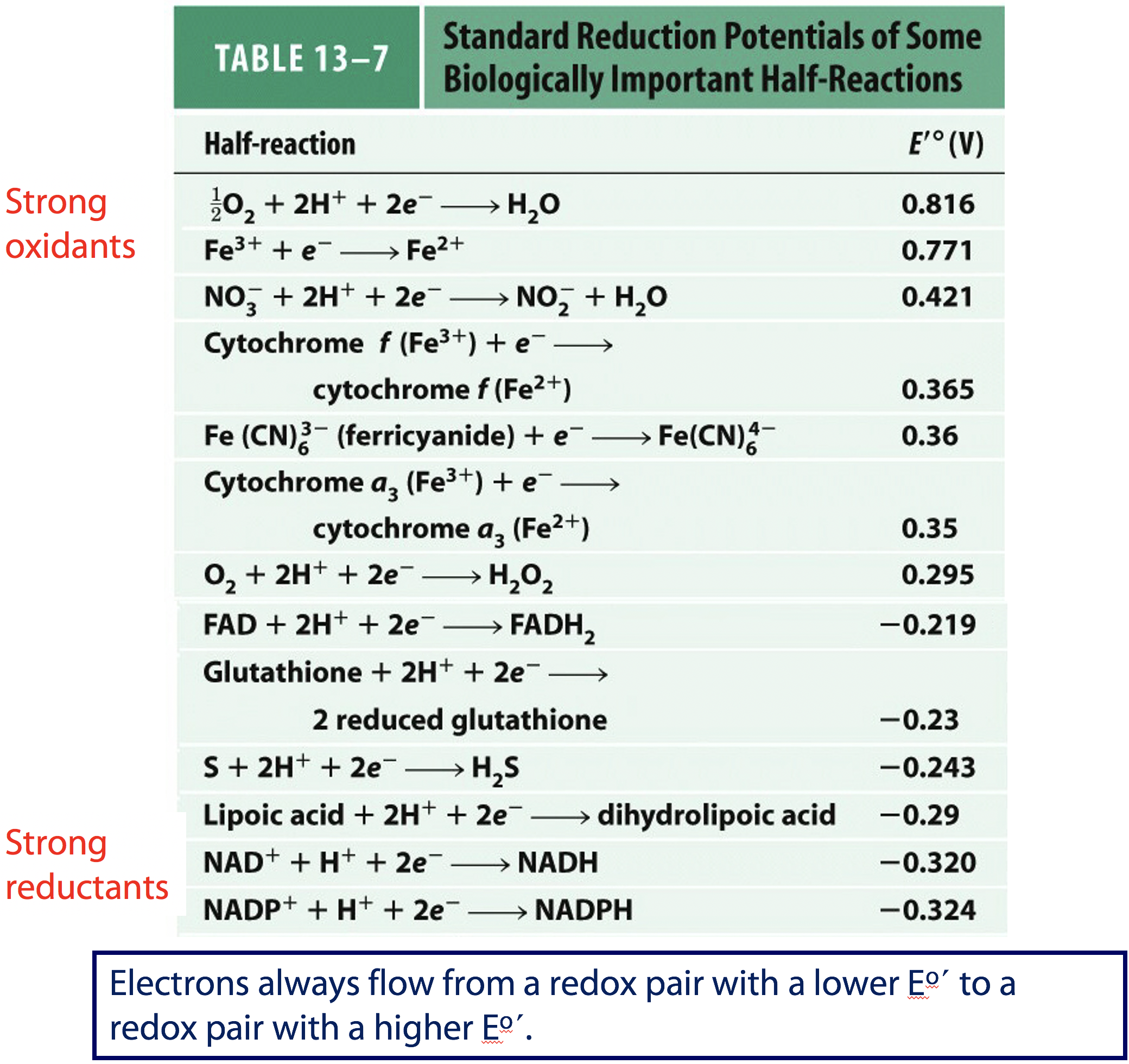
Looking at this table, you can see that for the reaction of NADH with oxygen:
- NADH is the electron donor (E°' = -0.320 V)
- O₂ is the electron acceptor (E°' = +0.816 V)
The electrons will spontaneously flow from NADH to O₂. We'll soon be able to calculate exactly how much energy this transfer releases.
2. From Volts to Joules: Linking ΔE°' and ΔG°'
You now have two separate criteria for spontaneity under standard conditions:
- ΔG°' < 0: The reaction is exergonic.
- ΔE°' > 0: The redox reaction is spontaneous.
These two measures are not independent; they are directly and quantitatively linked. The free energy released by a redox reaction is proportional to the potential difference driving the electron flow (ΔE°') and the total amount of charge transferred.
The following video provides a clear, first-principles derivation of this relationship, starting from the concept of electrical work. Given your background, you may find this fundamental approach particularly satisfying.
Cell Voltage and Gibbs Free Energy
This video derives the relationship between Gibbs free energy and cell voltage (reduction potential) from the ground up.
First, watch the segment that defines electrical work and derives the expression for total charge. The key insight here is that the total charge transferred is the product of the number of moles of electrons (n) and the charge per mole, Faraday's constant (F). Watch from this section on electrical work. Next, watch the crucial step where Gibbs free energy is related to this electrical work. This leads directly to the final equation. Pay close attention to the explanation for the negative sign. Watch from the derivation.
As the video explains, the relationship is given by the equation:
Where:
- ΔG°' is the standard free energy change (in J/mol).
- n is the number of moles of electrons transferred in the balanced redox reaction.
- F is the Faraday constant, the charge of one mole of electrons (96,485 J/(V·mol) or C/mol).
- ΔE°' is the standard reduction potential change (in V).
The negative sign is the critical convention that aligns the two frameworks: a positive ΔE°' (spontaneous electron flow) results in a negative ΔG°' (an exergonic, spontaneous reaction).
Let's apply this to the example we saw earlier: the oxidation of NADH by molecular oxygen, the final step of the electron transport chain.
-
Half-Reactions:
- Oxidation (donor): NADH → NAD⁺ + H⁺ + 2e⁻
- Reduction (acceptor): ½O₂ + 2H⁺ + 2e⁻ → H₂O
The E°' for the NAD⁺/NADH couple is -0.320 V.
The E°' for the ½O₂/H₂O couple is +0.816 V. -
Calculate ΔE°':
ΔE°' = E°'(acceptor) - E°'(donor) = 0.816 V - (-0.320 V) = +1.136 V
The large positive value confirms this is a highly spontaneous process. -
Calculate ΔG°':
In this reaction, n = 2 moles of electrons are transferred.
ΔG°' = -nFΔE°'
ΔG°' = -(2 mol) * (96,485 J/(V·mol)) * (+1.136 V)
ΔG°' = -219,262 J/mol ≈ -219 kJ/mol
This is a tremendous release of free energy, which the cell harnesses to pump protons and synthesize ATP. This calculation quantitatively demonstrates why aerobic respiration is so efficient.
The following short video provides a final, concise summary of how the sign of ΔE°' dictates the sign of ΔG°'.
Bioenergetics | Principles of Metabolism 01 | Biochemistry | PP Notes | Lehninger 6E Ch.13
This clip reinforces the direct relationship between the sign of the change in reduction potential and the sign of the free energy change.
Please watch from this segment for a quick recap.
3. A Deeper Look: When Standard Potentials Can Mislead
The relationship ΔG°' = -nFΔE°' is a fundamental law. However, applying it requires using the correct E°' values. The values in standard tables are measured for molecules in free aqueous solution. What happens inside the unique chemical microenvironment of an enzyme's active site?
Consider the pyruvate dehydrogenase complex, where an FAD cofactor plays a key role. In one step of the reaction cycle, the reduced cofactor, FADH₂, reduces NAD⁺ to NADH.
FADH₂ + NAD⁺ → FAD + NADH + H⁺
Let's analyze this using the standard potentials from the table:
- Donor: FADH₂ (E°' of FAD/FADH₂ couple = -0.219 V)
- Acceptor: NAD⁺ (E°' of NAD⁺/NADH couple = -0.320 V)
ΔE°' = E°'(acceptor) - E°'(donor) = -0.320 V - (-0.219 V) = -0.101 V
This negative ΔE°' predicts the reaction should be non-spontaneous, yet it readily occurs in the cell. This apparent paradox is a fantastic illustration of a deeper biochemical principle. The following discussion from a biology forum provides an excellent explanation.
This Stack Exchange post tackles the apparent contradiction of FADH₂ reducing NAD⁺. It provides a sophisticated explanation for how the enzyme environment modulates the redox potential of a cofactor.
First, read the initial question to understand the paradox clearly. Next, read the "Summary" and "Restating the problem" sections. This will confirm the thermodynamic calculation we just did and introduce the solution: the redox potential is altered by the enzyme. Now, read the core explanation in the section "Resolving the apparent anomaly." Pay attention to how a charged amino acid residue in the active site changes the local electrostatic environment of the FAD cofactor, altering its electron affinity and thus its effective reduction potential. Finally, read the "Final observations". This section makes a powerful point about the interplay between fundamental chemical laws and the specific, optimized environments created by proteins.
This example highlights that while the equation ΔG°' = -nFΔE°' is always true, the E°' values we plug into it must reflect the actual chemical conditions. The protein active site is not a simple aqueous solution; it is a highly evolved microenvironment that can fine-tune the properties of cofactors to drive specific chemical transformations.
Conclusion
In this lesson, we have connected the flow of electrons to the flow of free energy. You've learned how to use standard reduction potentials to predict the spontaneity of redox reactions and, crucially, how to quantify the associated free energy change.
Key Takeaways:
- Standard Reduction Potential (E°'): A measure of a molecule's affinity for electrons. Electrons spontaneously flow from a species with a lower E°' to one with a higher E°'.
- Calculating ΔE°': For a full reaction, ΔE°' = E°'(electron acceptor) - E°'(electron donor). A positive ΔE°' signifies a spontaneous reaction under standard conditions.
- The Link to Free Energy: The relationship ΔG°' = -nFΔE°' provides a direct conversion between the electrochemical potential difference (in volts) and the free energy change (in joules/mol).
- The Power of Environment: Standard potentials are measured in solution. The microenvironment of an enzyme's active site can significantly alter a cofactor's effective E°', allowing it to catalyze reactions that would otherwise seem thermodynamically unfavorable.
So far, all our calculations for both ΔG and ΔE have been at "standard conditions" (1 M concentrations). But the cell is not at standard conditions. In our next lesson, we will introduce the Nernst equation, which allows us to calculate the actual reduction potential (E) under any non-standard concentrations of reactants and products, giving us the power to analyze redox reactions as they truly occur in the cell.