Welcome to your first lesson in our study of Lehninger's Principles of Biochemistry. Given your background in computer science and biology, we'll approach this course with a focus on the quantitative and mechanistic principles that govern life at the molecular level. Our journey begins with biochemical energetics, the "operating system" that dictates which reactions can run and in which direction.
In this lesson, you will learn to calculate the standard free energy change (ΔG°') from a reaction's equilibrium constant and use this value to determine the reaction's intrinsic tendency to proceed. We will establish the fundamental thermodynamic relationship that allows us to predict whether a reaction, under a standardized set of conditions, favors the formation of products or reactants. This forms the bedrock for understanding metabolism, as every pathway is a series of interconnected reactions, each with its own energetic profile.
1. Spontaneity, Free Energy, and Equilibrium
At its core, a chemical reaction proceeds in the direction that leads to a state of lower energy. The thermodynamic quantity that captures this driving force under conditions of constant temperature and pressure is the Gibbs free energy (G). A reaction is considered spontaneous if it results in a decrease in the system's Gibbs free energy.
Let's visualize this. Imagine a reaction progressing from pure reactants to pure products. The Gibbs free energy of the mixture changes, typically following a curve like the one below.
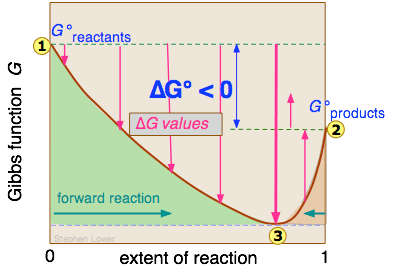
The slope of this curve at any point represents the instantaneous reaction Gibbs free energy (ΔG).
- If ΔG < 0, the slope is negative. The forward reaction is spontaneous and proceeds towards products.
- If ΔG > 0, the slope is positive. The reverse reaction is spontaneous and proceeds towards reactants.
- If ΔG = 0, the slope is zero. The system is at the bottom of the energy well; it has reached equilibrium. There is no net change in the concentration of reactants and products.
For a deeper dive into this fundamental concept, the following reading from a physical chemistry text formalizes the idea of reaction Gibbs energy as the slope of the G vs. composition plot.
This text provides a rigorous definition of reaction Gibbs energy and its relationship to spontaneity and equilibrium.
In the document, please read the section "4.1 The reaction Gibbs energy," starting from the paragraph that introduces the concept. Then, focus on the passage that defines the criterion for chemical equilibrium: the key condition.
2. The Standard Free Energy Change (ΔG°')
The actual free energy change, ΔG, depends on the current conditions (temperature, pressure, and concentrations). To compare the intrinsic spontaneity of different reactions, we need a common reference point. This is the standard free energy change (ΔG°), which is the free energy change under a set of standard conditions:
- 298 K (25 °C)
- 1 atm pressure for all gases
- 1 M concentration for all solutes
However, cellular conditions are quite different. In biochemistry, we use a modified biochemical standard state, which defines the standard free energy change as ΔG°'. The prime symbol (') signifies these biological modifications:
- The pH is constant at 7.0.
- The concentration of water ([H₂O]) is considered constant at 55.5 M.
ΔG°' is a physical constant for a given reaction. It tells you the direction and magnitude of the driving force when all reactants and products are initially present at 1 M concentrations (at pH 7).
This short video, based on your Lehninger textbook, clearly distinguishes the standard state from the biochemical standard state.
Bioenergetics | Principles of Metabolism 01 | Biochemistry | PP Notes | Lehninger 6E Ch.13
This video introduces the standard free energy change and the specific biochemical standard state used in our course.
Watch the segment from the definition of standard conditions to understand the distinction between ΔG° and ΔG°'.
3. The Quantitative Link: ΔG°' and K'eq
The standard free energy change (ΔG°') is intrinsically linked to the composition of the reaction mixture at equilibrium. The equilibrium constant (K'eq) is the ratio of product concentrations to reactant concentrations once the reaction has reached equilibrium.
The fundamental equation that connects these two quantities is derived from the more general expression for Gibbs free energy:
where R is the gas constant (8.314 J·mol⁻¹·K⁻¹), T is the absolute temperature in Kelvin, and Q is the reaction quotient (the [products]/[reactants] ratio at any given moment).
At equilibrium, two conditions are met: ΔG = 0 and Q = K'eq. Substituting these into the equation gives:
Rearranging this gives us the central equation for this lesson:
This equation provides a direct, quantitative link between a reaction's equilibrium position (K'eq) and its standard free energy change (ΔG°'). Watch this segment for a clear step-by-step derivation.
18.5 Gibbs Free Energy and the Equilibrium Constant | General Chemistry
This video from Chad's Prep provides a clear, logical derivation of the relationship between the standard free energy change and the equilibrium constant.
Watch the portion of the video from the explanation where the equilibrium condition (ΔG = 0) is used to derive the final equation, ΔG° = -RTlnK.
4. Interpreting the Relationship
Let's analyze the meaning of :
- If K'eq > 1: Equilibrium favors the products. The natural logarithm
ln(K'eq)is positive. Due to the negative sign in the equation, ΔG°' is negative. The reaction is exergonic under standard conditions. - If K'eq < 1: Equilibrium favors the reactants. The natural logarithm
ln(K'eq)is negative. This makes ΔG°' positive. The reaction is endergonic under standard conditions. - If K'eq = 1: Reactants and products are present in equal concentrations at equilibrium. The natural logarithm
ln(K'eq)is 0, so ΔG°' is 0. The reaction is at equilibrium under standard conditions.
The following image perfectly illustrates these three scenarios.
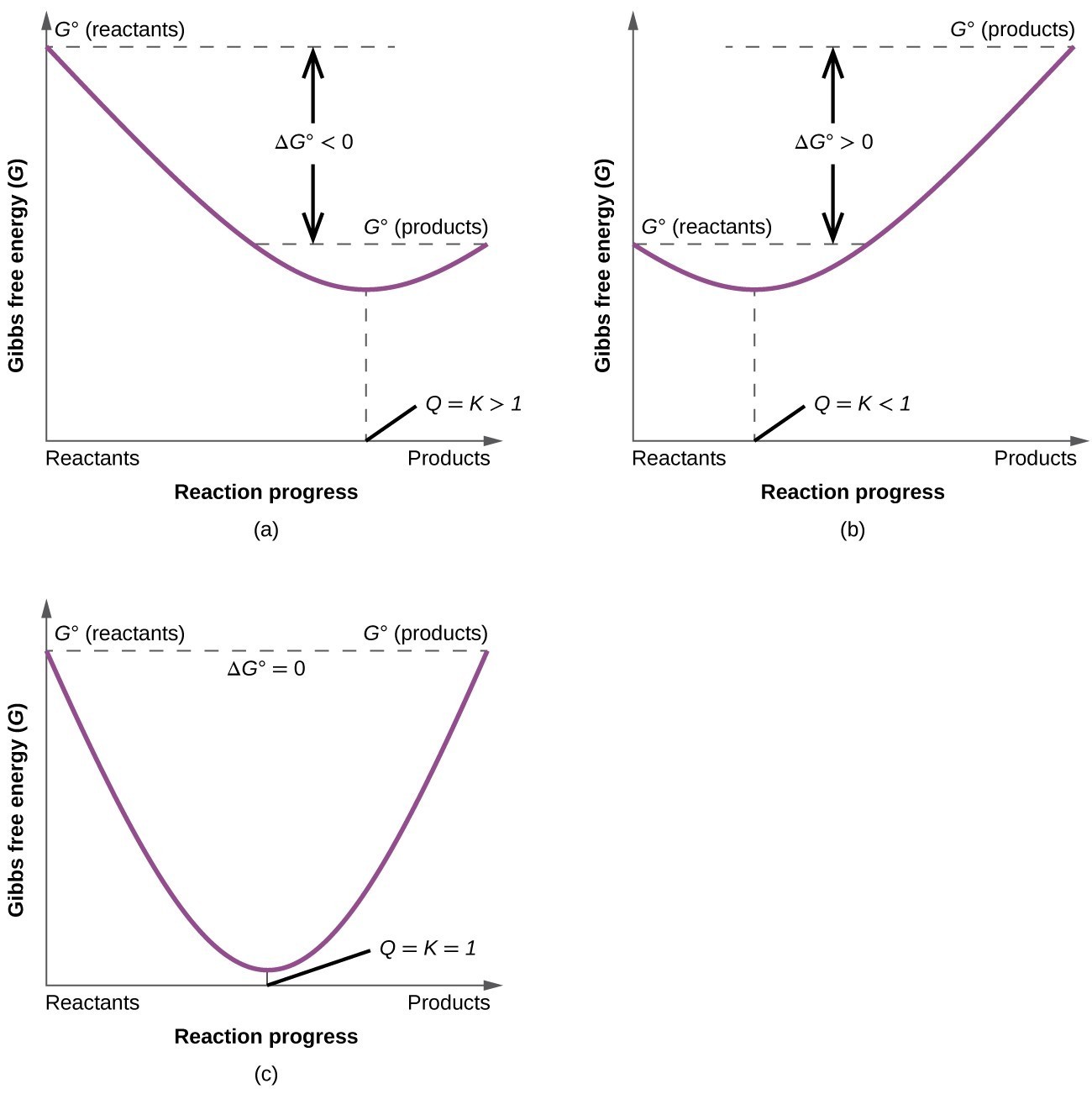
A reaction with a negative ΔG°' has its energy minimum shifted towards the products, meaning it will spontaneously proceed in the forward direction if it starts with equal concentrations of reactants and products. Conversely, a reaction with a positive ΔG°' has its energy minimum shifted towards the reactants.
5. Applying the Equation: A Worked Example
Let's put this into practice. A key step in glycolysis is the isomerization of glucose 6-phosphate (G6P) to fructose 6-phosphate (F6P).
G6P ⇌ F6P
At 25 °C (298 K), the equilibrium constant, K'eq, for this reaction is 0.5. Let's calculate ΔG°'.
-
Start with the equation:
-
Plug in the values. Remember to use the gas constant R in units of Joules (8.314 J·mol⁻¹·K⁻¹).
-
Calculate the result:
The positive value for ΔG°' indicates the reaction is endergonic under standard conditions. This means if you start with 1 M G6P and 1 M F6P, the net reaction will proceed in the reverse direction, towards G6P, to reach equilibrium.
Your Turn: Practice Calculation
Now, it's your turn to apply this principle. This problem is similar to what you might encounter in a typical biochemistry problem set.
Problem: At equilibrium at 25 °C (298 K), a reaction A ⇌ B + C has the following reactant concentrations: [A] = 3 mM, [B] = 4 mM, and [C] = 10 mM. What is the standard free energy change (ΔG°') for this reaction? Is the reaction endergonic or exergonic?
Follow these steps to solve it:
- Write the expression for the equilibrium constant, K'eq. Remember, it's products over reactants.
- Calculate the numerical value of K'eq. Be mindful of units, though they will cancel out in this ratio. It's good practice to convert all concentrations to Molar (M).
- Use the equation to calculate ΔG°'. Use R = 8.314 J·mol⁻¹·K⁻¹ and T = 298 K.
- Based on the sign of ΔG°', determine if the reaction is endergonic or exergonic.
Take a moment to work through the calculation.
Click here to see the solution
Step 1: Expression for K'eq
Step 2: Calculate K'eq
Step 3: Calculate ΔG°'
Step 4: Conclusion
Since ΔG°' is positive, the reaction is endergonic under standard conditions.
Conclusion
In this lesson, we established a crucial quantitative tool for analyzing biochemical reactions. You learned that the standard free energy change, ΔG°', provides a fixed benchmark for a reaction's intrinsic spontaneity, and that it is directly calculable from the equilibrium constant, K'eq, using the equation .
Key Takeaways:
- A negative ΔG°' corresponds to a K'eq greater than 1, indicating an exergonic reaction that favors products at equilibrium.
- A positive ΔG°' corresponds to a K'eq less than 1, indicating an endergonic reaction that favors reactants at equilibrium.
- ΔG°' tells us about the reaction under standardized conditions, not necessarily what is happening in the dynamic environment of a cell.
This foundation is critical. However, cells are not at standard conditions. The concentrations of reactants and products fluctuate wildly. So, how do we determine if a reaction is actually spontaneous inside a cell? In our next lesson, we will answer this by calculating the actual free energy change (ΔG) under non-standard cellular conditions, using the reaction quotient (Q).