Last lesson, Eurycleia recognized the disguised Odysseus by a scar whose history the poem paused to tell. She knew who the stranger was, but his return remained secret. Book 21 puts a different kind of evidence before the household: Odysseus’ bow. This time, identity will be demonstrated through an action, in front of the people occupying his hall.
The contest is also about authority. Penelope announces it, Telemachus oversees it, the suitors try to win it, and the supposed beggar asks to take part. Following those competing claims makes the famous shot more than a feat of archery.
A bow kept for home
Read “BkXXI:1-79 Penelope declares the contest” in A. S. Kline’s translation of Book 21. Allow about 6 minutes. Its opening sentence says Athena prompts Penelope; begin the linked passage as Penelope goes to retrieve the bow, and continue through the terms of her challenge.
Homer (c.750 BC) - The Odyssey: Book XXI
Read Kline’s translation to see why this particular bow, rather than any weapon, becomes the instrument of the contest.
In “BkXXI:1-79 Penelope declares the contest,” begin when Penelope retrieves and presents the bow. Notice the account of its former owner between the storeroom description and Penelope’s opening of the bow’s case. Continue through her announcement of what a successful suitor must do.
The bow has a history before Penelope brings it into the hall. Iphitus gave it to Odysseus when the two exchanged weapons as signs of friendship. Iphitus was later killed by Heracles while he was a guest in Heracles’ house—a stark violation of the guest-friendship the exchange had begun. Odysseus left the bow behind when he went to Troy and kept it as a memento to use at home. Like the scar in Book 19, the object comes with a story. Unlike the scar, it will allow Odysseus to perform something only he is expected to do.
Penelope weeps as she takes out her husband’s bow. Then she tells the suitors that whoever can string it and shoot through twelve aligned axes will win her hand, and that she will leave the house. Her words make this a marriage contest from her position: she faces the possibility of departing the home where she arrived as a bride. For Odysseus, who has returned to that home in disguise, it becomes a chance to take up a possession associated with his former place in it. The poem does not tell us here that Penelope knows the beggar is her husband. Her decision matters without requiring us to assume knowledge she has not disclosed.
Who can handle the master’s bow?
Next read “BkXXI:80-135 Telemachus sets up the axes” and “BkXXI:136-185 The Suitors try the bow.” Allow about 8 minutes, attending to the difference between Telemachus’ attempt and the suitors’ failures.
Homer (c.750 BC) - The Odyssey: Book XXI
Continue in Kline’s translation to follow the contest before Odysseus receives the bow.
In “BkXXI:80-135 Telemachus sets up the axes,” read the preparations and Telemachus’ attempt. Follow how he arranges the axes and why his fourth attempt ends. Then, in “BkXXI:136-185 The Suitors try the bow,” read the suitors’ attempts, ending after they warm and grease the bow.
Telemachus sets the axes in a straight line, astonishing people who have never seen him arrange them before. He nearly strings the bow on his fourth attempt, but Odysseus checks him with a gesture. Telemachus’ frustrated speech calls himself weak; the narrator’s account is more encouraging. He is growing capable of handling his father’s things, even though this is not the moment for him to complete the test. The reason for Odysseus’ signal is not stated outright. Keeping the decisive attempt for himself is a plausible strategic reading.
The suitors, by contrast, have made themselves at home without being able to master the absent householder’s weapon. Antinous remembers that Odysseus had no equal among them, yet hopes to succeed himself. When the bow proves difficult, the young men warm and grease it; those who try still cannot string it. Their failure does not prove that physical strength alone confers a right to rule. Rather, it exposes the gap between their occupation of the household and their claim to replace its master. They consume its food and challenge its son, but the contest confronts them with a possession they cannot use.
Getting the bow into the stranger’s hands
The bow cannot demonstrate anything until someone gives the apparent beggar a turn. Listen to two short portions of the Book 21 reading credited to Dan Stevens, provided by the Zsuzsanna Uhlik channel. Allow about 5 minutes. The first reconnects this scene to the scar; the second shows Penelope and Telemachus responding to the stranger’s request. Between the selected passages, Odysseus asks to try the bow and the suitors object.
The Odyssey by Homer - Book Twenty-one: The Test of the Bow (read by Dan Stevens)
Listen to “The Odyssey by Homer - Book Twenty-one: The Test of the Bow” to hear how Odysseus gathers allies while remaining disguised before the suitors.
In the herdsmen scene, Odysseus privately reveals his scar to Eumaeus and Philoetius, then assigns them tasks. Skip ahead to the disputed turn, where Penelope defends the stranger’s opportunity to try and Telemachus asserts his authority over the bow. Focus on the different reasons each gives for letting him handle it.
Odysseus shows the scar to Eumaeus and Philoetius as evidence that the stranger is their master. Their recognition turns into practical cooperation: Eumaeus is to bring him the bow, while the hall and courtyard exits are to be secured. This is another step beyond Eurycleia’s private discovery. People who know Odysseus is home can now act on that knowledge, though the suitors still cannot.
Penelope objects to the suitors’ treatment of Telemachus’ guest and supports letting him try. She does not propose marrying him if he succeeds; she speaks instead of gifts and safe passage. Telemachus then claims the authority to decide who may handle the bow and sends her upstairs. The moment is not simply a passing of power from mother to son. Penelope has chosen the contest and defended the guest, while Telemachus now directs access to the weapon. Both actions make Odysseus’ attempt possible. At the same time, Telemachus’ command shows the limits placed on Penelope’s participation: she will not witness the shot.
A shot before a declaration
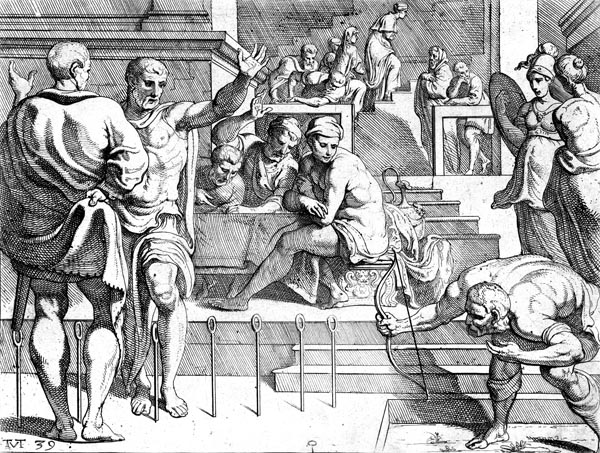
Read “BkXXI:359-403 Odysseus receives the bow” for the conclusion of Book 21. Allow about 6 minutes. The image below depicts a later artist’s interpretation of this crowded hall; it helps locate the bow and axes but cannot settle the precise physical arrangement of the axes in Homer’s description.
Homer (c.750 BC) - The Odyssey: Book XXI
Return to Kline’s translation for the contest’s decisive action and the final positioning of father and son.
In “BkXXI:359-403 Odysseus receives the bow,” begin as Eumaeus carries the bow. Read to the end of the book. Pay particular attention to Odysseus’ inspection of the bow, the comparison used when he strings it, and what Telemachus does after the shot.
The suitors threaten Eumaeus as he carries the bow, but Telemachus insists that he deliver it. Eurycleia locks the hall doors, and Philoetius bars the courtyard gates. These details change the meaning of the contest as it unfolds. The suitors still treat the stranger’s attempt as something they can mock; Odysseus and his allies have prepared the room for a confrontation.
Odysseus examines the bow for damage after its long storage. The suitors take his careful handling as another reason to jeer. Then the narrator makes an unexpected comparison: Odysseus strings it as readily as a skilled musician fits a string to a lyre. The string gives a clear note when he plucks it. This is practised mastery, not a description of brute force alone. His strength matters, but so do his familiarity with the object and the control with which he uses it. Zeus’ thunder follows as a sign that pleases Odysseus; it accompanies, rather than substitutes for, the work Odysseus and his allies have done.
Still seated, he sends an arrow through the aligned axes. The exact shape of their openings is less important to this reading than the feat the poem establishes: the line has been prepared, others have failed even to string the bow, and Odysseus completes both parts of Penelope’s test. He has not yet won peaceful recognition from everyone present. The suitors can see what he has done without immediately accepting who he is.
His next words keep up the language of a guest, telling Telemachus that the stranger in his hall has not disgraced him. Yet he also says that his strength has not diminished, and his signal brings Telemachus to his side, armed. The action has spoken before Odysseus names himself publicly. Where the scar allowed trusted individuals to recognize a hidden man, the bow displays his capacity to act as this household’s master. Demonstrating that claim and securing it are not the same thing.
Looking ahead
Book 21 turns an object kept at home into a public test. Penelope establishes the challenge; Telemachus and loyal servants make Odysseus’ attempt possible; the suitors fail to use the bow; and Odysseus handles it with strength and skill. The shot establishes his claim in action, but it also places a weapon in his hands inside a sealed hall.
The next lesson examines what follows in Book 22 and why the restoration of a household does not end the poem’s difficulties. Book 23 will then bring a different test of identity: one grounded not in a public feat, but in knowledge shared by Odysseus and Penelope.