Last time, Penelope tested the disguised Odysseus’ story without openly identifying its teller. Her decision to have Eurycleia wash the guest’s feet brings a different kind of evidence into play: a scar known to the woman who cared for him as a child.
This lesson follows the instant when Eurycleia recognizes him—and the surprising way the poem tells it. Just as the household’s secret is about to break, the narrator leaves the foot washing to recount how Odysseus acquired the scar. That interruption makes his concealed identity inseparable from a life that began long before Troy or the voyage home.
A mark that his disguise cannot conceal
Read the foot-washing scene in A. S. Kline’s translation of Book 19. Allow about 12 minutes to read and notice where the action in Penelope’s house gives way to the story of Odysseus’ youth.
Homer (c.750 BC) - The Odyssey: Book XIX
Read the scar-recognition passage in A. S. Kline’s translation of Homer’s Odyssey. It supplies both the event in the household and the childhood story inserted into it.
In “BkXIX:361-475 Eurycleia recognises Odysseus,” read the foot washing and recognition, finishing Eurycleia’s final sentence. Watch for the moment Eurycleia notices the scar, where the narrator begins recounting its origin, and where the scene returns to the basin.
Eurycleia first sees a resemblance in the stranger’s looks, voice, and feet. Odysseus can answer that observation without admitting anything: other people, he says, have noticed the likeness too. But he moves away from the fire because he expects her hands to find the scar. His clothing and words can support a false identity; the old wound is harder to explain away to someone who knows him intimately.
The narrator says Eurycleia knows the scar as she begins washing him. Instead of immediately showing her response, however, the poem turns to the wound’s origin. Only after the childhood account does her foot-washing motion finish: Odysseus’ foot strikes the basin, water spills, and she addresses him as the child she once nursed. The interruption occurs between recognition and its visible, audible consequences. It takes time in the telling, not in the room.
The life contained in the scar
The childhood account begins even before the hunt. Odysseus’ maternal grandfather, Autolycus, is associated with theft, oaths, and the god Hermes. When Eurycleia places the infant on his knees, Autolycus gives him his name, linking it in this translation to suffering wished upon others. Later, the young Odysseus visits his grandfather’s household. His relatives welcome and feast him, then take him hunting on Parnassus.
Odysseus attacks a boar, but it wounds him above the knee before he kills it. His relatives tend the injury and send him back to Ithaca with gifts. There, his parents ask what happened, and he tells them the story of the wound. The scar is therefore more than a convenient identifying mark. It has a history involving a name, a family welcome, an act of courage, an injury, and an earlier return home.
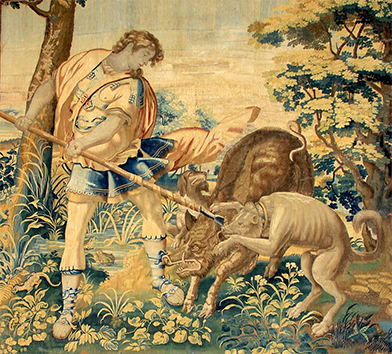
The embedded story also sharpens the contrast between the two homecomings. After the hunt, Odysseus can go home openly, receive his parents’ questions, and explain his wound. After Troy and his wanderings, he reaches that same island but must hide who he is inside his own household. Eurycleia’s touch brings evidence of the earlier Odysseus into the dangerous present. The narrator gives us the wound’s full story; Eurycleia recognizes its mark through her own longstanding knowledge of him.
Why linger when the secret is at risk?
Literary critic Erich Auerbach makes the length of this interruption central to his reading of the scene. Allow about 8 minutes for the relevant part of the opening chapter of Mimesis.
[PDF] Erich Auerbach, Mimesis - Centre for Comparative Literature
Read Erich Auerbach’s account of why Homer pauses over the scar’s origin at the very moment of recognition. His interpretation helps distinguish an extended epic digression from a brief explanatory flashback.
In Chapter 1, “Odysseus’ Scar,” move past the opening account of the foot washing. Begin Auerbach’s analysis and stop where he says the scar and a portion of the hero’s boyhood must be brought into full light, just before he turns to an example from the Iliad. Focus on his distinction between prolonging suspense and allowing the past episode to occupy the narrative fully.
Auerbach argues that the hunt is not principally a device for keeping us anxious about what Eurycleia will say. Its detailed welcome, feast, chase, injury, healing, and journey back become the poem’s immediate subject for a while. On his account, Homer does not let the scar appear as an unexplained object from an obscure past: the narrative gives that past a scene of its own.
This is an illuminating interpretation, though it need not settle every reader’s experience. The pause can give the hunt its own fullness and leave us aware that Eurycleia has discovered a secret. When the basin rings, the return narrative resumes with greater force: the scar now carries everything the intervening story has attached to it. The disguise has hidden Odysseus’ present appearance, but it cannot erase the history inscribed on his body.
Recognized, but not yet revealed
Eurycleia’s recognition does not become a household-wide announcement. Listen to the short continuation of Book 19, allowing about 2 minutes.
The Odyssey by Homer - Book Nineteen: Recognitions and a Dream (read by Dan Stevens)
Listen to the continuation of “The Odyssey by Homer - Book Nineteen: Recognitions and a Dream,” uploaded by Zsuzsanna Uhlik, to hear how the discovery is contained.
In the aftermath, listen for the falling foot and spilled water, Eurycleia’s response, Athena’s part in keeping Penelope unaware, and Odysseus’ demand for silence.
Eurycleia’s joy is mixed with pain, but Odysseus urgently prevents her from telling Penelope. The moment is tender because the former nurse knows the child beneath the stranger’s disguise; it is also tense because he treats secrecy as essential to surviving the suitors. Recognition and disclosure are different events. Eurycleia now knows who the guest is, while Penelope remains outside this revelation.
That difference connects the scar scene to the larger homecoming. Odysseus has physically returned, and someone who knew him before his adventures has confirmed his identity. Yet he still cannot inhabit his house openly. His past proves who he is at precisely the moment when his present circumstances require him to conceal it.
Looking ahead
Book 19 interrupts a perilous instant of recognition to tell how a childhood wound was made. The digression links Odysseus’ name, family, injury, and first return to Ithaca with the scar Eurycleia feels decades later. Her recognition confirms that the stranger is Odysseus, but his enforced silence shows how far he remains from an open homecoming.
In Book 21, the bow contest will put another sign of Odysseus’ identity before the household—one tied not only to who he was, but to his claim to act as its master again.