Last lesson, Odysseus strung the bow that the suitors could not and made his claim to the household visible through a public feat. In Book 22, he kills the suitors. Yet reclaiming the hall does not mean that Penelope must immediately accept the man in it as her husband.
Book 23 gives her a test of her own. Its answer lies not in strength or appearance but in a detail of the marriage bed—a detail that Odysseus and Penelope share. We will follow what she says, what he reveals, and why the exchange allows their reunion.
Why Penelope waits
Read “BkXXIII:85-140 Penelope’s uncertainty” in A. S. Kline’s translation of The Odyssey, Book 23. Allow about 4 minutes.
Homer (c.750 BC) - The Odyssey: Book XXIII
Read Kline’s translation to see what Penelope says she needs before accepting Odysseus.
In “BkXXIII:85-140 Penelope’s uncertainty,” begin where Penelope comes downstairs, at “So saying, she left her room, and went downstairs,” and read through Odysseus’ response. Stop after his words to Telemachus that she will soon be enlightened. Notice the distance between where the two sit, and Penelope’s explanation of how they can recognize one another.
Penelope studies the man across the room. She is not sure whether to keep her distance and question him or to embrace him. Telemachus calls her hard-hearted, measuring her response against the welcome he thinks a returning husband deserves. Penelope answers that she is overwhelmed, but adds something more precise: she and Odysseus have a better way to recognize one another, through secret tokens known to them.
This distinction matters. Other people have had reasons to identify Odysseus. Eurycleia recognized his scar; Telemachus has acted alongside him; the suitors saw him use the bow. Penelope’s question is not whether something extraordinary has happened in the hall. It is whether the man before her is the person with whom she made a life there. His newly restored appearance cannot answer that question by itself.
Odysseus, for his part, tells Telemachus to let her put him to the proof. They do not yet know what form that proof will take. The scene gives Penelope room to act rather than requiring her to accept the assurances of her son or the returning man.
A request that cannot be carried out
Read “BkXXIII:141-204 The Marriage-Bed” next. Allow about 7 minutes, taking particular care with Penelope’s instruction to Eurycleia and Odysseus’ answer.
Homer (c.750 BC) - The Odyssey: Book XXIII
Continue in Kline’s Book 23 translation for the test itself: a seemingly ordinary household instruction draws out the bed’s hidden history.
In “BkXXIII:141-204 The Marriage-Bed,” start at “They listened readily to his orders and obeyed.” Read to Odysseus’ final fear that someone has shifted the bed elsewhere. Follow the contrast between the dancing heard outside, Odysseus’ transformed appearance, and the construction details he supplies in reply to Penelope.
Outside the room, music and dancing lead passers-by to think a wedding is taking place. Inside, the existing marriage has not yet been securely restored. Odysseus has bathed, dressed, and been made more imposing through Athena’s help, but Penelope still holds back. In frustration, he asks Eurycleia to prepare him a bed alone.
Penelope then gives Eurycleia a different instruction: bring out the great bed from the bridal chamber and make it up. The narrator makes her purpose explicit: these are words to test her husband. She does not announce that the bed is impossible to move. She asks for it to be moved and waits to hear what the man will say.
Odysseus reacts angrily. He built the room around an olive tree and fashioned part of its rooted trunk into a bedpost. He then constructed and adorned the bed around that fixed point. Moving it would require someone to cut through the trunk. His answer supplies both a practical explanation and the personal history of an object he made for their shared room.
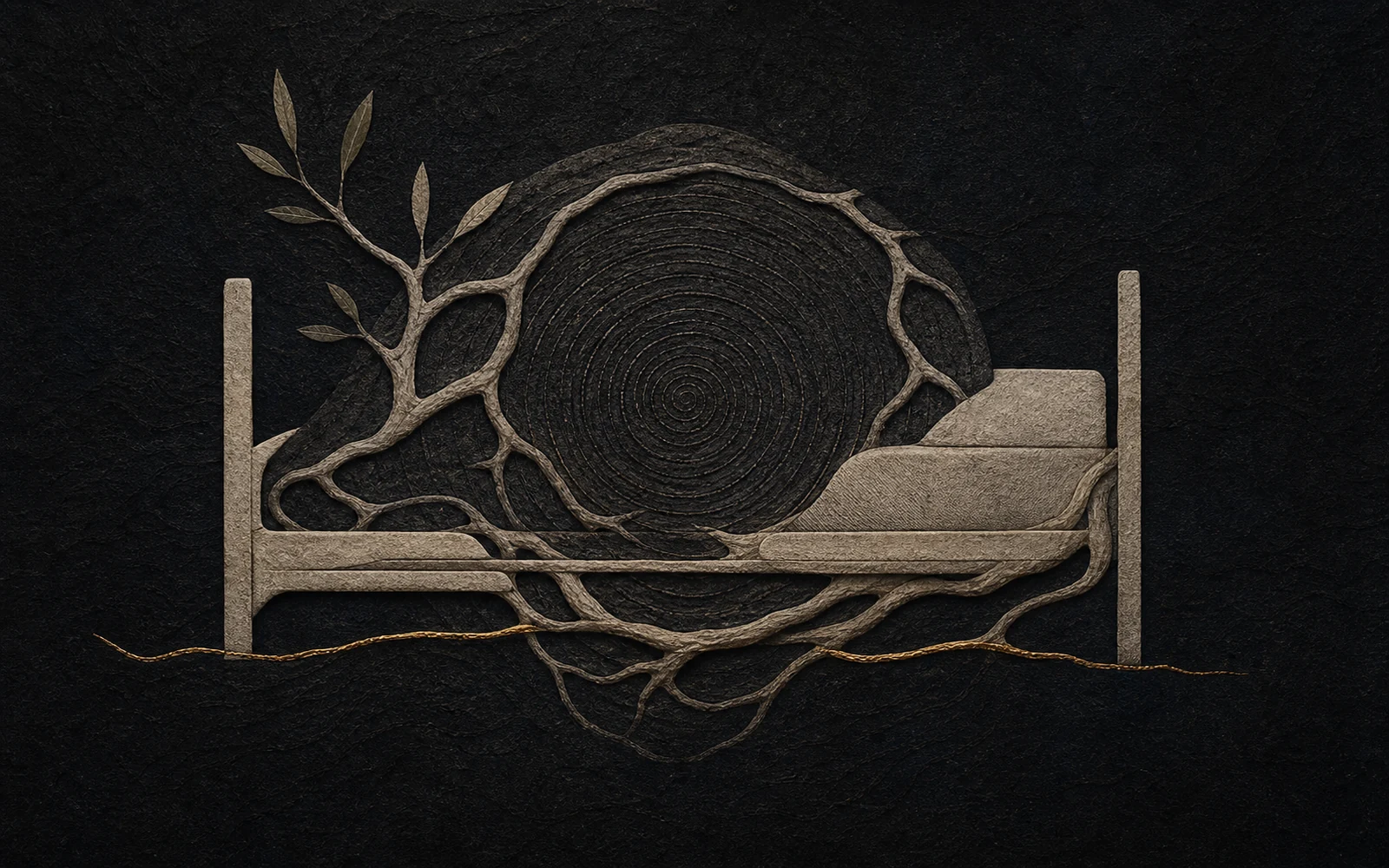
Penelope’s cunning lies in the indirectness of her request. A direct demand—“Describe the bed you made”—would tell a possible impostor what knowledge she was seeking. Instead, she speaks as though the bed were ordinary furniture. Odysseus’ protest brings out the secret, but also its emotional force. He does not merely recite construction details: he is alarmed by the possibility that someone has altered the room and cut away the rooted post.
That response need not be treated as an infallible test by modern standards. The poem will tell us that one other person knew the secret. Its force in the scene comes from the specific knowledge Odysseus reveals and from Penelope’s recognition of what his account means.
Recognition belongs to both of them
Read “BkXXIII:205-246 Penelope is convinced” through the reunion simile. Allow about 4 minutes.
Homer (c.750 BC) - The Odyssey: Book XXIII
Read Penelope’s reply and the reunion to see how the poem explains her caution rather than simply ending it.
In “BkXXIII:205-246 Penelope is convinced,” begin at “As he spoke, revealing the unchanged truth she knew.” Read through the comparison with sailors reaching land. Stop before the paragraph about Dawn. Attend to Penelope’s reason for delaying her welcome and to whom the poem compares her as she embraces Odysseus.
Penelope embraces him only after hearing the bed’s true history. She explains that she feared someone might deceive her with words, and says that the bed’s secret was known to Odysseus, herself, and a maidservant who guarded their chamber. Her caution has not meant indifference. It has been a way of protecting her judgment when accepting the wrong person would be consequential.
The test also lets Penelope show a resourcefulness akin to Odysseus’ own. His cunning often works by controlling what another person knows about his identity. Here he is the one who must respond to another person’s carefully chosen words. Penelope creates the conditions for recognition; Odysseus completes it by telling the story only the two of them can fully place in their shared past.
The bed joins several meanings of home without reducing them to one. It is a crafted object, made by Odysseus; it stands in the room built around it; and its history belongs to their marriage. The rooted olive trunk makes that history physically difficult to separate from the house. In Book 21, Odysseus’ skill with the bow made his claim visible before others. In Book 23, a private account of how he made the bed allows Penelope to recognize the person making that claim.
Finally, the poem compares Penelope’s sight of Odysseus to the sight of land for shipwrecked sailors. A long-awaited homecoming is felt from her side, too. Odysseus has struggled to reach Ithaca, while Penelope has lived through the uncertainty of whether he would return and whether she could trust a supposed return. Their embrace answers both experiences for this moment.
What the test establishes
Penelope does not simply refuse to believe or suddenly give in. She devises a test that depends on shared knowledge, and Odysseus’ account of the rooted bedpost gives her grounds to welcome him. Their recognition is mutual: her cunning calls forth his memory, and his answer convinces her.
The reunion settles the question between the couple, but not every consequence of the return. The final lesson will consider the violence in the household and the peace imposed in Book 24 when deciding how secure Odysseus’ homecoming really is.