Welcome back. In Book 23, Penelope’s marriage-bed test gave her grounds to recognize Odysseus. Their reunion restored a relationship, but it did not settle what his return had done to everyone else. The suitors’ deaths leave a hall to clean, families to mourn, and a community at risk of further fighting.
This final lesson returns to selected passages in Book 22, then follows the consequences into Book 24. The aim is to defend a reading of the homecoming without treating either the reunion or the violence as the whole story. Allow about 40 minutes for the readings and commentary.
Victory in the hall
Odysseus’ success with the bow in Book 21 established that he could perform the feat the suitors could not. In Book 22, the contest becomes a killing. Read the opening confrontation closely, especially the different accounts of what the suitors have done and what might now count as restitution.
Homer (c.750 BC) - The Odyssey: Book XXII
Read A. S. Kline’s translation of Book 22 to examine how Odysseus announces his return and rejects an offer of compensation.
In “BkXXII:1-67 The death of Antinous,” read the confrontation, from Odysseus throwing off his disguise through his answer to Eurymachus. Focus on Odysseus’ charges against the suitors, Eurymachus’ attempt to place the blame on Antinous, and Odysseus’ refusal to spare the others.
Odysseus does not present the killings as a dispute over wasted food alone. He charges the suitors with consuming his household’s wealth, pursuing Penelope while he lives, and violating obligations to gods and people. Their treatment of a man they believed to be a poor stranger has already shown what kind of guests they are. Eurymachus nevertheless proposes a different settlement: Antinous, now dead, was chiefly responsible; the rest will repay what they took.
Odysseus rejects even the offer of their entire property. That refusal has two possible emphases. It makes sense within the poem’s account of the suitors’ sustained wrongdoing: repayment cannot undo their conduct toward the household. It also marks the moment when the possibility of a nonlethal settlement closes. The suitors’ guilt explains why Odysseus fights them; it does not require you to pass over the scale of what follows.
Who receives mercy, and who does not
The battle does not end in a single indiscriminate sweep. Once the suitors are defeated, people in the hall appeal to Odysseus for their lives. The different answers matter when assessing the justice claimed for his return.
Homer (c.750 BC) - The Odyssey: Book XXII
Continue in Kline’s Book 22 to compare the treatment of suppliants with the punishment of twelve enslaved women of the household.
In “BkXXII:310-377 Leodes and Phemius,” read the appeals for mercy, beginning with Leodes’ plea and ending when Odysseus sends Phemius and Medon outside. Then find the short exchange immediately before “BkXXII:433-501 Telemachus executes the serving-women”: read Eurycleia’s account of the women. Read the cleanup and punishments through the end of that subsection. Attend to who gives each order and who changes the manner of execution.
Leodes, the suitors’ priest, says that he tried to restrain their wrongdoing. Odysseus reasons instead that a man serving the suitors must have wished for Odysseus’ return to fail, and kills him. The poem gives us Leodes’ claim and Odysseus’ judgment, not independent proof of every thought Leodes held. By contrast, Telemachus speaks for the singer Phemius, who says he was compelled to perform, and for Medon, who cared for Telemachus as a child. Odysseus spares them. He can distinguish among people found in the suitors’ company, though his decisions remain consequential judgments made in anger.
Eurycleia then identifies twelve of the household’s fifty enslaved women as having behaved disrespectfully toward Penelope and herself. Odysseus orders that they help remove the bodies and clean the hall before they are killed by the sword. Telemachus changes the means of execution: saying they will not die “cleanly,” he hangs them. The sequence turns a restoration of order into an ordeal for people who have no power to refuse the work or the punishment. The poem gives these women no individual defense comparable to the appeals made by Leodes and Phemius.
Care is needed here. Earlier in Book 22, Odysseus accuses the suitors of forcing women of his household; later, Eurycleia condemns these twelve for their conduct, and Telemachus speaks of their sleeping with the suitors and scorning his family. The text does not establish the circumstances of each woman’s sexual relationship. It would exceed the evidence either to assert that all twelve freely chose it or to claim that the poem explicitly acquits them all. What is clear is the difference in power: they are enslaved, and the returning household judges and executes them without hearing them speak.
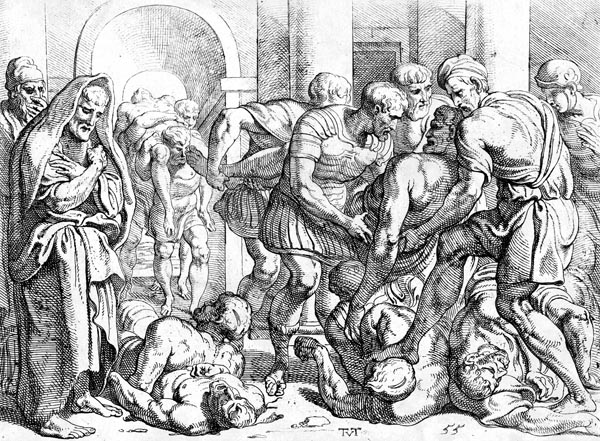
Afterward, Odysseus orders fire and sulphur to purge the palace. The cleansing marks his wish to make the household fit to inhabit again. It cannot reverse the deaths that made the cleanup necessary. Book 22 thus supports two truths at once: the suitors’ occupation ends, and the manner of its ending leaves a moral burden on the homecoming.
The deaths become a public matter
A household is not an island unto itself. In Book 24, news spreads, relatives retrieve the suitors’ bodies, and the people gather in assembly. Odysseus has regained his home, but he has not yet secured peace with the people whose sons and brothers were killed there.
The next reading uses A. T. Murray’s translation, rather than Kline’s. The English appears below the Greek text on the page; use the English line numbers to locate the passage.
Odyssey, Book 24 — Greek Text & English Translation
Read the English translation of Book 24 on The Homer Reader to see how the killings are judged outside Odysseus’ household.
Below the Greek text, find the English passage at approximately lines 412-486. Read the assembly and Zeus’ plan, from the report spreading through the city to Zeus’ proposed peace. Follow the disagreement between Eupeithes and Halitherses, then note precisely what Zeus wants Athena to bring about.
Eupeithes, father of the slain Antinous, urges revenge. His speech is not a neutral history: he speaks in grief, blames Odysseus for the men lost on his voyage as well as the suitors killed at home, and fears the shame of leaving their deaths unavenged. Halitherses answers that the families failed to stop their sons when warned of their reckless behavior. Neither man speaks for everyone. More than half the assembly follows Eupeithes, while the others remain behind. Ithaca is divided, despite the suitors’ defeat.
The disagreement gives public form to a tension present throughout the epic. In Book 1, Zeus’ account of Aegisthus warned against placing all responsibility for human wrongdoing on the gods. Here, Medon says he saw divine support for Odysseus, and Halitherses recalls the suitors’ choices and their families’ failure to restrain them. Divine involvement does not erase human responsibility. Yet it also does not, by itself, persuade every bereaved relative to accept what happened.
Zeus proposes that Odysseus remain king, that both sides swear an oath, and that the gods bring about a forgetting of the killings so affection, prosperity, and peace can return. This is a striking plan: peace requires more than Odysseus’ victory, but its decisive terms come from above, not from an agreement reached in the assembly.
Peace imposed at the edge of another battle
Odyssey, Book 24 — Greek Text & English Translation
Finish Murray’s translation of Book 24 to distinguish Athena’s first call to stop from what finally makes Odysseus stop.
In the English text, read approximately lines 495-548, beginning the final clash. Notice Laertes’ action, the response to Athena’s first command, Zeus’ thunderbolt, and the covenant in the closing sentence.
The fighting has already resumed when Athena intervenes. Laertes kills Eupeithes; Odysseus and Telemachus press their attack. Athena orders the Ithacans to separate, and the opposing fighters drop their weapons. Odysseus, however, charges after them. Only after Zeus casts a thunderbolt and Athena addresses him does he obey and stop. The poem says that Athena then establishes a solemn covenant between the sides.
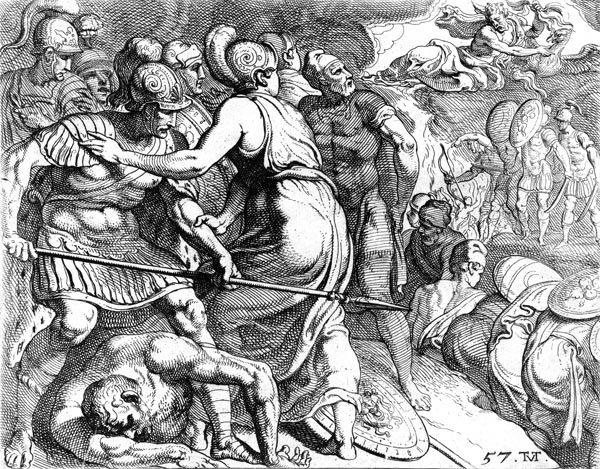
This ending gives strong grounds for calling the homecoming secure. The threatened cycle of retaliation is stopped; Odysseus remains king under Zeus’ plan; and the poem closes with a covenant described as lasting “for all time to come.” It does not narrate another attack or invite us to invent one after the final line.
It also gives grounds for calling the homecoming unsettled in another sense. The families’ grief and the division in the assembly are real parts of the ending. Athena must halt not only the avengers but Odysseus himself, after he pursues men already retreating. The gods can establish peace in the story, but the text does not show the parties working through their losses together. Zeus’ proposed forgetting answers the danger of renewed violence without answering every ethical concern raised by Book 22.
A defensible reading of the homecoming
The strongest interpretation need not choose between denying the peace and denying the violence. One defensible claim is that Odysseus’ return is politically secured but ethically unsettled. Book 22 shows why the suitors’ conduct calls for an end to their hold on the household, while the killing of suppliants and the hanging of enslaved women complicate an uncomplicated celebration of its cleansing. Book 24 then shows grief becoming a collective threat. Athena’s covenant stops that threat, even though peace has to be imposed upon a divided community and, at the last moment, upon Odysseus.
A different reading could put greater weight on the poem’s final assurance: divine authority, an oath, and the promise of enduring peace make this a genuinely completed homecoming. That reading still has to account for the passage in which Odysseus continues his attack after Athena first calls a halt. Conversely, an unsettled reading has to acknowledge that the poem does end with a covenant, not with battle left in progress. A defended interpretation is one that lets both kinds of evidence exert their full force.
Across the epic, “home” has meant a place to reach, a household to reclaim, and relationships to recognize. The marriage bed in Book 23 gives Odysseus and Penelope a private assurance grounded in what they share. Books 22 and 24 show why private recognition is not the whole of a homecoming: restoring the house also changes the lives of people within it and beyond its walls. The poem ends in peace, while leaving the cost of reaching it available for judgment.