Welcome back. The previous lesson showed how the Odyssey’s opening announces both Odysseus’ resourcefulness and his companions’ deaths. Book 1 soon adds a sharper problem: when people suffer, how much is the work of gods, and how much follows from human choices? Zeus raises that problem through a story about another homecoming, the murder of Agamemnon.
Allow about 40 minutes for the passages, short video, and close reading below.
A warning ignored
Begin with Zeus’ speech and Athena’s immediate response in the Book 1 excerpt from Charles Weiss’s Homer’s Odyssey. This translation lets you follow the argument before considering what it might mean for Odysseus.
Part One (Books 1–4): The 'Telemachy'
Read the Book 1 passage in Charles Weiss’s Homer’s Odyssey for Zeus’ account of Aegisthus and Athena’s reply. Read the short notes beneath it for the family-story parallel and the meaning of “recklessness.”
On p. 15, under “Book 1,” begin at line 1.27, where “The father of men and gods began to speak.” Read Zeus’s account through line 1.43. Continue from Athena’s judgment that Aegisthus deserved his death through her description of Odysseus’ isolation: Athena’s reply, lines 1.45–1.50. Below the passage, read the notes beginning “Orestes made famous in Greek literature” and ending with the explanation that recklessness means failing to heed a warning: the notes.
Zeus begins with a complaint: mortals blame the gods for misfortunes that result from their own recklessness. His example is Aegisthus. While Agamemnon was away at Troy, Aegisthus pursued Agamemnon’s wife and then killed Agamemnon when he returned. The gods had sent Hermes to warn Aegisthus against both acts, including a warning that Agamemnon’s son Orestes would take revenge. Aegisthus proceeded anyway, and Orestes killed him.
The warning makes Zeus’ point more precise than “people cause their own suffering.” Aegisthus was told what not to do and what the consequence would be. Hermes did not force him to stop; Aegisthus did not stop. Divine intervention supplied knowledge, while the decisive misconduct remained his choice. Weiss’s note identifies the Greek word translated “recklessness,” atasthalia, with this failure to heed a warning. It is a useful term to retain as the poem presents other decisions and their costs.
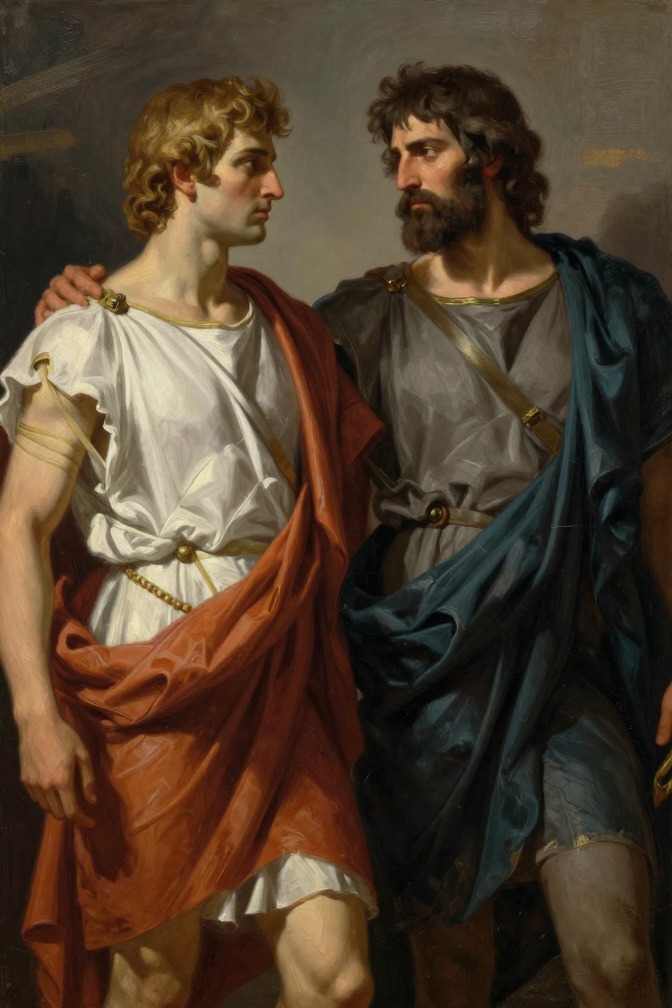
The difference between the image and the poem’s telling matters. The Odyssey does not open by showing Orestes’ revenge. It lets Zeus select and recount that event as evidence for an argument about blame.
The example and its limits
Zeus’ account offers an initial framework for judging events in the epic: attend to warnings, choices, and consequences before attributing every loss to divine power. The poem’s invocation has already said that Odysseus’ companions perish after eating the Sun god’s cattle and has called their conduct reckless. Aegisthus gives that opening claim a second, more detailed instance: someone proceeds despite a warning and suffers a foreseeable consequence.
The video excerpt revisits this opening exchange. Use it to hear how the gods’ council places a question about responsibility near the start of a poem filled with divine action.
The Odyssey doesn't start with Odysseus | Odyssey Book 1
Watch the gods’ council discussion in WINNOW’s The Odyssey doesn’t start with Odysseus | Odyssey Book 1. It connects Zeus’ example to the poem’s wider treatment of divine intervention and human responsibility.
Watch Zeus’s example. Focus on the distinction between a god’s warning and a mortal’s response, rather than treating Zeus’ speech as a rule that explains every misfortune in advance.
Athena’s reply immediately tests the reach of Zeus’ argument. She agrees that Aegisthus deserved his death, then turns to Odysseus, who is stranded far from those he loves. Her move is not to say that Odysseus ignored a warning like Aegisthus. She asks the gods to consider a sufferer whose predicament involves divine power. The shift prevents us from applying Zeus’ complaint indiscriminately: suffering alone is not evidence of guilt.
There is a further complication. The gods are not merely commentators on mortal decisions. They sent Hermes to warn Aegisthus; Orestes’ revenge is the consequence Hermes foretold; and, in the council that follows, divine action will matter to Odysseus’ return. The poem can therefore give mortals responsibility for what they choose without making the gods irrelevant. Aegisthus’ story distinguishes a warning from compulsion, not a human world from a divine one.
Hearing Zeus as a speaker, not a final verdict
The Dickinson College Commentary presses this complication further. Read its interpretation as an argument to weigh against the passage, not as a replacement for Zeus’ words.
1.1–43 | Dickinson College Commentaries
Read the interpretive discussion in Dickinson College Commentaries’ “1.1–43.” It challenges the idea that Zeus’ speech proves the gods consistently enforce one moral code throughout the Odyssey.
In the essay on Book 1, lines 1–43, find the paragraph beginning “We might be tempted to see this speech as a reflection of divine justice in the poem.” Read the interpretation through the paragraph’s closing claim about human moral agency. Focus on the distinction between Zeus’ judgment in this case and a claim about how every god behaves.
The commentary cautions against turning Zeus’ complaint into a complete theory of divine justice. Gods in the poem have preferences and take sides; their interventions do not always look like the even-handed enforcement of a single rule. That caution does not make Zeus’ account meaningless. Within his chosen example, the ignored warning clearly matters. It does mean that Zeus’ speech is a perspective voiced by a character in the story, however powerful that character is.
A careful reading can hold both observations together. Aegisthus’ conduct supports Zeus’ charge of recklessness. Athena’s concern for Odysseus shows why the charge cannot simply be transferred to everyone in distress. And the gods’ own actions remain part of the circumstances in which human decisions are made.
The murdered Agamemnon also supplies an uneasy parallel to the absent Odysseus: both are men associated with a return from Troy, and a son’s place in the household matters to each story. The parallel invites attention to what may await Odysseus at home, but it does not declare that the two households—or their members—are identical.
Takeaway
Zeus uses Aegisthus to argue that mortals can incur suffering through reckless choices made despite divine warning. The example gives you a way to assess responsibility in later episodes, but Athena’s immediate turn to Odysseus limits any simple conclusion that sufferers deserve their fate. In the Odyssey, divine intervention and human agency must be judged together, case by case.
Next, Book 1 brings Athena from the council to Odysseus’ household in disguise. Telemachus’ reception of an unknown visitor will make hospitality another way to judge conduct while the household’s future remains uncertain.