Zeus’ story of Aegisthus gave us one way to judge conduct in the Odyssey: notice what people know, what they choose, and how the gods intervene. Athena now leaves the gods’ council and arrives at Odysseus’ house in disguise. Before she offers Telemachus any guidance, he must decide how to treat someone whose identity and intentions he does not know.
This lesson takes about 40 minutes. You will read Telemachus’ reception of the visitor, learn the obligations of xenia (guest-friendship), and use them to interpret the contrast between his welcome and the suitors’ feast.
A stranger at the door
Athena appears as Mentes, a visitor who claims to have ties to Odysseus’ family. Telemachus does not know that a goddess has arrived. He sees a stranger waiting while the suitors occupy the household.
Read the scene before assigning motives to anyone in it.
Homer (c.750 BC) - The Odyssey: Book I
Read the opening reception scene in the Poetry in Translation version of Book 1. It shows hospitality as a sequence of actions rather than a declaration of goodwill.
In “BkI:96-155 Athene visits Telemachus,” begin at Athena’s arrival and continue through the suitors’ feast and the singer’s introduction. Track who notices the visitor, when Telemachus asks about her purpose, and who supplies the food and drink.
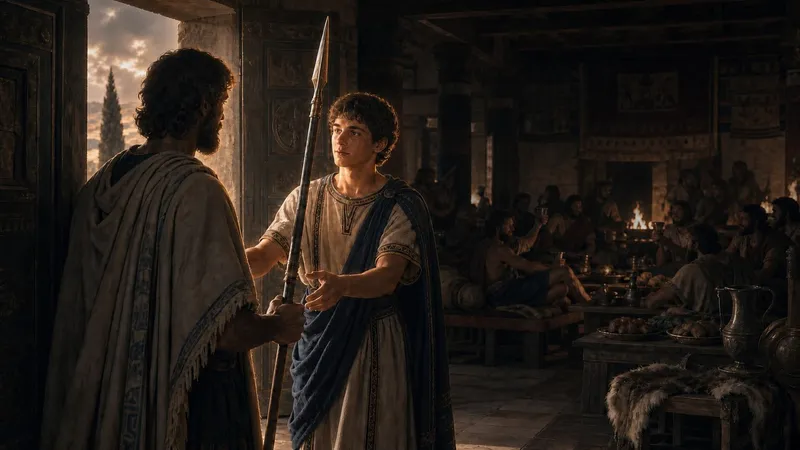
Telemachus is grieving and imagining his father’s return when he notices the visitor. Yet he goes straight to the doorway because he is ashamed that a stranger has been left waiting. He clasps the visitor’s hand, takes the spear, and offers food before asking why the visitor has come. Inside, he places the spear in a rack, provides a chair and footstool, and sits beside his guest away from the suitors’ noise. Members of the household bring washing water, bread, meat, and wine.
These details give xenia its practical shape. A host receives and protects the stranger, meets immediate needs, and allows the guest to eat before pressing for an account of their identity or business. A guest, in turn, is expected to respect the host and the household rather than treat its resources as theirs to consume indefinitely. Guest-friendship can also form a lasting, reciprocal bond between households. It is more than being polite at dinner.
Telemachus’ care is not entirely selfless: a quiet seat will also let him ask privately for news of his father. The two motives coexist. He makes room for an unknown person’s comfort while hoping the encounter might help him.
Why the contrast matters
A short note on xenia adds the social meaning behind Telemachus’ gestures.
[PDF] Athena Mentors Telemachus in the Odyssey
Read the explanatory note following “Key Passage Two” in this annotated Book 1 excerpt. It clarifies why the welcome matters beyond the immediate meal.
Find “Key Passage Two: 1.113-143” and its translation of Telemachus’ welcome. In the commentary that follows, on approximately pp. 6-7, read the explanation of xenia. Stop before the translation resumes with “In came the manly suitors.” Focus on the note’s distinction between care for any stranger and enduring ties between families.
The note describes both sides of the custom. A traveler needs food, shelter, and consideration; families may also exchange gifts and maintain relationships across generations. Those longer-standing ties help explain why Telemachus will eventually ask whether Mentes knew his father. But he does not wait for proof of such a tie before offering a seat and supper.
The suitors make the scene sharper. Their eating is not wrong simply because they enjoy a feast: Telemachus offers his new guest food from the same household. The difference is how people occupy another person’s space. The suitors repeatedly consume Odysseus’ provisions without repayment, dominate the hall, and have compelled the singer Phemius to perform. Telemachus, although surrounded by them, tries to ensure that a newcomer can eat without being distressed by their din. One group takes the household’s welcome for granted; Telemachus attends to what a welcome requires.
The WINNOW discussion draws out that contrast. Treat its praise of Telemachus as an interpretation to check against the actions you have just read.
The Odyssey doesn't start with Odysseus | Odyssey Book 1
Watch the xenia discussion in WINNOW’s “The Odyssey doesn’t start with Odysseus | Odyssey Book 1.” It connects the visitor’s reception to the disorder already present in Odysseus’ house.
Watch the hospitality discussion. Notice how the hosts contrast Telemachus’ conduct with the suitors’ use of the household, even though Odysseus’ absence leaves Telemachus’ authority uncertain.
His welcome is an early sign that Telemachus can act responsibly within the house, not proof that he can already control it. Servants and other household members make the meal possible, while the suitors remain in place. The poem lets a small act of authority stand beside a much larger problem that it cannot yet solve.
From welcome to guest-friendship
Hospitality does not end when the guest has eaten. Telemachus next speaks privately about the suitors and his fear that Odysseus is dead. Only then does he ask where the visitor comes from, how they arrived, and whether they were once a friend of his father. At departure, he offers a bath and a keepsake gift.
Homer (c.750 BC) - The Odyssey: Book I
Return to the same Book 1 translation to follow the conversation and the end of the visit. These passages show when questions and gifts enter the relationship.
In “BkI:156-212 Athene introduces herself as Mentes,” begin with Telemachus’ private remark, read through Mentes’ claim of friendship between their fathers, and stop there. Then, in “BkI:306-324 Athene departs like a bird,” start with Telemachus’ reply, read to the departure. Note that Athena postpones the offered gift, and that Telemachus realizes only afterward that his visitor was divine.
The order matters. Telemachus asks detailed questions, but after providing care. His inquiry is neither a failure of hospitality nor the condition for it: knowing a guest’s story can deepen a relationship already begun. Athena’s claim of friendship between their fathers offers a possible inherited bond, while Telemachus’ promised gift would give the visit a lasting token. No gift is exchanged at this moment; Athena asks him to save it for her return.
The disguise reveals something else. Telemachus has welcomed the visitor without knowing she is Athena. Her later departure makes him realize that a god has visited, but it does not retroactively turn his courtesy into a calculated bid for divine favor. As in the previous lesson, divine action and human choice belong in the same account: Athena chooses to come and guide him; Telemachus chooses how to receive the person at his door.
Takeaway
Xenia obliges a host to care for a stranger before demanding their story, and it obliges a guest to respect the household that receives them. Telemachus’ handclasp, seating, meal, private conversation, and offered gift show successive parts of that relationship. His conduct contrasts with the suitors’ prolonged consumption, even while he lacks the power to remove them. Athena’s disguise makes his welcome especially revealing: he treats the unknown visitor well before he learns who she is.
Next, Telemachus will confront the suitors publicly in Book 2. The question shifts from whether he can act as a considerate host to whether he can make others acknowledge his authority.