Last lesson mapped the difference between Odysseus’ journey and the order in which the Odyssey tells it. Now turn to the poem’s first words. Before you meet Telemachus in Ithaca or hear Odysseus recount his travels, a voice asks the Muse to tell a story. That appeal—and the descriptive phrases you soon hear again—establishes the poem as something shaped for telling and listening, not just silent reading.
Allow about 40 minutes for the passages, selected video excerpts, and close reading below.
The opening asks for a story
Read the first paragraph of Book 1 slowly, preferably aloud. A. T. Murray’s translation uses some old-fashioned English, but its opening request is clear.
HOMER, ODYSSEY BOOK 1 - Theoi Classical Texts Library
Read the opening passage in Theoi Classical Texts Library’s edition to see what the poet asks the Muse to tell—and what the audience learns before the action begins.
Under “THE ODYSSEY BOOK 1, TRANSLATED BY A. T. MURRAY,” read the paragraph marked [1], from the opening appeal to its final request. Notice the repeated words “many,” “tell,” and “return,” as well as the shift from “me” to “us.”
The speaker does not begin, “Odysseus left Troy.” Instead, “Tell me, O Muse” makes the telling itself an event. The Muse is a divine source of poetic inspiration; an invocation is this formal appeal for her help. When the speaker closes by asking the “goddess, daughter of Zeus” to tell the story “even unto us,” the poem places its human voice and its audience in a relationship with that divine source. The appeal is a storytelling convention, not proof that a goddess literally dictated the words.
The invocation also gives the listener a guide to the epic. Its subject is initially “the man of many devices,” identified shortly afterward as Odysseus. The opening holds together his adaptability, the many places and minds he encounters, his suffering at sea, and his desire to bring his companions home. Then it announces a loss: despite that desire, he does not save them. The passage points ahead to their eating the Sun god’s cattle, an episode you will encounter in Book 12. Before the adventures begin, then, the audience knows that this is not a simple tale of a hero who succeeds at everything.
The last request—“beginning where thou wilt”—suits the narrative arrangement from the previous lesson. The poem need not begin at Troy to be a coherent telling of the journey. The invocation announces a subject and a destination, but leaves room for the story to start elsewhere.
A poem made to be heard
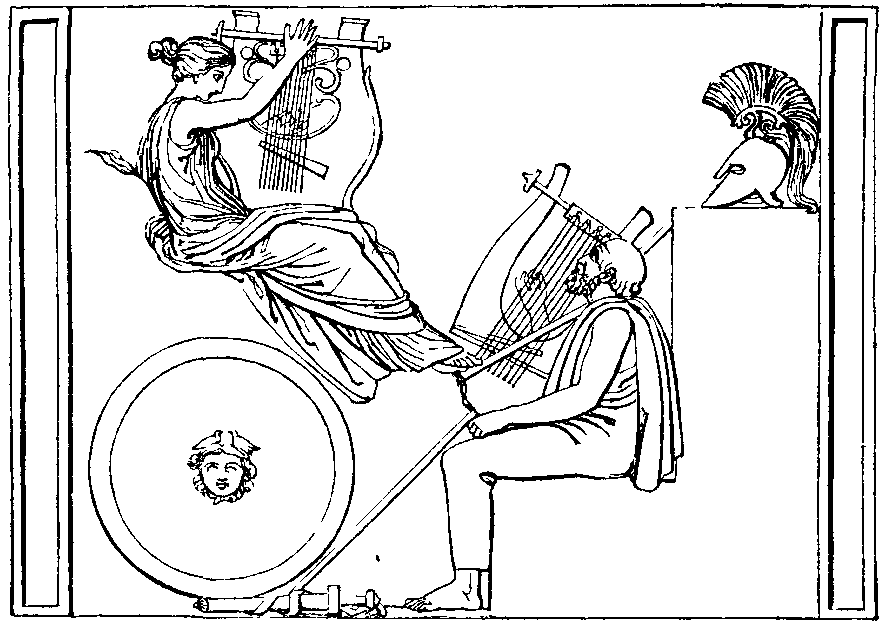
The Odyssey belongs to an oral-poetic tradition: its stories and characteristic ways of phrasing them developed through spoken or sung performance. This does not require you to imagine a performer memorizing every line exactly as it appears in a modern edition. Traditional poets could draw on familiar story material and reusable expressions while shaping a long performance. The surviving poem has a fixed text for us to read; its language still bears the marks of that performance culture.
Watch the selected excerpts of Benjamin McEvoy’s How to Read the Epics of Homer: The Iliad & The Odyssey. The video uses a different English translation for its discussion of the opening, so attend to the convention rather than expecting its wording to match Murray’s.
How to Read the Epics of Homer: The Iliad & The Odyssey
Benjamin McEvoy explains why repeated phrases matter to oral storytelling and how an invocation introduces an epic.
Watch recurring phrases for examples of epithets, then the invocation for the poet’s appeal to the Muse. Skip ahead to the Odyssey opening to hear how the appeal presents its subject. The video’s “Speak, Memory” comes from another translator; compare the idea of asking for a story with Murray’s “Tell me, O Muse.”
One reusable element is an epithet: a descriptive word or phrase repeatedly attached to a person, god, or thing. Epithets are part of the wider category of formulaic language, recurring expressions available to the poet. In a long performance, such phrases offer recognizable patterns of sound and rhythm. They also help listeners keep track of figures and qualities across many scenes. The Greek verse has a regular meter based on syllable length; an English translation may preserve the repeated wording without reproducing the same metrical effect.
Look now for repetition within Book 1, rather than treating an epithet as a definition learned once and set aside.
HOMER, ODYSSEY BOOK 1 - Theoi Classical Texts Library
Return to Murray’s Book 1 and follow a short exchange among the gods. Reading connected speeches makes it easier to hear how familiar descriptions recur within an unfolding scene.
In “THE ODYSSEY BOOK 1, TRANSLATED BY A. T. MURRAY,” begin at the paragraph marked [44], where Athena answers Zeus. Read from Athena’s first answer through the end of her proposal in paragraph [80]. Notice how Athena is introduced when she speaks in both [44] and [80], and how Zeus is introduced in [63]. Then find paragraph [213] and read Telemachus’s answer; the same description introduces another answer of his at [230].
Athena is “flashing-eyed Athena” when she answers Zeus, and the phrase returns when she speaks again. Zeus is “the cloud-gatherer” in his reply. Later, “wise Telemachus” answers Athena, even though what he says reveals uncertainty about his absent father. The epithet need not report a fresh observation about someone’s mood at that instant. It can be a familiar way of naming the figure, while the surrounding speech shows what is happening now.
That distinction matters for Odysseus too. “The man of many devices” sets an expectation of resourcefulness, but the opening immediately places that resourcefulness beside suffering and failure to save his companions. A recurring description gives the audience a way to recognize a character; it does not settle every judgment the story will ask us to make. Because translations handle repeated Greek expressions differently, the safest habit is to notice patterns in the version you are reading without assuming that every identical English phrase represents an identical Greek one.
Hearing the two conventions together
The invocation and epithets work at different scales. The invocation frames the whole performance: it asks for the tale, identifies its central figure, and gives the audience a sense of its stakes. Epithets recur inside the tale: they make its people and gods recognizable in a flowing sequence of speeches and events. Both remind us that the poem’s words are addressed to listeners.
They also invite interpretation rather than replacing it. The Muse’s opening account tells us the companions will die, but not yet how to weigh the choices involved. “Wise Telemachus” names a quality associated with him, but his hesitant answer still deserves attention. Read the traditional phrases with the scene around them: ask what a listener is prompted to remember, then notice where the present situation adds tension to that familiar description.
Takeaway
The Odyssey begins by invoking the Muse, presenting its story as a tale requested from a divine source and shared with an audience. Its recurring epithets belong to the traditional, patterned language of oral poetry; they aid recognition and performance without reducing characters to fixed traits. Together, these conventions make the opening both a promise about what will be told and an introduction to how the epic tells it.
Next, the lesson stays in Book 1 but turns to Zeus’ discussion of Aegisthus: a first test of how the poem distributes responsibility between gods and human beings.