Welcome to our fifth lesson in the Digital Marketing Foundations module. In our last session, we got to know our ideal customer by creating a detailed buyer persona. We now have a clear picture of who we are talking to. Today, we will bring that persona to life by mapping out the journey they take when interacting with a business.
This lesson focuses on creating a customer journey map. This is a powerful tool that visualizes the entire customer experience from their perspective. By understanding this path, you can identify critical moments to engage them, address their pain points, and ultimately guide them toward becoming a loyal customer. This skill is foundational for all marketing activities, especially performance marketing, where optimizing every step of the journey is key to success.
What is a Customer Journey Map?
A customer journey map is a visual story of a customer's interactions with your company. It helps you move from a business-centric view (our marketing funnel) to a customer-centric one (their experience). Instead of just seeing stages, you see the thoughts, feelings, and actions of a real person—the persona you created in our last lesson.
Each map is created for a specific persona. After all, "Business Owner Betty" will have a very different journey from "Marketing Manager Mara," even if they are interacting with the same company.
The WordStream article, "Customer Journey Map How-To," provides an excellent introduction to this concept and its core elements.
Customer Journey Map How-To (+7 Templates & Examples)
Please read the first few sections of this article to understand what a customer journey map is and its three core elements.
Start by reading the introduction and the section "What is a customer journey map?". Then, continue to "The three elements". Pay close attention to how the author explains the relationship between the buyer persona, the marketing funnel, and the buyer's journey.
As the article explains, the journey map is a "marketing mashup" that combines your persona with the stages of the marketing funnel to tell a story from the customer's point of view.
The Anatomy of a Customer Journey Map
So, what does this map actually look like? Most journey maps are structured as a grid. The columns represent the stages of the journey, and the rows represent the different facets of the customer's experience at each stage.
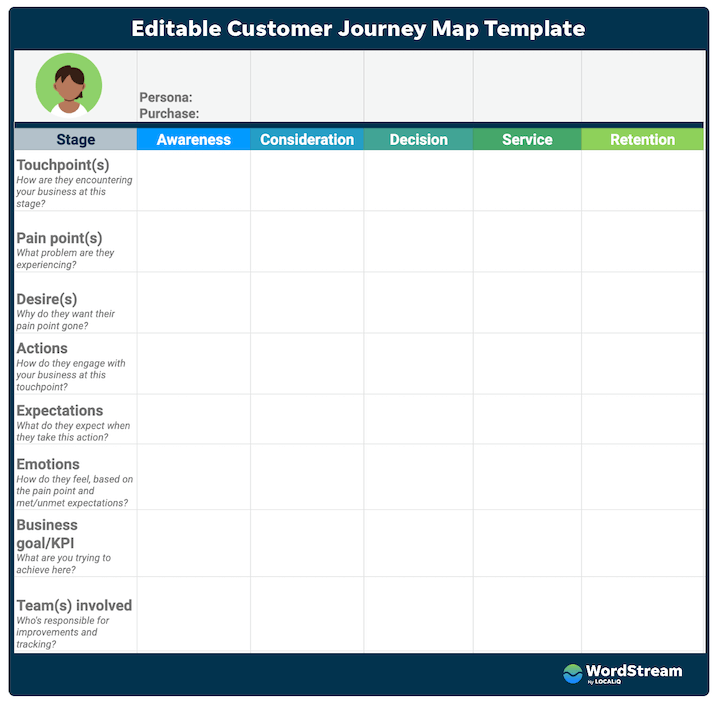
Let's break down these components.
1. The Stages (The Columns)
These are the major phases a customer goes through. While different models exist, a common framework includes five stages:
- Awareness: The persona realizes they have a problem or need and starts looking for information. Your SEO work is critical here, as organic search is a primary touchpoint in this stage.
- Consideration: The persona has defined their problem and is now researching and comparing potential solutions and providers.
- Decision: The persona is ready to choose a solution and make a purchase. They are evaluating final options, pricing, and reviews.
- Service / Retention: After the purchase, the customer uses the product or service. The goal here is to ensure they have a positive experience and see the value in their purchase.
- Advocacy: The customer is so happy with their experience that they become a promoter, recommending the business to others.
2. The Data Points (The Rows)
For each stage, we need to dig into the persona's experience. This is where you'll identify what's happening and where there are opportunities to improve.
The WordStream article you started reading provides a fantastic, practical breakdown of the eight key data points to collect for each stage.
Customer Journey Map How-To (+7 Templates & Examples)
This section provides a detailed, step-by-step guide for filling out your journey map.
Please read the section titled "How to make your own customer journey map." Focus on understanding the definition and examples for each of the eight points, from Touchpoints to Teams involved. This is the core "how-to" of our lesson.
To summarize the key rows you'll be filling in:
- Touchpoints: Where does the customer interact with the business? (e.g., social media ad, blog post, review site, email).
- Actions: What is the customer doing at this stage? (e.g., Googling symptoms, comparing features, requesting a demo).
- Pain Points: What are their frustrations or problems? (e.g., confusing website, lack of clear pricing, slow customer support).
- Emotions: How are they feeling? (e.g., overwhelmed, curious, confident, frustrated).
A Practical Walkthrough
Now that we understand the theory and the structure, let's see it in action. The best way to learn is to watch someone build a map from scratch.
This video from HubSpot Marketing provides a clear, step-by-step example using a fictional business that offers soccer classes for kids. It perfectly illustrates how to apply the concepts we've just discussed.
How To Make An Effective Customer Journey Map In 1 Hour (FREE Templates)
Watch this video to see how a customer journey map is created for a specific buyer persona, stage by stage. Pay close attention to how the presenter connects the customer's actions and feelings to specific marketing strategies.
The video starts by defining the journey map and the importance of choosing a persona at the start. The core of the walkthrough covers the Awareness Stage, the Consideration Stage, and the Decision Stage. Notice how for each stage, the presenter answers: What is the customer thinking/feeling? What are their actions? How can we move them forward?
This practical example shows that the goal isn't just to document the journey, but to identify specific opportunities. Did you notice how they suggested a blog post for the Awareness stage and a clear pricing page with a discount for the Decision stage? Every pain point is an opportunity for a marketing solution.
Templates and Examples
You don't need to start from a blank page. There are many excellent templates available to guide you. The Zendesk article "How to create customer journey maps" offers several examples for different industries, which can help you visualize the final product.
How to create customer journey maps in 2026 (+ templates) - Zendesk
This article provides further reinforcement on the steps to create a map, and most importantly, shows several visual examples.
First, quickly review the section on the "Steps for creating a customer journey map". Then, scroll down and explore the various examples provided, such as the ones for B2C, E-commerce, and B2B. Finally, you can browse the free templates at the end to see different layouts.
The various templates and layouts show that while the core components are consistent, the visual presentation can be adapted to your specific needs and audience.

Conclusion
In this lesson, we connected our buyer persona to the marketing funnel by creating a customer journey map. This process allows you to step into your customer's shoes and see your business from their perspective.
Here are the key takeaways:
- A customer journey map is a visual representation of a specific persona's experience with a business, from initial awareness to long-term advocacy.
- It is built around key stages (e.g., Awareness, Consideration, Decision) and details the persona's touchpoints, actions, emotions, and pain points at each step.
- The primary goal of mapping the journey is to identify opportunities to improve the customer experience, remove friction, and guide the customer more effectively.
- For your goal of performance marketing, this map becomes your strategic blueprint for deciding where to invest your budget and what message to deliver at each stage to maximize conversions.
Now that we understand the customer's path and the key touchpoints along the way, our next lesson will focus on measurement. We will explore how to match key performance metrics to each stage of the marketing funnel, so you can track your success and make data-driven decisions to optimize your campaigns.