Welcome to the fourth lesson in our Digital Marketing Foundations module. In our last session, we drew a clear line between organic and paid marketing strategies—the two main engines for driving growth. Now, it's time to ask the most fundamental question in marketing: who exactly are we trying to reach?
Today's lesson is all about defining your target audience. We'll move beyond broad descriptions to create detailed buyer personas. This is a crucial skill because all effective marketing, whether it's an SEO-driven blog post or a highly targeted paid ad campaign, starts with a deep understanding of the customer. By the end of this lesson, you will be able to define what a buyer persona is, understand its components, and know the research process required to build one from scratch.
From Target Audience to Buyer Persona
First, let's clarify two terms that are often confused: target audience and buyer persona. A target audience is a broad description of a group of people, while a buyer persona is a detailed, semi-fictional profile of a single ideal customer within that group.
A target audience tells you who might buy. A buyer persona tells you why they buy and how they make decisions. This distinction is the difference between shouting into a crowd and having a meaningful conversation.
The article "Buyer Persona Template: A Guide + Examples" from monday.com provides an excellent table that breaks down this difference.
Buyer Persona Template: A Guide + Examples For 2026
Please read the section that distinguishes between a target audience and a buyer persona.
In the article, focus on the table under the heading What’s the difference. Pay close attention to the examples provided for B2C and B2B, as they clearly illustrate the shift from a general group to a specific, detailed character.
As you can see, moving from "women ages 25-40 interested in fitness" to "Emma, a 32-year-old working mom who exercises at 5 AM" gives you a much richer picture. This level of detail is what allows you to craft messages that truly resonate.
The Anatomy of a Buyer Persona
So, what information do you need to build this detailed profile? A strong buyer persona goes far beyond basic demographics. It's a composite sketch that brings your ideal customer to life.
The HubSpot article, "How to create detailed buyer personas," offers a clear definition and breakdown of the core components.
How to create detailed buyer personas for your business ...
Read the introduction to understand the official definition of a buyer persona and what it includes.
Focus on the sections What is a buyer persona? and the bulleted list under What Buyer Personas Include. This will give you the foundational vocabulary for our discussion.
To summarize, a complete persona typically includes:
- Demographics: Age, location, job title, income level.
- Psychographics: Their values, interests, and lifestyle.
- Goals & Challenges: What are their primary professional or personal goals? What "pain points" or obstacles stand in their way?
- Behaviors & Information Sources: How do they consume information? Do they read blogs, watch YouTube videos, or listen to podcasts? What social media platforms do they use?
- Decision Criteria: What factors influence their buying decisions? Is it price, quality, customer support, or peer reviews?
This infographic provides a great visual summary of the kinds of questions you need to answer to build your persona.

It's also important to note that personas for Business-to-Business (B2B) and Business-to-Consumer (B2C) contexts will emphasize different elements. A B2B persona will focus more on professional goals, job responsibilities, and company challenges, while a B2C persona will lean more into personal lifestyle, motivations, and emotional triggers.
How to Create a Buyer Persona: The Research Process
A persona is only as valuable as the research it's based on. Making up an "ideal customer" without data is a common mistake. The process of creating an effective persona is rooted in a mix of quantitative and qualitative research.
The HubSpot Marketing channel on YouTube provides a great overview of this research process.
How To Create a Buyer Persona (FREE Template)
This video explains the different avenues for research you can explore.
Watch the section from this timestamp, which covers the "three keys" to creating a persona: internal research, market research, and customer interviews.
Let's break down those steps:
-
Gather Quantitative Data: Start with the data you already have. Your website analytics (like Google Analytics), CRM data, and social media insights can reveal demographic information and behavioral trends. Your experience in SEO gives you a head start here, as you're already familiar with analyzing data to understand user behavior through search.
-
Conduct Qualitative Research: This is where you uncover the "why" behind the data. The most powerful method is conducting interviews with:
- Current Customers: Talk to your best customers. They've already chosen you for a reason.
- Prospects: Speak with people who are in your sales pipeline but haven't yet purchased.
- Sales & Support Teams: Your colleagues who speak to customers every day are a goldmine of information about common questions, objections, and pain points.
When you conduct interviews, having a structured set of questions is key. The video you just watched mentions a helpful framework.
How To Create a Buyer Persona (FREE Template)
This part of the video offers a simple yet powerful framework for your interview questions.
Focus on the brief section explaining the "who, what, why, and how" question structure. This is a highly actionable takeaway you can use immediately.
- Synthesize and Build: Once you've collected your data, look for patterns. Group similar answers and traits to form your core personas. Give each persona a name, a job title, and a photo to make them feel like a real person to your entire team.
This is what a finished persona template might look like, with different sections for all the information you've gathered.
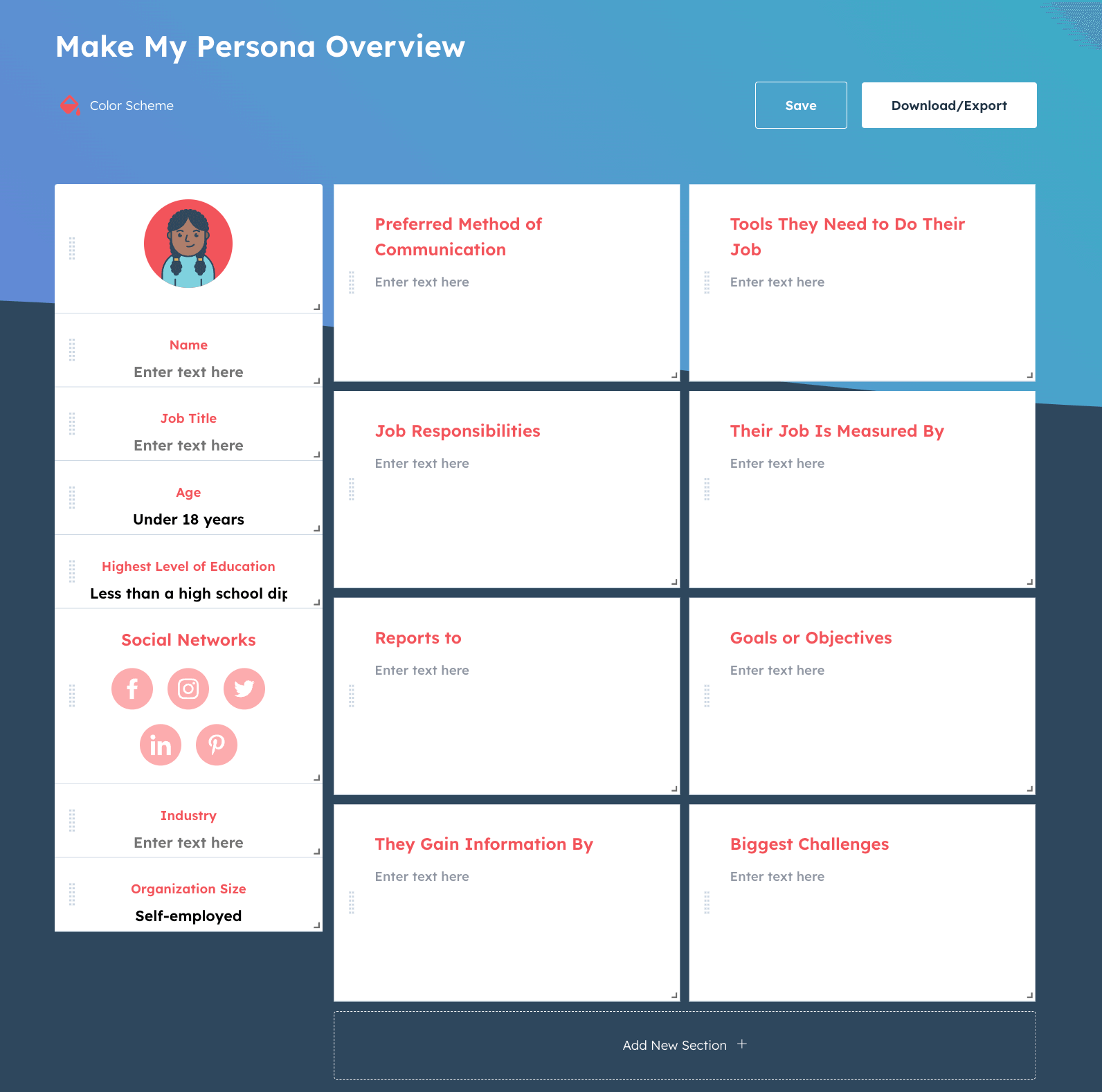
Positive and Negative Personas
Finally, it's useful to create not only your ideal customer persona but also a negative persona—a profile of the customer you don't want. This could be someone who is too expensive to acquire, has a high churn rate, or is too advanced for your product.
For your goal of mastering performance marketing, negative personas are incredibly valuable. They help you refine ad targeting to exclude audiences that are unlikely to convert, saving you significant budget and improving your campaign's Return on Ad Spend (ROAS).
The HubSpot article provides excellent examples of both positive (B2B and B2C) and negative personas.
How to create detailed buyer personas for your business ...
Now, let's look at some finished examples to see how all these pieces come together.
Review the examples provided under the heading Buyer Persona Examples. Pay special attention to the "B2B SaaS Buyer Persona: Enterprise Emma," the "B2C Ecommerce Persona: Sustainable Sarah," and the "Negative Buyer Persona: Discount-Only Dan." Notice how each profile directly informs marketing strategy.
Conclusion
Today we've established the critical importance of knowing your customer on a deep, personal level. You've learned that effective marketing isn't about reaching everyone; it's about reaching the right one.
Here are the key takeaways from our session:
- A buyer persona is a detailed, research-based profile of an ideal customer, going beyond the broad strokes of a target audience.
- Personas are built from a combination of quantitative data (the "what") and qualitative research (the "why"), primarily through interviews.
- They contain demographics, psychographics, goals, challenges, and behavioral information that guide everything from content creation to ad targeting.
- Creating negative personas is just as important, as it helps you avoid wasting resources on audiences that are a poor fit for your business.
In our next lesson, we will put our new persona to work. Now that we know who our customer is, we will create a sample customer journey map to visualize the path they take from first hearing about a brand to becoming a loyal customer. This will connect our persona directly to the marketing funnel we discussed earlier.