Welcome to the final lesson of our introductory module. Over the last six sessions, we have built a complete conceptual model of the Mandarin Chinese language, starting from the sounds of Pinyin and tones, moving through the structure of characters with radicals, and finally, understanding how characters combine to form compound words. You now have the architectural overview.
Today, we shift our focus from the language itself to the specific challenge you've set for yourself: the HSK 1 exam. Your goal for this lesson is to outline the structure, timing, and task types of the HSK 1 (3.0) listening and reading sections. We will deconstruct the exam, treating it as a system with defined parameters and predictable components. Understanding this system is the first step to mastering it.
Your Target: HSK 1 under the "3.0" Standard
First, it's important to be precise about which exam we're targeting. The HSK has been undergoing a significant overhaul. You started this course with the goal of passing the HSK 1 (3.0 version), and it's crucial to understand what that entails compared to the older system.
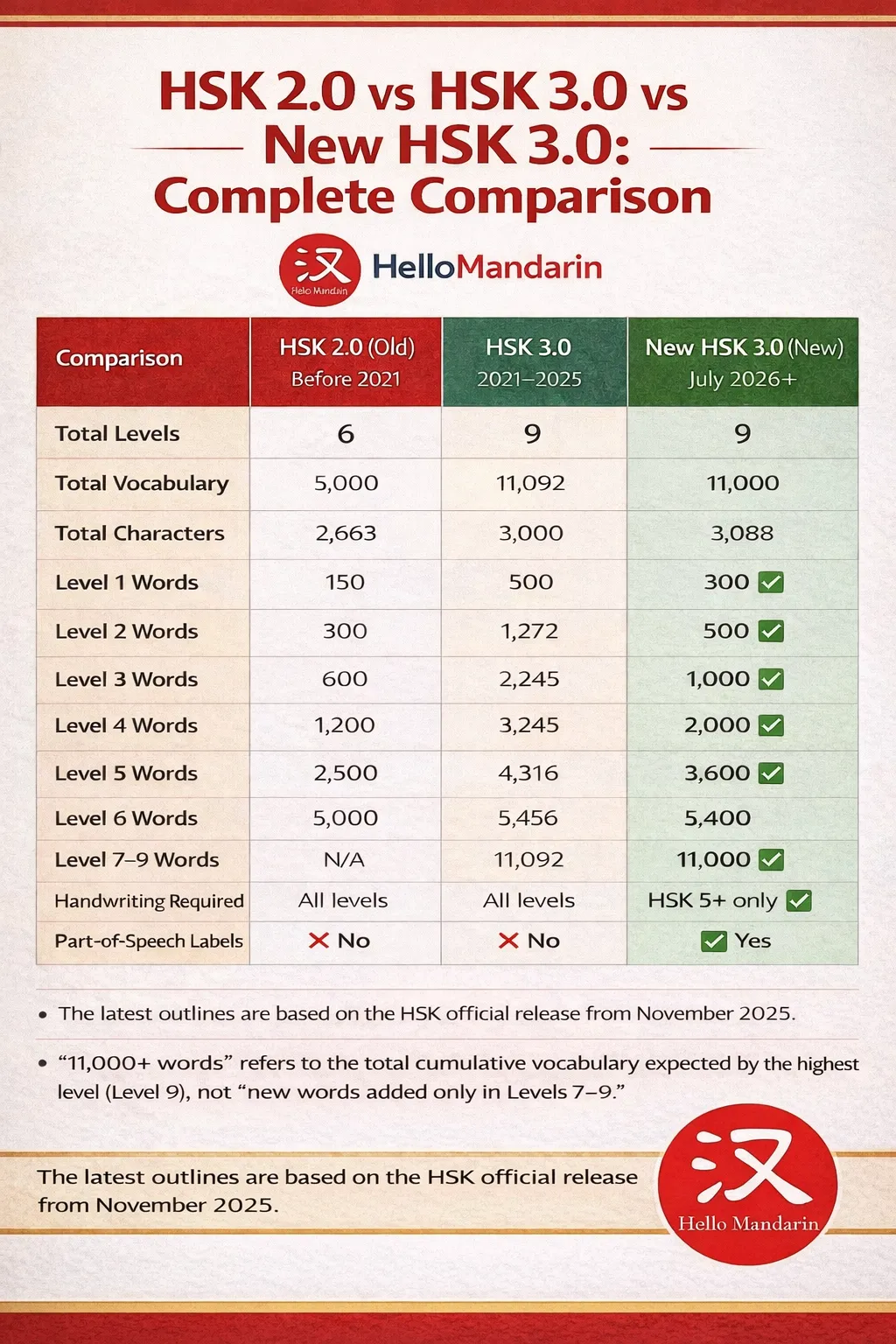
Take a close look at the columns in the "Complete Comparison" image.
- HSK 2.0 (Old): This was the standard for many years. Notice that HSK Level 1 only required 150 words.
- HSK 3.0 (2021-2025): This is our target. Look at the "Level 1 Words" row for this column. The requirement has increased significantly to 500 words. The official materials refer to this as "Band 1". This is why our course is structured around a larger vocabulary base than older HSK 1 guides.
- New HSK 3.0 (July 2026+): This is a future revision. While it's good to be aware of, it doesn't affect our current goal.
This 500-word target dictates our entire strategy. Now, let's see how those 500 words are tested.
The HSK 1 Exam Blueprint
The exam is a short, focused test of your foundational listening and reading abilities. It is designed to be completed in under an hour. The resource from China Education Center provides the exact specifications.
This document outlines the structure of the HSK 1 exam. We will break it down piece by piece.
First, focus on the summary paragraph and the main table under the heading "Test Content". This gives us the high-level parameters of the entire exam. Also, note the scoring information at the end.
From that reading, here is the top-level summary of the exam's architecture:
| Component | Sections | Total Questions | Total Time |
|---|---|---|---|
| Listening | 4 | 20 | ~15 minutes |
| Reading | 4 | 20 | 17 minutes |
| Total | 8 | 40 | ~35-40 minutes |
The exam is scored out of 200 points (100 for listening, 100 for reading). A score of 120 or higher is required to pass.
Now, let's dissect each of those components.
Part I: Listening Comprehension (听力)
The listening section tests your ability to understand simple, spoken Mandarin. The audio is intentionally slow and clear. As we'll see in the next reading, the standard specifies a speed of no less than 100 characters per minute, which is a very manageable pace.
This section describes the general expectations for the listening test.
Read the section under the heading "1. Listening". Pay attention to the description of the material: "simple dialogues (within 80 characters)" and the slow, clear pronunciation.
The 20 listening questions are divided into four parts. While the resource doesn't specify the task for each part, the standard format is as follows:
- Part 1 (5 questions): You will hear a short phrase or sentence. You will see a picture. Your task is to determine if the sentence you heard accurately describes the picture (True/False).
- Part 2 (5 questions): You will hear a short dialogue. You will see several pictures. Your task is to select the picture that corresponds to the dialogue.
- Part 3 (5 questions): This is similar to Part 2, but you will hear a single, longer sentence instead of a dialogue. You must match it to the correct picture.
- Part 4 (5 questions): You will hear a short dialogue followed by a question. Your answer sheet will show three possible text answers (in characters). You must choose the correct answer to the question you heard. This is the only part of the listening section that requires you to read.
Part II: Reading Comprehension (阅读)
The reading section tests your ability to recognize the core characters and words from the 500-word vocabulary list. Crucially, at HSK 1, all characters are accompanied by Pinyin, which acts as a significant aid.
This section describes the reading proficiency expected.
Read the section under the heading "3. Reading". Note the key phrase: "Be able to use pictures and pinyin to understand the materials".
Like the listening part, the 20 reading questions are split into four distinct task types:
- Part 1 (5 questions): You will see a written sentence and a picture. Your task is to determine if the sentence and picture match.
- Part 2 (5 questions): You will see a picture with a sentence that has a missing word (a blank). You must select the correct word from a provided list to complete the sentence logically.
- Part 3 (5 questions): You will be given a set of short dialogues. The first person's line is given, but the second person's response is missing. You must match the correct response from a list of options to complete the dialogue.
- Part 4 (5 questions): You will be given a set of questions and a set of answers. Your task is to match each question with its most logical answer.
A Note on Speaking and Writing
The official HSK 3.0 standards for Band 1 do include requirements for basic speaking and handwriting. However, the HSK 1 test that you will register for only consists of the listening and reading sections we have just detailed. Furthermore, as per your explicit goal to find the fastest path to passing, our course will not cover handwriting practice. We will focus 100% of our effort on the skills that are actually measured on the exam.
Conclusion
You now have a complete schematic of the HSK 1 exam. You know the exact number of questions, the time allocation for each section, the passing score, and the specific type of task you will face for every single question. This removes all uncertainty about the challenge ahead. It is no longer an unknown entity, but a well-defined problem with clear parameters.
Key Takeaways:
- The HSK 1 (3.0) exam tests a vocabulary of 500 words.
- The test has two sections: Listening (20 questions, ~15 mins) and Reading (20 questions, 17 mins).
- A passing score is 120 out of 200.
- All tasks are multiple-choice, true/false, or matching. There are no open-ended answers.
- Pinyin is provided for all characters in the reading section, which is a crucial aid for beginners.
This lesson concludes our first module. We have built the necessary theoretical foundation. Now, the real work begins. In our next lesson, we will open Module 2, "Mastering Pronunciation," and start practicing the fundamental sounds of Mandarin: the simple finals (a, o, e, i, u, ü) and basic initials.