Welcome to your sixth lesson. In our previous session, we dissected Chinese characters to understand their internal structure, focusing on how semantic radicals like 氵 (water) or 心 (heart) provide clues to a character's meaning. We learned to see a character as a logical construct.
Today, we will zoom out one level. Having examined the building blocks within characters, we will now explore how characters themselves function as building blocks for a higher-level concept: words (词, cí). Your goal is to distinguish between single-character words and multi-character compound words. Grasping this is crucial, as it fundamentally shapes how you'll acquire and recognize vocabulary in Mandarin. Most of the vocabulary in modern Chinese is not a vast collection of unique symbols, but rather a combinatorial system built from a finite set of characters.
From Characters to Words: A New Level of Combination
In English, the basic units of meaning are words, which are built from letters. In Chinese, the situation is layered. The fundamental graphemes are characters (字, zì), each corresponding to one syllable. However, a single character is not always a complete word.
In modern Mandarin, the vast majority of words are actually compounds formed by combining two or more characters. Let's watch a short video that explains the historical and practical reasons for this dominance of two-syllable words.
Why is Chinese OBSESSED w/ 2 Syllable Words?
This video from the ABChinese channel provides an excellent statistical and historical overview of why two-character words are so prevalent.
Watch the segment from the beginning until the 1:38 mark. Pay attention to the statistics—that over 80% of modern Chinese is composed of disyllabic (two-syllable) words—and the core reason: it's more efficient to create new words by combining existing characters than to invent thousands of new ones.
As the video explains, this is a matter of efficiency. The writing system reuses its ~3,500 common characters in various combinations to express a much larger vocabulary.
This leads to a fundamental distinction you must make as a learner:
- Single-character words: These tend to be the oldest and most fundamental words in the language. Examples you will soon learn include 人 (rén) - person, 大 (dà) - big, and 好 (hǎo) - good.
- Multi-character words: These are the norm in modern Chinese, especially for more complex or modern concepts. The most common structure by far is the two-character word.
This article from HSKLord provides a concise explanation in its FAQ section.
100 Most Common Chinese Words (With Sentences & Audio) | HSKLord
This reading directly answers the question of why some words are single characters and others are compounds.
Please find the "FAQ" section near the end of the article. Read the answer to the question "Why are some words...". It clearly contrasts the older, single-character words with the more common two-character compounds.
The Logic of Compound Words
The power of this system lies in the fact that these combinations are not random. The meaning of a compound word is often directly related to the meanings of its constituent characters. This transforms vocabulary learning from pure memorization into a process of logical deduction.
The image below provides a perfect visual illustration of this principle with three "root" characters: 心 (xīn) - heart, 高 (gāo) - high, and 意 (yì) - meaning/intent.
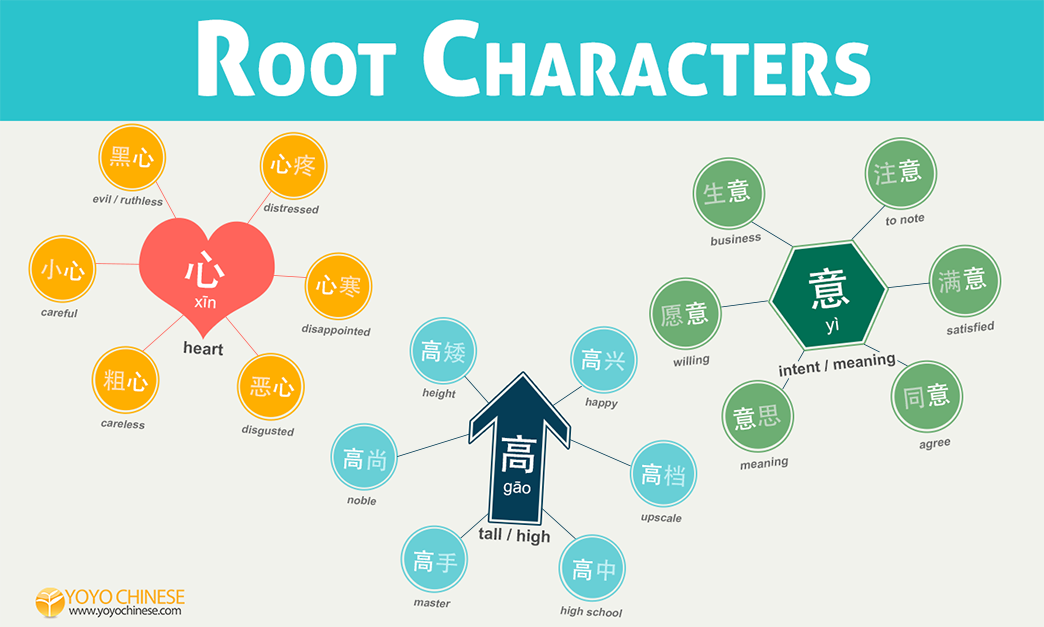
Let's analyze the patterns shown in the "Root Characters" image:
-
Centered on 心 (xīn - heart): This character relates to feelings and the mind.
- 小心 (xiǎoxīn): Literally "small heart." When your heart is small and focused, you are careful.
- 粗心 (cūxīn): Literally "coarse/thick heart." This implies a lack of fine detail or sensitivity, hence careless.
- 恶心 (ěxīn): Literally "disgusted heart." This means disgusted or nauseated.
-
Centered on 高 (gāo - high/tall):
- 高兴 (gāoxìng): Combines "high" with 兴 (xìng), meaning "spirits" or "interest." When your spirits are high, you are happy.
- 高中 (gāozhōng): Combines "high" with 中 (zhōng), meaning "middle." This is the word for high school.
-
Centered on 意 (yì - intent/meaning):
- 同意 (tóngyì): Combines "same" (同, tóng) with "meaning." To have the same meaning or intent is to agree.
- 意思 (yìsi): Combines "meaning" with 思 (si), meaning "thought." This compound word simply means meaning.
As you can see, knowing the meaning of a single character like 心 (xīn) gives you a powerful semantic key to unlock the meaning of multiple related words.
Deconstructing Compound Words
This compositional logic is everywhere in Chinese. Recognizing it will dramatically accelerate your vocabulary acquisition. Let's look at a few more transparent examples.
100 Most Common Chinese Words (With Sentences & Audio) | HSKLord
This section of the HSKLord article provides several excellent, intuitive examples of compound words.
Find the heading "Compound Words in Action". Study the five bullet points that break down words like "computer" and "airplane".
Let's review those examples here, framing them as simple equations of meaning:
- 电脑 (diànnǎo) → 电 (diàn, electric) + 脑 (nǎo, brain) = computer
- 飞机 (fēijī) → 飞 (fēi, to fly) + 机 (jī, machine) = airplane
- 学校 (xuéxiào) → 学 (xué, to learn) + 校 (xiào, school) = school
- 老师 (lǎoshī) → 老 (lǎo, old/venerable) + 师 (shī, master/teacher) = teacher
This is not to say that all compound words are so transparent. Some are more abstract, and a few are "binding words" where the individual characters lose their meaning when separated. However, for your current goal of passing HSK 1, thinking of two-character words as logical combinations will be an exceptionally effective strategy. As the video Why is Chinese OBSESSED w/ 2 Syllable Words? aptly puts it, you can think of characters as ingredients in a recipe; they combine to create new, unique flavors while retaining their core properties.
Conclusion
In this lesson, we completed our initial survey of the Chinese linguistic system by moving from the character level to the word level. You now understand the fundamental distinction between single-character words and the far more common multi-character compounds.
Key Takeaways:
- A Chinese character (字, zì) is a single grapheme tied to a single syllable. A word (词, cí) is the basic unit of meaning in a sentence and can be composed of one or more characters.
- Most words in modern Mandarin are two-character compounds.
- Single-character words are common but typically represent older, more fundamental concepts (e.g., 人 person, 水 water, 大 big).
- The meaning of a compound word is often a logical combination of its constituent characters. Recognizing these combinations is a key skill for efficient vocabulary learning.
This lesson concludes our introductory module on the structure of the Chinese language. You now have the foundational knowledge of Pinyin, tones, radicals, and word formation needed to begin tackling the HSK 1 material directly.
In our next lesson, we will do just that. We will pivot from theory to practice by outlining the structure, timing, and task types of the HSK 1 (3.0) exam, so you know exactly what to expect on test day.