With all the Pinyin initials now in your repertoire, we can turn our attention to the second half of the Mandarin syllable: the final. In previous lessons, we encountered the simple finals (a, o, e, i, u, ü). Today, we will build on that foundation to master the compound finals.
This lesson is designed to help you pronounce the most common compound finals required for HSK 1. We will approach this systematically, breaking them into two distinct categories:
- Diphthongs: Finals formed by gliding from one vowel sound to another (e.g.,
ai,ei,ao,ou). - Nasal Finals: Finals formed by combining a vowel with a nasal consonant (
-nor-ng).
By the end of this lesson, you will be able to recognize and pronounce these essential sounds, which will dramatically expand the number of Mandarin syllables you can produce.
Let's begin with a visual map of the sounds we'll be covering. The chart below shows all Pinyin finals, categorized into simple, compound, and nasal groups. Our focus today is on the latter two.
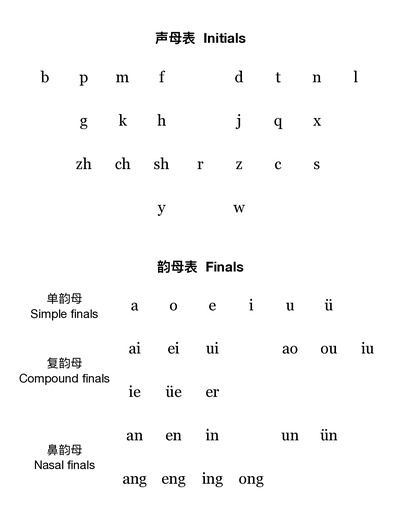
1. Diphthongs: The Vowel Glides (ai, ei, ao, ou)
A diphthong is a single syllable that contains two distinct vowel sounds. The key to pronouncing them correctly is to think of it as a smooth, continuous glide from a starting vowel position to an ending one, with the first vowel being more prominent.
The video "Master Chinese Compound Finals" by Grace Mandarin Chinese offers an exceptionally clear breakdown of the physical mouth and tongue movements for these sounds.
Master Chinese Compound Finals | Chinese Pronunciation Training
This video provides detailed, step-by-step instructions for producing the four main diphthongs. Pay close attention to the visual demonstrations of mouth shape and tongue position.
Please watch the following segments: The final ai: Watch from 0:44 to 1:45. The sound is similar to the English "eye" or "tie". Notice how the mouth starts wide for the a sound and then narrows as the tongue rises for the i sound. The final ei: Watch from 2:34 to 3:15. This is like the "ay" in "hay". The key is that the transition is quick, and the second vowel sound is light. The final ao: Watch from 4:06 to 4:47. This is like the "ow" in "cow". Grace points out an important detail: although spelled ao, it is pronounced more like au. The mouth starts wide and open for a and then becomes small and round for the u sound. The final ou: Watch from 5:43 to 6:11. This is similar to the "o" in "go". The mouth starts in a medium round shape and closes to a smaller round shape for the u sound.
For a supplementary text-based explanation, you can refer to the following guide.
Mastering Mandarin Sounds: An interactive H5P Pressbook.
This section of the online textbook provides concise written instructions for articulating these sounds.
In the chapter "Learning compound vowels," read the descriptions for ai, ei, and ao, ou. Notice how the descriptions align with the video, describing a glide from a start sound to an end sound.
2. The Nasal Finals (an, en, ang, eng, ong)
The second group of compound finals are the nasals. These are formed by a vowel followed by a nasal consonant: -n or -ng. The distinction between these two endings is one of the most important—and often trickiest—aspects of Pinyin pronunciation.
- Final
-n(Alveolar Nasal): To produce this sound, your tongue tip should rise to touch the ridge just behind your upper front teeth (the alveolar ridge), stopping the airflow through the mouth and directing it through the nose. It's the same position as the 'n' in the English word "sun". - Final
-ng(Velar Nasal): To produce this sound, the back of your tongue rises to touch the soft palate (the velum) at the back of your mouth, again directing air through the nose. It's the same position as the 'ng' in the English word "song".
The video "Learn Chinese Pinyin Compound Finals & Nasal Finals" provides an excellent demonstration of this crucial difference and guides you through the nasal finals.
Learn Chinese Pinyin Compound Finals & Nasal Finals | Mandarin Pinyin Pronunciation | Lesson 09
This video clearly explains the physical difference between the -n and -ng endings and then demonstrates the pronunciation of the nasal finals.
Watch the following two segments: n vs. ng: From 4:50 to 5:31, the instructor demonstrates the different tongue positions for the alveolar (n) and velar (ng) nasal consonants. Physically mimicking this action is key to mastering the difference. Pronunciation and Practice: Watch from 5:31 to 6:29 to hear the pronunciation of an, en, ang, eng, ong and practice along with the examples. Notice how the vowel sound is followed by the nasal sound produced with the correct tongue position.
As a reference, you can read the text descriptions for these sounds.
Mastering Mandarin Sounds: An interactive H5P Pressbook.
This text reinforces the concepts from the video, describing how the nasal finals are formed.
First, in the chapter "Learning compound vowels - an en...", read the brief descriptions for an and en. Then, read the section n vs. ng for a clear explanation of the tongue positions, followed by the descriptions of ang, eng, and ong. Finally, look at the description for iong under the next chapter heading, which shows it's a simple combination: i + ong.
3. A Critical Rule: Tone Mark Placement
Now that we have finals with more than one letter, a logical question arises: where does the tone mark go? Pinyin follows a very simple and consistent rule.
The tone mark is always placed above the main vowel of the final. The main vowel is determined by a fixed order of precedence: a, o, e, i, u, ü.
Think of it as a hierarchy. Whichever of these vowels appears first in the sequence gets the tone mark.
bái:acomes beforei, so the tone goes ona.gěi:ecomes beforei, so the tone goes one.hǎo:acomes beforeo, so the tone goes ona.gōu:ocomes beforeu, so the tone goes ono.
The ChineseFor.Us video explains this rule perfectly.
Learn Chinese Pinyin Compound Finals & Nasal Finals | Mandarin Pinyin Pronunciation | Lesson 09
This short segment clearly explains the simple, hierarchical rule for placing tone marks on compound finals.
Watch the explanation from 3:51 to 4:40. This rule-based approach is a highly efficient way to handle tone placement correctly every time.
(Note: There is one special exception for iu and ui, where the tone goes on the last letter, but the a, o, e rule covers the vast majority of cases you will encounter.)
4. Practice and Consolidation
You now have all the initials and a wide range of finals. The best way to practice is to hear them in combination. The interactive Pinyin chart from the Chinese Pronunciation Wiki is an invaluable tool for this. You can think of it as a complete lookup table for all possible Mandarin syllables.
Pinyin chart - Chinese Pronunciation Wiki
This interactive chart allows you to click on any valid Pinyin syllable and hear its pronunciation with the first tone.
Go to the chart and find the columns for the finals we learned today: -ai, -ei, -ao, -ou, -an, -en, -ang, -eng, -ong. Click on syllables that combine these finals with initials you've learned. For example: b + ai -> bai p + ao -> pao m + en -> men g + ong -> gong h + an -> han zh + eng -> zheng Experiment with different combinations to train your ear and practice your pronunciation.
Conclusion
In this lesson, we significantly expanded your phonetic toolkit by adding nine common compound finals. You learned to distinguish between diphthongs (vowel glides) and nasal finals, focusing on the critical difference between the -n and -ng endings. You also learned the systematic rule for placing tone marks.
Key Takeaways:
- Diphthongs like
ai, ei, ao, ouare smooth glides from one vowel to another. - Nasal finals end in either an alveolar (
-n, tongue tip forward) or a velar (-ng, tongue back up) nasal sound. - Tone marks follow a hierarchy: the mark goes on the vowel that appears first in the sequence
a, o, e, i, u, ü.
You are now equipped to pronounce a vast majority of Mandarin syllables. However, pronunciation isn't just about isolated sounds; it's also about how those sounds behave when placed next to each other. In our next lesson, we will explore our first major tone change rule, the third-tone sandhi, which governs how two third-tone syllables interact in a word.