Welcome to the next stage of our work on Mandarin pronunciation. In our last lesson, you mastered the crucial concept of aspiration, learning to distinguish the unvoiced pairs b/p, d/t, and g/k based on the presence or absence of a puff of air. This principle is a cornerstone of Mandarin phonetics, and we will apply it again today.
This lesson focuses on the remaining initial consonants you need for HSK 1. They fall into three distinct groups known as sibilants—sounds characterized by a hissing quality produced by forcing air through a narrow channel in the mouth. These are often the most challenging sounds for learners, but also the most rewarding to master. Our goal is to systematically deconstruct these sounds, focusing on precise tongue placement and airflow, so you can distinguish and pronounce:
- The retroflex series:
zh, ch, sh, r - The alveolar series:
z, c, s - The palatal series:
j, q, x
By the end of this lesson, you will have a complete map of all Mandarin initial consonants.
The Three Sibilant Families: A Systems View
Before we dive into the specifics, let's establish a framework. Think of these three sound groups as distinct families, each defined by a unique tongue position. Your main task is to learn the "setting" for each family. Within two of these families, you'll find that the aspiration rule you learned previously applies directly.
- Retroflex (
zh, ch, sh, r): The "curled tongue" sounds. The tongue tip curls up and back. - Alveolar (
z, c, s): The "flat tongue" sounds. The tongue tip is placed flat, just behind the front teeth. - Palatal (
j, q, x): The "smiling" sounds. The tongue tip is held down, while the body of the tongue arches up.
We will tackle them in an order designed to highlight their contrasts.
1. The Retroflex Series (zh, ch, sh, r): Curled Tongue Sounds
This group is defined by retroflexion, which means curling the tip of your tongue upwards and backwards towards the hard palate (the roof of your mouth).

The video "Master Chinese 'zh ch sh r'" by Grace Mandarin Chinese provides an excellent, step-by-step guide to producing these sounds. We will use it to break down each one.
Master Chinese "zh ch sh r" | Pronunciation Training
This video methodically explains the tongue position and airflow for each retroflex initial, using IPA symbols and physical demonstrations to clarify the mechanics.
Watch the following segments carefully: The Baseline (sh): Start with Grace's explanation of sh from 1:01 to 2:13. This is a fricative, meaning it's a continuous hissing sound. Focus on curling your tongue and letting air flow without the tongue tip touching the roof of your mouth. The Unaspirated Affricate (zh): Now watch from 2:13 to 3:28. An affricate is a two-part sound: a stop followed by a release. For zh, you start with the same curled tongue position as sh, but you briefly touch the tip to your palate to block the air, then release it into the sh sound. Crucially, this is unaspirated—no strong puff of air. It is similar to the 'dr' sound in "drink," but with a more pronounced tongue curl. The Aspirated Affricate (ch): Next, watch the segment on ch from 3:28 to 4:48. This is the aspirated partner to zh. The tongue movement is identical: block and release. The only difference is a forceful puff of air upon release. Use the tissue test you learned in the last lesson. zh should not move the paper; ch should. The Voiced Fricative (r): Finally, watch the explanation for r from 4:48 to 5:59. The tongue position for r is exactly the same as for sh. The difference is voicing. The sh sound is unvoiced (just air), while the r sound is voiced (your vocal cords vibrate). Place your hand on your throat to feel the vibration for r, which should be absent for sh. It is similar to the 'r' in the English word "raw," but with a flatter, less-rounded lip position. To consolidate, watch the practice section from 6:04 to 6:48, where Grace contrasts zh/ch and sh/r with example words.
Practice: Pronounce these syllables, focusing on tongue curl and the correct aspiration/voicing.
zhī(知, know) vs.chī(吃, eat)shì(是, to be) vs.rì(日, day)zhǎo(找, to find) vs.chǎo(炒, to fry)
2. The Alveolar Series (z, c, s): Flat Tongue Sounds
This group is the "flat tongue" counterpart to the retroflex series. Instead of curling the tongue up and back, you place the tip of your tongue flat, just behind your upper front teeth (the alveolar ridge).
s: This is a fricative, and it's virtually identical to the English 's' in "see". Air flows continuously over the flat tongue.z: This is the unaspirated affricate. Start by blocking the air with your tongue tip in the 's' position, then release it without a puff of air. It sounds like the "ds" in "kids".c: This is the aspirated affricate. The mechanics are identical toz, but you release the air with a sharp, forceful puff. It sounds like the "ts" in "cats".
The key contrast is zh (curled) vs. z (flat), ch (curled) vs. c (flat), and sh (curled) vs. s (flat). The Rita Mandarin Chinese video provides excellent side-by-side demonstrations.
Stop Pronouncing These Chinese Sounds WRONG| zh ch sh | z c s | j q x | Improve in 10 Mins!
This video contrasts the three sibilant groups, which is perfect for understanding the subtle but critical differences in tongue position.
Please watch the segment from 3:07 to 4:36. Rita clearly demonstrates the tongue position for z, c, s and contrasts it with the retroflex sounds you just learned. Pay close attention to her description of the tongue "biting" the back of the teeth for z and c.
Practice: Pronounce these minimal pairs. Feel the difference between the curled tongue for the first word and the flat tongue for the second.
zhā(扎, to prick) vs.zā(扎, to tie up)chá(茶, tea) vs.cā(擦, to wipe)shā(沙, sand) vs.sā(撒, to scatter)
3. The Palatal Series (j, q, x): The Smiling Sounds
This final group has no English equivalent and requires learning a new tongue posture. The key is that the tip of your tongue must stay down, pressed against the back of your lower front teeth. The hissing sound is made by the middle (or blade) of your tongue rising to the hard palate.
The Chinese Pronunciation Wiki offers a very detailed guide.
The "j" "q" and "x" sounds - Chinese Pronunciation Wiki
This guide methodically breaks down the tongue position for this unique sound group and explains their relationship to each other.
Read through the following sections: x - The Baseline: Start with the section Pronouncing Pinyin's "x" Sound. The x is a fricative. Follow the instructions to make a "sh" sound while keeping your tongue tip down. The "smile test" is a great diagnostic: it's easy to smile while saying x, but awkward while saying sh. q - The Aspirated Affricate: Now read Pronouncing Pinyin's "q" Sound. The q sound is the aspirated partner. You start by blocking the air with the middle of your tongue against the palate (tongue tip still down), then release with a strong puff of air. It's essentially "t + x". j - The Unaspirated Affricate: Read the section Pronouncing Pinyin's "j" Sound. The j sound is the unaspirated partner to q. Same tongue posture, same block-and-release, but with no puff of air. It is essentially "d + x". Key Takeaways: Read the summary section. Pay special attention to points 3 and 4. The tongue position is non-negotiable, and the vowel rule is critical: j, q, and x are only ever followed by i or ü-type vowels. If you see ju, qu, or xu, the u is always pronounced ü.
Practice: Pronounce these syllables, focusing on keeping your tongue tip down.
jī(鸡, chicken) vs.qī(七, seven) vs.xī(西, west)jiā(家, home) vs.qiā(掐, to pinch) vs.xià(下, down)jù(句, sentence) vs.qù(去, to go) vs.xù(续, to continue) - remember to pronounce theuasü!
Tying It All Together: The Phonetic Chart
You've now covered all the initials. Let's see how they fit into a systematic chart. This is a standard tool in phonetics, organizing sounds by their place and manner of articulation.
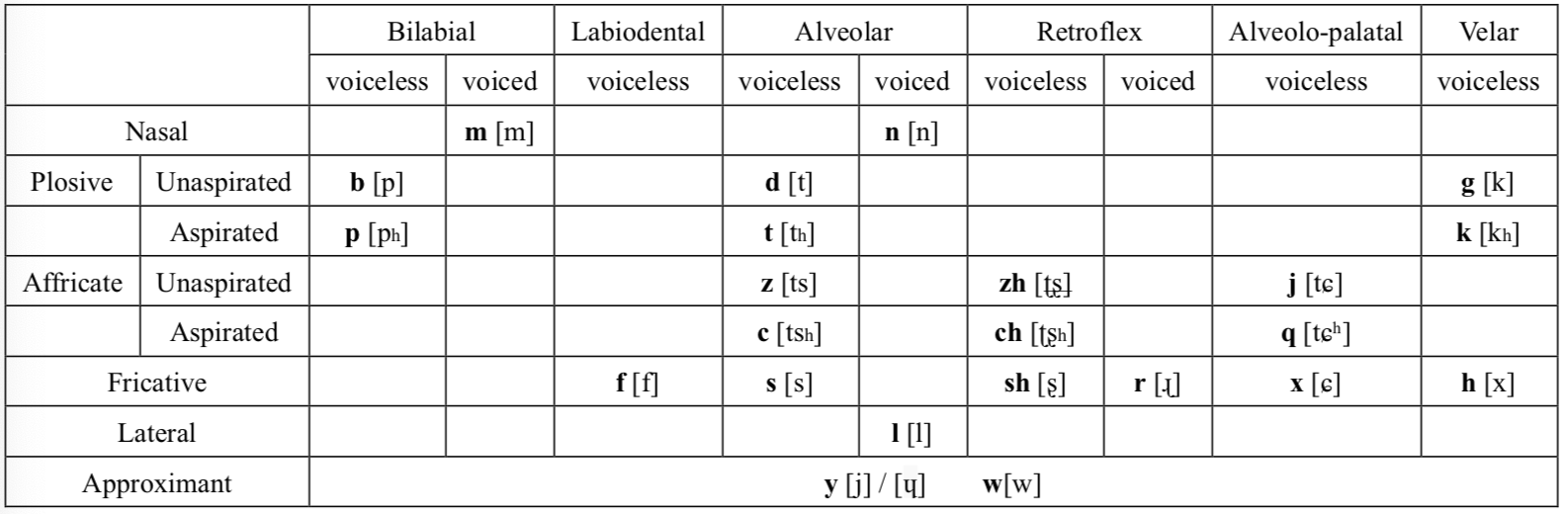
This chart provides a logical, top-down view of the system you've just learned piece by piece. The aspiration distinction is shown by having separate rows for "Unaspirated" and "Aspirated" plosives and affricates.
Conclusion
This lesson covered a lot of challenging but essential ground. You've now dissected the three main groups of Mandarin sibilant initials, which are often a major hurdle for learners. By focusing on the underlying mechanics of tongue position and airflow, you are building a robust and accurate pronunciation foundation.
Key Takeaways:
- Mandarin sibilants are divided into three families based on tongue position: Retroflex (
zh, ch, sh, r- curled), Alveolar (z, c, s- flat), and Palatal (j, q, x- tip down, body up). - The principle of aspiration is the key difference between the pairs
zh/ch,z/c, andj/q. - The principle of voicing is the key difference between
shandr. - The palatal initials
j, q, xcan only be followed byiorüvowels, a rule that simplifies spelling.
You now have all the initial consonants in your toolkit. In our next lesson, we will expand our palette of sounds by learning the compound finals, such as ai, ei, ao, and ou. Combining the initials you've just mastered with these new finals will unlock a vast number of Mandarin syllables.