Welcome to your next lesson on Mandarin pronunciation. In our previous session, you mastered the compound finals, which gave you the ability to form a vast number of Mandarin syllables. We also established the clear, hierarchical rule for placing tone marks. Today, we move from pronouncing syllables in isolation to understanding how they interact with each other in natural speech.
This lesson focuses on a crucial concept known as tone sandhi—a technical term for tone changes that occur at word boundaries. Specifically, we will cover the single most common and important tone change in Mandarin: the third-tone sandhi. Mastering this rule is not just about sounding more natural; it's a fundamental requirement for correctly understanding and being understood, which is essential for your HSK 1 exam goal.
1. The Rationale for Tone Changes
Why do tones change at all? The answer lies in the physical mechanics of speech. Pronouncing certain tone combinations can be awkward and slow. Languages naturally evolve shortcuts to make speech more fluid and efficient. This phenomenon, called "sandhi," exists in many languages. For instance, in English, the pronunciation of "government" often omits a distinct "n" sound to flow more smoothly into the "m".
In Mandarin, this principle most notably applies to the third tone. Let's start by revisiting its nature.
The 3rd Tone in Mandarin Chinese: Pronunciation Tips and Tricks!
This video from Skritter explains that while the third tone is taught as a full "dipping and rising" sound in isolation, it's often simplified in connected speech.
Watch the segment from 0:42 to 2:16. The key insight here is the concept of the "half-third tone." In most contexts, only the initial low, dipping part of the tone is pronounced (a pitch of 2-1), while the final rise is omitted. This low, slightly "creaky" sound is the default third tone you'll hear in multi-syllable words.
Now, imagine trying to pronounce two of these low, creaky tones back-to-back. It's phonetically clumsy and breaks the rhythm of speech. To solve this, Mandarin employs a simple and elegant rule.
2. The Third-Tone Sandhi Rule: 3 + 3 → 2 + 3
The rule is straightforward: When two third-tone syllables appear consecutively, the first syllable is pronounced with a second tone (a rising tone).
This is often represented as: 3 + 3 → 2 + 3.
The most famous example, and likely the first word you'll learn, is "hello":
- It's composed of two third-tone characters: 你 (nǐ) and 好 (hǎo).
- Written in Pinyin, it's nǐ hǎo.
- However, it is always pronounced ní hǎo (second tone + third tone).
This visual guide neatly summarizes the rule with common examples.
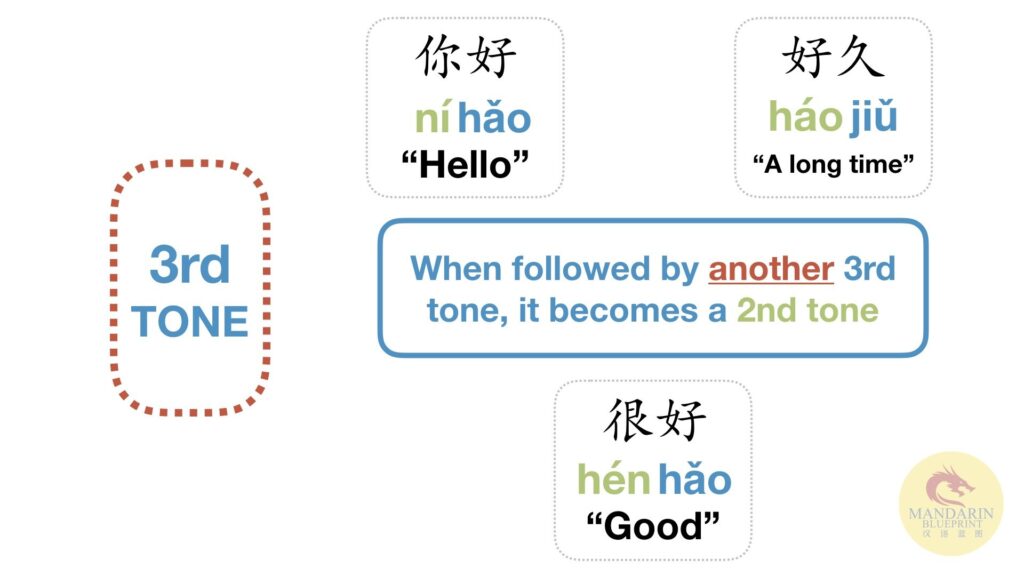
Now, let's dive into a more detailed explanation and see more examples.
Tone changes for third tones - Chinese Pronunciation Wiki
This article from the Chinese Pronunciation Wiki provides a concise and clear breakdown of the rule, complete with audio examples and a critical point about Pinyin spelling.
First, read the introduction under the heading "Tone Change Rule for Consecutive Third Tones" to solidify your understanding of the rule. Next, examine the tables of examples. The first table shows two-character words where the rule applies internally. The second table shows how the rule applies when two separate words are combined. You can click the audio icon for each example to hear the correct pronunciation. Finally, and this is crucial, read the section Why Tone Changes Are Not Written. This explains that Pinyin always shows the original tone of a character, not the pronounced tone after sandhi. You are expected to know and apply the rule yourself.
This last point is fundamental. Think of it as a simple algorithm you run during pronunciation:IF tone(syllable_N) == 3 AND tone(syllable_N+1) == 3, THEN pronounce syllable_N with tone 2.
The underlying data (nǐ hǎo) remains unchanged, but the output is transformed.
3. Hearing and Practicing the Rule
Let's reinforce this with another explanation and more audio practice.
The Third Tone in Depth (Tone Change Rules) | Beginner Lesson 17 | CHINESE FAQs
This video from Harbin Mandarin refers to the changed third tone as a "rising third tone" and provides clear examples.
Watch the segment explaining the rule for two consecutive third tones, from 7:34 to 8:35. The instructor demonstrates with 你好 (nǐhǎo) and 水果 (shuǐguǒ), which means "fruit". Practice saying these aloud, focusing on making the first syllable rise (like a second tone) and keeping the second syllable low (a half-third tone).
Practice Time
Here are some common HSK 1 words. Read the Pinyin (which shows the original third tones) and practice saying them aloud using the 2 + 3 pattern.
hěn hǎo(很 好) - very good -> Pronounce as:hén hǎokě yǐ(可 以) - can, may -> Pronounce as:ké yǐshuǐ guǒ(水 果) - fruit -> Pronounce as:shuí guǒyǔ sǎn(雨 伞) - umbrella -> Pronounce as:yú sǎn
4. What About Three Third Tones in a Row?
A logical next question is what happens with a sequence of three or more third tones, for example, in the phrase wǒ hěn hǎo (我 很 好), which means "I am very good."
In this scenario, things are a bit more flexible, but the core principle of avoiding consecutive third tones still applies. There are two common patterns:
- 2 + 2 + 3: The first two syllables become second tones.
wǒ hěn hǎo→wó hén hǎo
- 3 + 2 + 3: The phrase is broken into a natural group, with the first word staying a third tone and the sandhi applying to the second word.
wǒ hěn hǎo→wǒ hén hǎo
Both are correct and used by native speakers. For now, as a beginner, you don't need to master this. Focus entirely on the 3 + 3 rule, as it accounts for the vast majority of cases you'll encounter.
Conclusion
In this lesson, you've learned the most important tone change rule in Mandarin, moving from static syllables to the dynamics of connected speech.
Key Takeaways:
- Reason: The third-tone sandhi exists to make speech more fluid, as pronouncing two low, dipping third tones in a row is phonetically difficult.
- The Rule: When a third tone is followed by another third tone, the first one is pronounced as a second (rising) tone:
3 + 3 → 2 + 3. - Spelling vs. Pronunciation: Pinyin notation always uses the original third-tone mark. You must apply the pronunciation rule mentally.
This rule is automatic for native speakers, and with practice, it will become second nature for you as well.
In our next lesson, we will continue exploring tone sandhi by examining the specific pronunciation rules for two of the most frequent characters in Chinese: 一 (yī) and 不 (bù). Their tones also change based on the context, and mastering them is another critical step toward fluent pronunciation.