Introduction
Welcome to our final module: Capital Budgeting and Corporate Valuation. In the previous module, we focused on the 'financing decision'—how companies raise capital and decide on their capital structure. Now, we turn to the 'investment decision'—how they decide to spend that capital on long-term projects. This is the heart of corporate finance, where firms create value.
Our first step is to determine the relevant figures for making these investment decisions. This lesson focuses on the first learning outcome of this module: to calculate the after-tax cash flows of a capital project, incorporating corporation tax and capital allowances. We will learn how to move from a project's revenues and costs to the precise cash flow figures that form the basis of project appraisal techniques like Net Present Value (NPV), which we'll cover in subsequent lessons.
From Accounting Profit to After-Tax Cash Flow
When a company undertakes a project, it generates revenues and incurs costs. An accountant would calculate the accounting profit from these activities. However, for investment appraisal, we are interested in cash flows, not profits. Cash is what the company can actually spend, save, or return to investors.
The most critical adjustment to our cash flow projections is for tax. Companies pay corporation tax on their taxable profits, which represents a significant cash outflow. Therefore, all our project cash flows must be considered on an after-tax basis.
The fundamental calculation is to take the project's net operating cash inflow (revenues minus cash costs) and subtract the tax payable on it.
Let's look at a very simple example of a tax calculation.
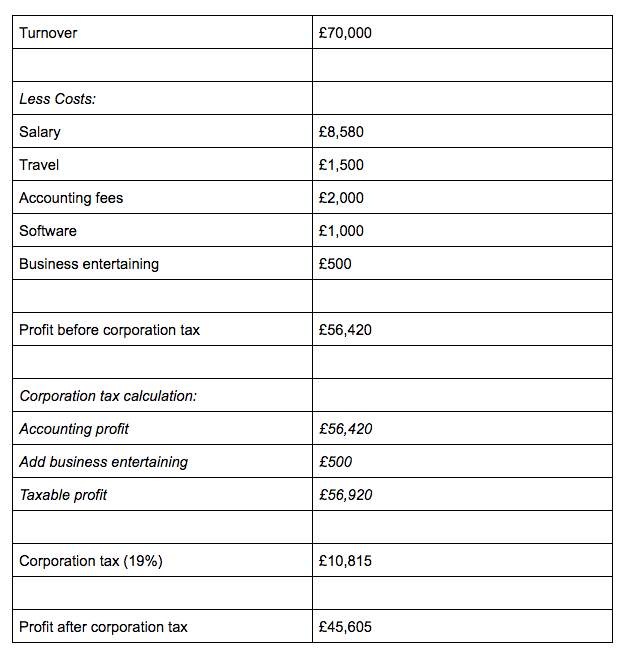
This simple example highlights a key point: taxable profit is not always the same as accounting profit. For project appraisal, our starting point is the taxable cash flow generated by the project.
The following video provides an excellent, intuitive walkthrough of converting pre-tax cash flows to an after-tax basis.
How to Calculate NPV with Taxes
The video "How to Calculate NPV with Taxes" by Edspira clearly breaks down the initial steps of finding after-tax cash flows.
Please watch the first part of this video. First, get an overview of the two-step process in the introduction. Next, understand the problem setup and the initial investment cash outflow in the example. Finally, focus on the calculation of the after-tax operating cash flow from this segment. The key formula here is: After-Tax Cash Flow = Pre-Tax Cash Flow × (1 - Tax Rate).
The Tax Shield of Capital Allowances
The video you just watched introduced an interesting element: depreciation. Depreciation is a non-cash accounting entry, so why does it affect our cash flow calculation? The answer lies in its effect on tax.
While depreciation itself isn't a cash flow, tax authorities allow companies to deduct a certain amount for the wear and tear on their assets when calculating taxable profit. In the UK and for your CB1 exam, this is known as a capital allowance or writing-down allowance (WDA).
Because capital allowances are a tax-deductible expense, they reduce the company's taxable profit, which in turn reduces the amount of tax it has to pay. This tax saving is a real cash benefit and is often called the tax shield.
The value of this tax shield is calculated as:
This tax shield is treated as a cash inflow in our project appraisal.
The process of calculating these allowances and their tax impact can be nuanced, especially concerning the timing of the tax payments. The following video explains the standard approach you'll need for your exam.
ACCA F9 - Advanced NPV with Inflation & Taxation | @financeskul
The video "ACCA F9 - Advanced NPV with Inflation & Taxation" from FinanceSkul provides a detailed, exam-focused explanation of incorporating tax and capital allowances.
Please watch the following segments carefully: First, understand the two key tax effects: corporation tax and capital allowances. Next, see how tax on operating cash flows is handled, paying close attention to the difference in timing when tax is paid in the same year versus one year in arrears. This delay is a common feature in exam questions. Finally, watch the detailed walkthrough of calculating the tax savings from writing-down allowances. Follow the step-by-step working that shows how the allowance is calculated each year on the reducing balance and how the resulting tax saving is determined.
Assembling the Full Project Cash Flow
Now we can bring all the pieces together to construct a complete schedule of a project's after-tax cash flows. A typical project will involve several types of cash flows over its life:
- Initial Investment (Capex): The cost of the asset, which is a cash outflow at the start of the project (Time 0).
- Operating Cash Flows: The net cash generated from sales less operating costs each year. We then calculate the tax on these profits.
- Tax Shield: The cash inflow from the tax saved due to capital allowances.
- Working Capital: Projects often require an investment in working capital (e.g., inventory). This is an outflow at the start of each period where it increases, and the full amount invested is typically recovered as a cash inflow at the end of the project. Importantly, changes in working capital are not tax-deductible.
- Scrap/Residual Value: The cash received from selling the asset at the end of the project. This is a cash inflow.
- Balancing Allowance/Charge: At the end of the project, the tax written-down value is compared to the scrap value.
- If Scrap Value < Tax WDV, it creates a balancing allowance (like a loss on disposal), resulting in a final tax saving (cash inflow).
- If Scrap Value > Tax WDV, it creates a balancing charge (like a profit on disposal), resulting in additional tax to pay (cash outflow).
The following reading from ACCA Global provides an excellent, comprehensive guide and a worked example that illustrates how all these elements fit together.
Investment appraisal | ACCA Global
This article explains the key areas of investment appraisal and provides a detailed calculation of a project's Net Present Value, starting with the after-tax cash flows.
Please read the following sections: Start with the "Key areas" section. This will give you a good summary of relevant cash flows, inflation, and the "good, the bad, and the ugly" of taxation. Next, review the problem data for the "CBS Co" example. Then, carefully study Working 1, which shows the calculation of the tax savings from capital allowances. Note how the tax cash flow is delayed by one year because tax is paid in arrears. Finally, examine the main NPV pro-forma table. For this lesson, focus only on understanding how the cash flow for each year (the "Total net money cash flows" row) is constructed. Don't worry about the discount factors or present values yet; we'll cover that in the next lesson. Notice how it's structured with a 'Revenue' section (for taxable items) and a 'Capital' section (for non-taxable items like working capital and the asset cost).
Let's look at another common layout for presenting project cash flows, this time for a real estate investment.

This pro-forma style, where you systematically list all inflows and outflows for each year of the project's life, is precisely what you'll need to master for the CB1 exam.
The key is to be methodical:
- Identify all relevant cash flows.
- Determine their timing (e.g., Year 0, Year 1, etc.).
- Calculate the tax on operating profits.
- Calculate the tax shield from capital allowances.
- Ensure the timing of the tax payments and tax shields is correct (e.g., paid in arrears).
- Sum up all cash flows for each year to get the net after-tax cash flow.
Conclusion
In this lesson, we have laid the essential groundwork for capital budgeting by learning how to calculate a project's after-tax cash flows. This is the most critical input for evaluating whether a project is financially viable.
Key Takeaways:
- Investment decisions are based on after-tax cash flows, not accounting profits.
- Tax on operating profit is a cash outflow, calculated on taxable cash flows:
Taxable Cash Flow × Tax Rate. - Capital allowances (tax depreciation) are not a cash flow, but they create a tax shield (
Capital Allowance × Tax Rate), which is a real cash saving and is treated as an inflow. - The timing of tax payments is crucial. Payments made 'in arrears' shift the cash flow to a later period.
- A complete project appraisal must also include the initial investment, changes in working capital, and any final scrap value.
You are now equipped to prepare the financial data needed to evaluate a capital project. In our next lesson, we will begin using this data, starting with two simple but useful appraisal techniques: the Payback Period and the Discounted Payback Period.