Introduction
In our previous lesson, we explored how companies decide to return cash to shareholders through dividend payments, weighing the theoretical irrelevance proposed by Modigliani and Miller against real-world factors like taxes and signaling. We now turn our attention to the main alternative to dividends: share buybacks, also known as share repurchases.
This lesson directly addresses your learning outcome to analyse the financial impact of share buybacks as an alternative to dividends on EPS and share price. We will start by understanding the mechanics of a buyback and its immediate, calculated effect on key financial metrics. You'll put your quantitative skills to work by analyzing how financing the buyback with either cash or debt alters the outcome. Finally, we'll step back to critically assess whether this financial engineering truly creates value for shareholders, comparing the strategic pros and cons of buybacks versus dividends. This lesson concludes our module on capital structure and payout policy.
What is a Share Buyback?
A share buyback occurs when a company uses its cash to repurchase its own shares from the open market or directly from shareholders. The immediate effect is twofold: the company's cash balance decreases, and the number of its shares outstanding also decreases. The repurchased shares are typically cancelled or held by the company as "treasury stock."
To get a clear picture of this process and the main ways companies execute it, the following video provides a concise introduction.
Stock Buybacks - The Good And The Bad Explained
The video "Stock Buybacks - The Good And The Bad Explained" from The Plain Bagel offers a straightforward definition of share buybacks.
Watch the initial segment (the introduction) which defines what a buyback is, explains the difference between a tender offer and an open market purchase, and clarifies that the shares are absorbed by the company, reducing the total share count.
Companies can choose from several methods to repurchase shares, each with different implications for timing and price. The video you just watched mentioned tender offers and open market purchases. For a more detailed look at the common methods, the following video from AnalystPrep provides a good overview.
Analysis of Dividends and Share Repurchases (2025 Level II CFA® Exam –Corporate Issuers–Module 1)
This video, part of a CFA Level II prep course, details the various share repurchase methods.
Please watch the section covering repurchase methods (repurchase methods). Pay attention to the descriptions of: Open Market Repurchase: The most common and flexible method. Dutch Auction: An interesting method where shareholders bid the price at which they're willing to sell. Fixed-Price Self-Tender Offer: An offer to buy a specific number of shares at a set price. Negotiated Repurchase: A direct purchase from a major shareholder.
The Financial Impact of Share Buybacks
The primary reason share buybacks are so appealing is their immediate, and often positive, impact on a key investor metric: Earnings Per Share (EPS).
Recall the formula for basic EPS:
By reducing the denominator (the number of shares), a buyback mechanically increases EPS, assuming net income remains the same. This can make the company appear more profitable on a per-share basis. If the market continues to value the company at the same Price-to-Earnings (P/E) ratio, this higher EPS will imply a higher share price.
Let's walk through a clear numerical example of this effect.
Stock Buyback | Formula + Calculator - Wall Street Prep
The article "Stock Buyback" from Wall Street Prep provides a simple and effective step-by-step calculation.
Please read the section titled "Stock Buyback Calculation Example". Follow the calculation that shows how a company with $2 million in net income can increase its EPS from $2.00 to $2.50 by repurchasing 200,000 shares, leading to an implied share price increase of 25% if the P/E ratio holds constant at 10x.
The calculation you just reviewed is visualized in the table below. It clearly shows the "before" and "after" scenario, highlighting the changes in shares outstanding, EPS, and the resulting share price.

The Effect of Financing
The example above assumed net income stays constant. However, the way a company pays for the buyback affects its net income. Let's analyze the two main scenarios:
- Financing with Surplus Cash: The company uses cash on its balance sheet. This cash was likely earning interest. By spending it, the company forgoes this interest income, which slightly reduces its net income. EPS will increase only if the earnings yield of the shares (EPS / Price) is greater than the after-tax return the company was earning on its cash.
- Financing with Debt: The company borrows money to fund the buyback. This increases the company's interest expense, which reduces net income. EPS will increase only if the earnings yield is greater than the after-tax cost of debt.
The following video provides detailed calculations for both scenarios, which is crucial for your exam preparation.
Analysis of Dividends and Share Repurchases (2025 Level II CFA® Exam –Corporate Issuers–Module 1)
We return to the AnalystPrep video, which offers excellent worked examples on the impact of financing a buyback.
Watch the segment on the effect on EPS (EPS impact). This section is critical. Focus on the two numerical examples: Repurchase financed by surplus cash: Follow the calculation from the cash example. Repurchase financed by debt: Follow the calculation from the debt example, and pay close attention to the rule explained at the end: EPS increases because the earnings yield (6%) was greater than the after-tax cost of debt (4%).
Does the EPS Boost Create Real Value?
At this point, share buybacks might seem like a straightforward way to boost a stock's price. However, we must question whether this mechanical increase in EPS translates to a genuine increase in the company's intrinsic value.
From the perspective of Modigliani and Miller, which we discussed in the last lesson, a share buyback should have no effect on shareholder wealth in a perfect market. A buyback is simply an exchange of assets: the company gives cash to some shareholders in exchange for their shares. The total value of the firm drops by the amount of cash paid out. While the remaining shareholders now own a larger percentage of a smaller firm, the value of their individual shares should, in theory, remain unchanged.
The following table neatly illustrates this point. Whether the company retains its cash, pays a dividend, or conducts a share buyback, the total value per share for the shareholder ends up being the same.
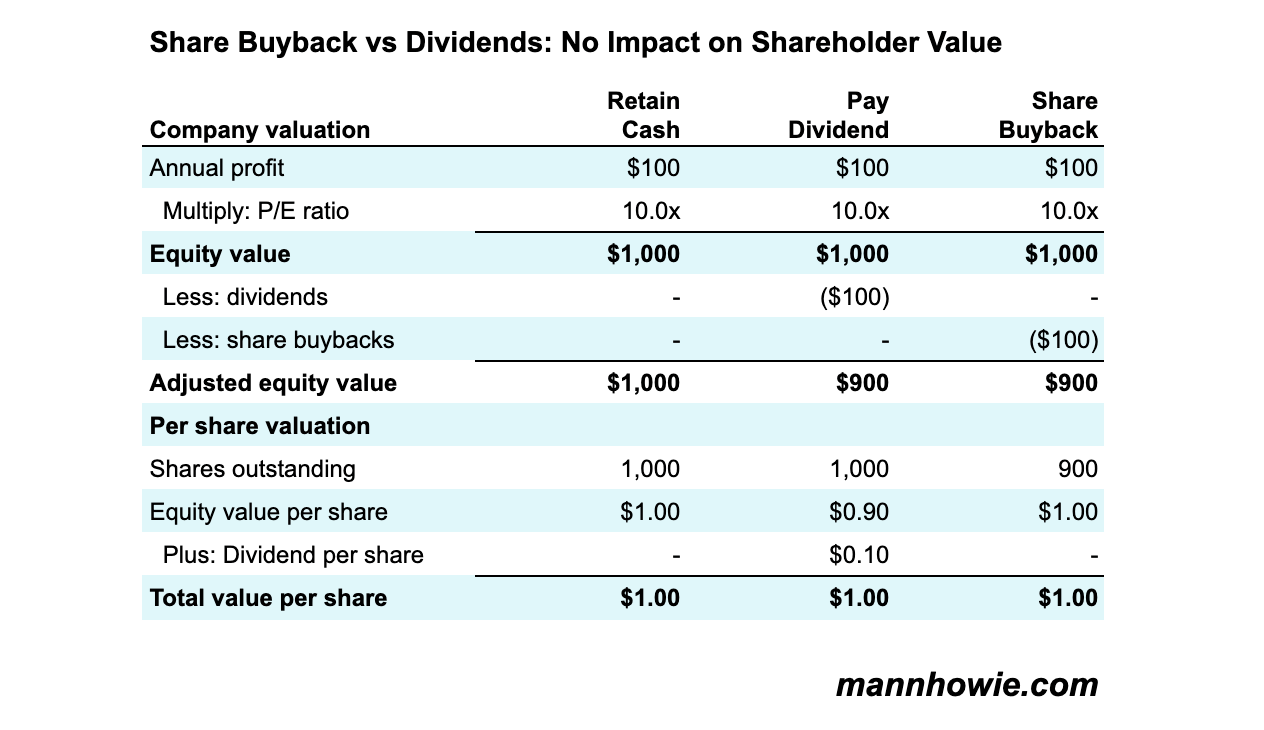
So how do we reconcile the "EPS boost" with the "no value creation" theory? A sophisticated analysis from McKinsey explains that the market isn't fooled by the mechanical EPS increase. Instead, the P/E ratio adjusts downwards to reflect the firm's new capital structure (less cash, which is a low-risk asset).
[PDF] The value of share buybacks - McKinsey
This article from McKinsey provides a sharp analysis challenging the simple "buybacks boost value" narrative.
Read the section titled "EPS may be up, but intrinsic value remains flat". The hypothetical example here is key. It shows how, even though EPS rises from €1.00 to €1.09 after the buyback, the P/E ratio falls from 15.0 to 13.8, resulting in the exact same share price of €15.00. This demonstrates that any mechanical EPS increase can be offset by a reduction in the company’s P/E ratio.
Buybacks vs. Dividends: The Strategic Choice
If buybacks don't automatically create value, why have they become so popular, often preferred over dividends? The choice between these two methods of returning cash to shareholders comes down to a few critical real-world factors.
- Taxation: For many investors, buybacks are more tax-efficient. A dividend is typically taxed as income in the year it is received. A buyback increases the value of the remaining shares, and investors only pay capital gains tax when they choose to sell, allowing for tax deferral. If capital gains tax rates are lower than income tax rates, the advantage is even greater.
- Flexibility: A company can start, stop, or adjust a share buyback program with little negative signaling. In contrast, once a company establishes a regular dividend, investors expect it to continue. Cutting a dividend is seen as a major sign of trouble and is punished severely by the market.
- Signaling: While a dividend increase signals confidence in stable, future earnings, a buyback announcement often signals that management believes the company's shares are currently undervalued. It's a strong statement that they believe the best investment the company can make is in itself.
The following short video segment and reading selection summarize these key differences.
Stock Buybacks - The Good And The Bad Explained
The Plain Bagel video provides a succinct comparison between buybacks and dividends.
Watch the portion of the video that compares the two (buybacks vs. dividends). It directly addresses the similarity in purpose and the key difference in tax treatment.
Stock Buyback | Formula + Calculator - Wall Street Prep
The Wall Street Prep article also offers a clear comparison.
Read the section "Stock Buyback vs. Dividend". This reinforces the concepts of tax advantages and managerial flexibility.
Conclusion
We have completed our analysis of share buybacks, the primary alternative to dividends for returning cash to shareholders. You are now equipped to analyze their financial impact, a key requirement for your CB1 exam.
Key Takeaways:
- Mechanical EPS Impact: A share buyback reduces the number of shares outstanding, which mechanically increases Earnings Per Share (EPS), assuming net income is constant.
- Financing Matters: The EPS increase is muted if the buyback is financed with cash (due to lost interest income) or debt (due to new interest expense). EPS only rises if the firm's earnings yield is higher than the after-tax cost of the funds used.
- Value Creation is Not Automatic: In a perfect market, a buyback does not create value. The increase in EPS is offset by a corresponding decrease in the P/E ratio, leaving the share price unchanged. The firm's total value decreases by the amount of cash spent.
- Real-World Advantages: Buybacks are popular due to significant real-world advantages over dividends, primarily greater tax efficiency for shareholders and greater managerial flexibility for the company. They also serve as a powerful signal that management believes the stock is undervalued.
This lesson marks the end of Module 11. You have built a strong understanding of how companies finance their operations and how they make critical decisions about their capital structure and payout policies.
In our next lesson, we will begin our final module, Capital Budgeting and Corporate Valuation. We will start by learning how to evaluate the financial viability of long-term investment projects, a core activity for any business.