Introduction
In our last lesson, we delved into Net Present Value (NPV), a powerful tool that tells us the absolute monetary value a project is expected to add to a company. While NPV is a cornerstone of investment appraisal, managers and investors often find it intuitive to think in terms of percentage returns. This brings us to our topic for today: the Internal Rate of Return (IRR).
This lesson will introduce you to the IRR, a metric that measures a project's expected rate of return in percentage terms. We will cover how to calculate it using a method you'll need for your CB1 exam, and critically, we'll evaluate the significant limitations of IRR. This second part is crucial, as understanding when IRR can be misleading is just as important as knowing how to calculate it.
What is the Internal Rate of Return?
Let's start with a formal definition. The Internal Rate of Return is the discount rate at which the Net Present Value (NPV) of a project's cash flows equals zero.
Recall the NPV formula from our previous lesson:
To find the IRR, we set NPV to zero and solve for the rate, which we call the IRR:
In simpler terms, the IRR is the project's "break-even" discount rate. It represents the true underlying percentage return generated by the investment.
The decision rule is very intuitive:
- If IRR > Cost of Capital (or hurdle rate): The project is expected to earn more than it costs to finance. Accept.
- If IRR < Cost of Capital: The project is not generating enough return to cover its financing costs. Reject.
Calculating the IRR: Trial, Error, and Interpolation
Solving the IRR equation directly for the IRR variable is a complex mathematical task, as it involves finding the roots of a polynomial. For your exam and for practical understanding, you are expected to know how to estimate the IRR using a method called linear interpolation.
The process involves a bit of trial and error:
- Calculate the NPV of the project using a "guess" discount rate.
- If the NPV is positive, it means our guess rate is lower than the true IRR. We need to try a higher rate to bring the NPV down towards zero.
- If the NPV is negative, our guess rate is higher than the true IRR. We need to try a lower rate to bring the NPV up towards zero.
- The goal is to find two discount rates—one that yields a positive NPV and another that yields a negative NPV. The true IRR must lie somewhere between these two rates.
The graph below illustrates this relationship. The IRR is the point where the NPV profile crosses the horizontal axis (where NPV is zero).
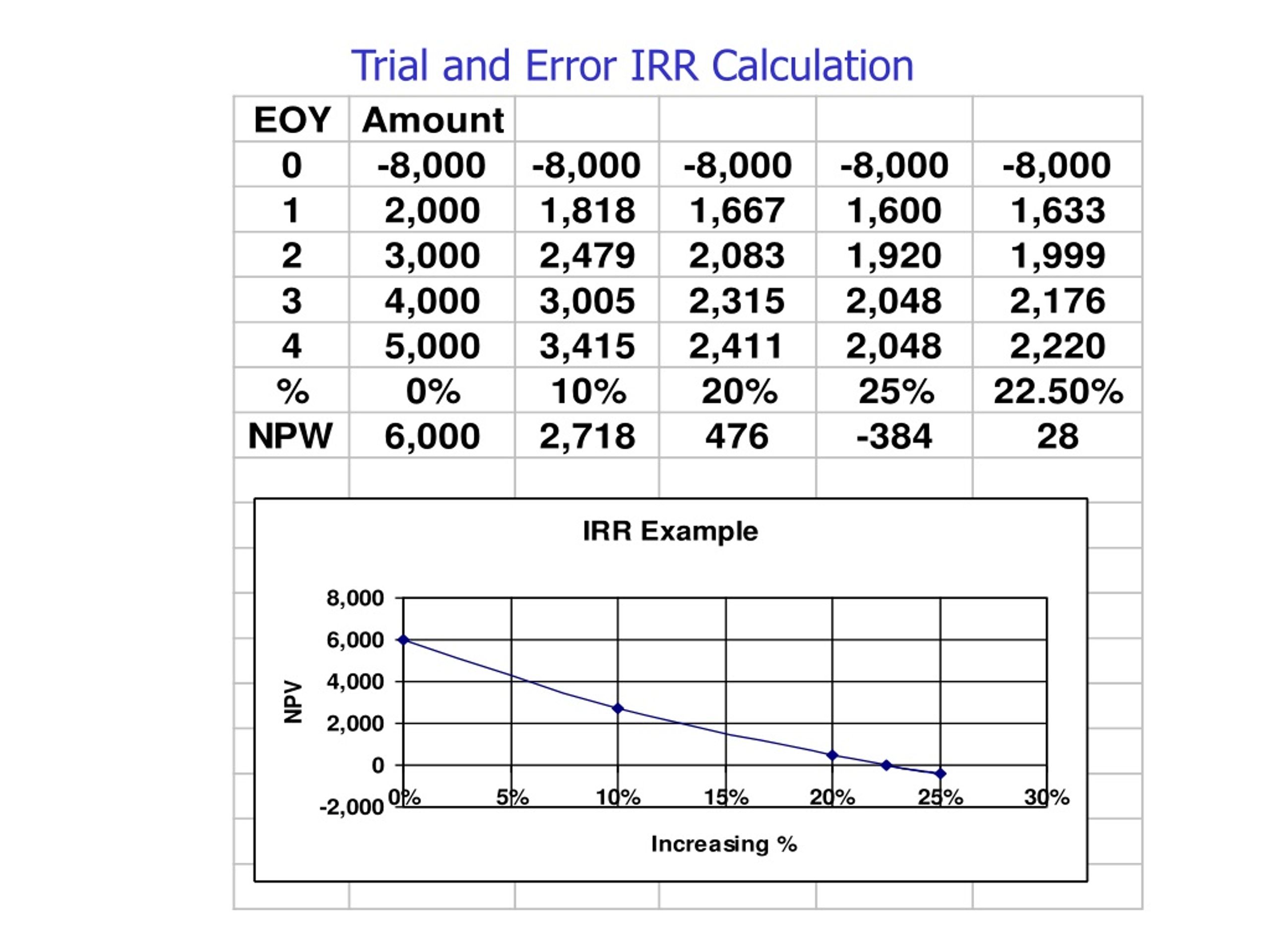
Once we have our two rates (a lower rate with a positive NPV, , and a higher rate with a negative NPV, ), we can estimate the IRR using the linear interpolation formula:

The formula is:
Let's see this entire process in action. The following video provides an excellent, step-by-step walkthrough of an IRR calculation, which is exactly the kind of question you can expect in your exam.
#5 Internal Rate of Return (IRR) - Investment Decision - Financial Management ~ B.COM / CMA / CA
This video from Saheb Academy clearly defines IRR and demonstrates the full calculation process using interpolation.
Please watch the following segments carefully: IRR Definition and Decision Rule: This section explains what IRR is and how to use it to accept or reject a project. The Interpolation Method: Pay close attention to the logic of finding one positive and one negative NPV, and the introduction of the interpolation formula. Complete Worked Example: Follow this numerical example from start to finish. It shows how to pick initial rates, calculate two NPVs, and then plug the results into the interpolation formula to find the final IRR.
The Limitations of IRR
While IRR is popular for its intuitive percentage format, it has several serious theoretical flaws. In certain situations, it can lead to incorrect investment decisions. It's crucial to understand these weaknesses.
The video below provides clear examples of when IRR can be problematic.
The video "NPV vs IRR" from Edspira highlights the key scenarios where IRR fails and why NPV is generally superior.
Watch these key sections that explain the main drawbacks of IRR: Multiple IRRs: See how projects with non-conventional cash flows (e.g., negative, then positive, then negative again) can result in more than one IRR, making the decision rule ambiguous. No IRR: This segment shows that for some cash flow patterns, there might be no real discount rate that makes the NPV zero. Mutually Exclusive Projects: This is a critical point. Watch how IRR can rank projects incorrectly when they are of different sizes (scales). It might favour a smaller project with a high percentage return over a larger project that adds more absolute value (higher NPV).
Let's summarize these limitations and add one more subtle but important point.
-
Mutually Exclusive Projects (The Scale Problem): As the video showed, IRR is a relative measure (a percentage), while NPV is an absolute measure (in currency). When choosing between two projects where you can only pick one, you should always choose the project that adds the most value. IRR can be misleading here; a project with a lower IRR but a much larger initial investment can have a much higher NPV. When NPV and IRR give conflicting rankings for mutually exclusive projects, always trust NPV.
-
Non-Conventional Cash Flows (Multiple IRRs or No IRR): A conventional project has one initial cash outflow followed by a series of cash inflows (a
-, +, +, +pattern). Non-conventional projects have cash flows that change signs more than once (e.g., a project requiring a large decommissioning cost at the end, giving a-, +, +, -pattern). Such projects can have multiple IRRs or no IRR at all, making the metric unreliable. NPV handles these patterns without any issue. -
The Reinvestment Rate Assumption: This is a more theoretical but important weakness. The IRR calculation implicitly assumes that any intermediate cash flows generated by the project can be reinvested at the IRR itself. If a project has a very high IRR (e.g., 40%), this assumption is often unrealistic, as the company is more likely to reinvest funds at its normal cost of capital (e.g., 10-15%). This can overstate the project's true profitability. NPV, by contrast, implicitly assumes reinvestment at the discount rate (the cost of capital), which is a more reasonable and consistent assumption.
To better understand this final point, please read the following brief explanation.
Using NPV and IRR in Project Investment Decisions
This section of the article clearly explains the problematic reinvestment rate assumption inherent in the IRR calculation and contrasts it with NPV's more realistic assumption.
Please read the section titled The Reinvestment Rate Assumption. Focus on why assuming reinvestment at the IRR can be unrealistic and why NPV's assumption is considered more sound.
Conclusion
In this lesson, we explored the Internal Rate of Return, a widely used capital budgeting metric. We saw that it provides an intuitive measure of a project's percentage return and learned the practical steps of calculating it using interpolation.
However, the most critical part of this lesson is understanding IRR's weaknesses. While it works well for simple, independent projects, its flaws become apparent when dealing with mutually exclusive projects or non-conventional cash flows.
Key Takeaways:
- IRR is the break-even discount rate where a project's NPV equals zero.
- The decision rule is to accept projects where the IRR exceeds the cost of capital.
- IRR is calculated using trial and error and linear interpolation to estimate the rate between a positive and negative NPV.
- IRR has significant limitations:
- It can lead to incorrect rankings for mutually exclusive projects due to the scale problem.
- It can yield multiple or no solutions for projects with non-conventional cash flows.
- It relies on an often unrealistic reinvestment rate assumption.
- The Golden Rule: When NPV and IRR provide conflicting decisions, NPV is the theoretically superior method and should be followed.
In our next lesson, we will continue to build on our project appraisal toolkit by addressing a real-world complication: inflation. We will learn how to incorporate inflation into our NPV calculations to ensure our investment decisions are based on sound, real-terms analysis.