Introduction
In our previous lessons on NPV and IRR, we worked with cash flow forecasts to determine whether a project adds value. However, we have so far ignored a crucial real-world factor: inflation. Inflation erodes the purchasing power of money over time, meaning a dollar received in the future is worth less than a dollar today, not just because of the time value of money, but because it will buy less. Ignoring this can lead to a significant overestimation of a project's profitability.
Today's lesson will equip you with the tools to properly incorporate inflation into your capital project appraisals. Your learning outcome is to be able to perform these calculations using two distinct but equivalent methods: the nominal approach and the real approach. Mastering both is essential for your CB1 exam, as questions are often structured to test your ability to choose the most appropriate method for a given scenario.
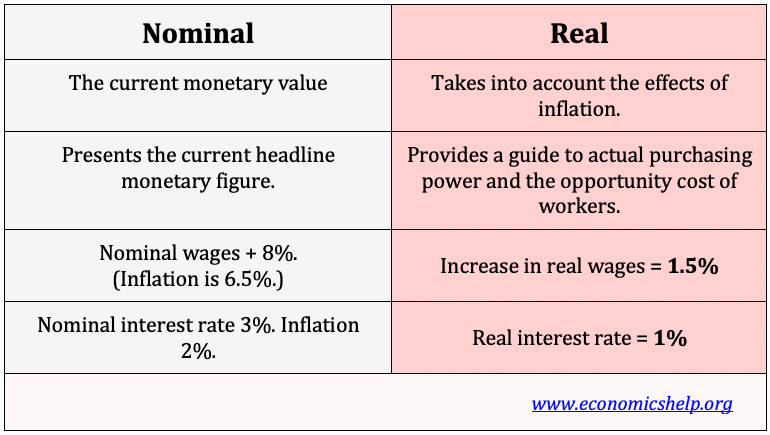
What are Real and Nominal Values?
Before we dive into the calculations, we must be crystal clear on the terminology. The distinction between 'real' and 'nominal' is fundamental to finance.
- Nominal values refer to the actual, monetary amounts of cash that are expected to be received or paid at a future date. They are sometimes called 'money' or 'inflated' values.
- Real values refer to the value of those cash flows in terms of today's purchasing power. They are expressed in 'constant' or 'today's' prices, with the effect of inflation stripped out.
The same distinction applies to discount rates:
- A nominal discount rate is the market rate you would typically see quoted (e.g., by a bank). It includes a premium to compensate investors for expected inflation.
- A real discount rate represents the rate of return in terms of pure purchasing power, excluding the effect of inflation.
The relationship between these rates is formally described by the Fisher formula:
Where:
- = nominal rate of interest
- = real rate of interest
- = the rate of general inflation
This formula is essential, as it allows us to convert between nominal and real rates. To solidify these core concepts, please review the following text.
Inflation and investment appraisal | ACCA Qualification | Students
This article from ACCA Global lays out the fundamental concepts of inflation in project appraisal.
Please read the following three sections: The first section to see how cash flows are inflated over time. General and specific inflation to understand the difference between a single economy-wide inflation rate and different rates for various project costs/revenues. This is a very important practical distinction. Real and nominal costs of capital to understand the Fisher formula, which connects these two rates.
The Two Consistent Approaches
The golden rule for handling inflation in DCF analysis is to be consistent. You must not mix and match real and nominal terms. This gives rise to two valid approaches:
- The Nominal Terms Approach: Discount nominal (inflated) cash flows at the nominal discount rate.
- The Real Terms Approach: Discount real (uninflated, current-price) cash flows at the real discount rate.
If both methods are applied correctly, they will produce the same Net Present Value. The choice of which to use often comes down to which is more convenient based on the data provided in the problem.
Let's see this principle stated clearly in a solved problem from a university resource.
[DOC] Chapter 7: Net Present Value and Capital Budgeting
This document from Wharton provides solved problems that crisply illustrate the core principle.
Please read problem 7.13. Focus on the very first two sentences which state the consistency principle, and then see how the real discount rate is calculated and applied to 'Project A' (with real cash flows) while the nominal rate is applied to 'Project B' (with nominal cash flows).
The Nominal Approach in Practice
This is the most common and robust method, especially when a project's revenues and various costs are expected to inflate at different rates (specific inflation).
The steps are:
- Start with your project cash flows estimated at today's prices (Year 0 prices).
- Inflate each line item (e.g., sales revenue, variable costs) for each future year using its specific inflation rate. This gives you the nominal cash flows. Remember that inflation compounds, so for year , the factor is .
- Calculate the net nominal cash flow for each year.
- Discount these net nominal cash flows using the nominal cost of capital to find the NPV.
The following video gives an excellent practical demonstration of this process in a spreadsheet, which mirrors the environment of the CB1 exam.
NPV Exam Technique SIMPLIFIED | ACCA FM / F9 | Question Darn D13
This video by Steve Willis ACCA provides a great walkthrough of the nominal approach using a spreadsheet.
Please watch the section from dealing with inflation. Pay close attention to how he: Takes the uninflated (current price) sales and costs. Creates new rows for "inflated sales" and "inflated costs," applying a compounding inflation factor year-on-year. Calculates the net cash flow from these inflated figures. Confirms that since he is using inflated (nominal) cash flows, he must use the given nominal discount rate (12%) to find the NPV.
The Real Approach and Proving Equivalence
The real terms approach is often simpler if all project cash flows are expected to inflate at the same, single rate of general inflation.
The steps are:
- Start with your project cash flows estimated at today's prices. These are your real cash flows. You do not inflate them.
- Take the nominal cost of capital and use the Fisher formula to convert it into a real cost of capital:
- Discount the real cash flows using the calculated real discount rate to find the NPV.
The next video provides a perfect illustration. It first calculates an NPV using the nominal method, and then recalculates it using the real method on the same project, demonstrating that they produce the same result.
Relevant Cash Flows for DCF – Inflation effective rates - ACCA Financial Management (FM)
The OpenTuition video you are about to watch demonstrates both approaches on the same simple example, proving they lead to the same result.
First, watch the section covering the Nominal Approach from the normal way. This will be a quick review of what you just saw in the previous video. Next, watch the demonstration of the Real Approach from the alternative. Observe how the presenter: Calculates the real cost of capital from the nominal rate using the Fisher formula. Discounts the uninflated (real) cash flows using this new real rate. Arrives at the same NPV (allowing for minor rounding differences), proving the two methods are equivalent.
Exam Technique: Which Method Should You Use?
In the CB1 exam, you won't always be told which method to use. You need to be able to identify the best approach from the information provided.
Here are the key rules:
- If a question provides different (specific) inflation rates for revenues, costs, etc., you must use the nominal approach. This is the only way to correctly account for the fact that the project's profit margin will change over time in real terms.
- If a question involves a perpetuity (a cash flow stream that continues forever) that grows with inflation, you must use the real approach. It is impossible to list and inflate an infinite series of nominal cash flows.
- If a question explicitly gives you some figures in nominal terms and others in real terms (e.g., nominal cash flows but a real discount rate), you must convert one to be consistent with the other. The path of least resistance is usually the best choice.
The final section of the OpenTuition video provides an excellent summary of these exam-critical points.
Relevant Cash Flows for DCF – Inflation effective rates - ACCA Financial Management (FM)
This final clip from the OpenTuition video provides crucial exam advice on when to apply each method.
Watch from when this is relevant. Pay close attention to the specific scenarios he outlines: What to do when you have different inflation rates. Why the real approach is necessary for perpetuities. How to handle a question that gives you a real cost of capital but requires you to work with nominal cash flows.
Conclusion
Today we have addressed the critical issue of inflation in investment appraisal. We've established the fundamental difference between real and nominal values and learned how to move between them using the Fisher formula. Most importantly, you now have two consistent frameworks for calculating NPV in an inflationary environment.
Key Takeaways:
- Failing to account for inflation leads to incorrect investment decisions.
- The Nominal Approach involves discounting inflated (nominal) cash flows with a nominal discount rate. This is the most versatile method, especially with specific inflation rates.
- The Real Approach involves discounting uninflated (real) cash flows with a real discount rate. This is useful for perpetuities or when a single inflation rate applies.
- The Fisher formula, , is the key to converting between the two rate types.
- Both methods, when applied correctly, yield the same NPV. Your choice of method should be driven by the specifics of the exam question.
In our analyses so far, we have used single-point estimates for variables like sales volume and costs. But these are forecasts, not certainties. In our next lesson, we will explore sensitivity analysis, a technique used to understand how our project's final NPV changes when these key assumptions are varied. This will be our first step in formally analysing project risk.