Introduction
In our last lesson, we explored the payback and discounted payback periods. We learned they are useful for assessing liquidity and risk but have a critical flaw: they ignore all cash flows that occur after the investment is recovered. This means they can't measure a project's total profitability.
Today, we move to a superior capital budgeting technique that overcomes this very limitation: Net Present Value (NPV). NPV is arguably the most important concept in investment appraisal because it considers all of a project's expected cash flows over its entire life. In this lesson, we will define NPV, learn the step-by-step process for calculating it, and apply the NPV decision rule to determine whether a project is financially acceptable.
The Core Idea: What is Net Present Value?
At its heart, NPV answers a simple question: "After accounting for the time value of money, how much value will this project add to the company?"
The "time value of money" is a concept you're already familiar with from our previous lesson—a pound today is worth more than a pound in the future. NPV systematically applies this by discounting all future cash flows back to their value in today's terms (their "present value") and then summing them up. The initial investment, which occurs today (at time t=0), is treated as a negative cash flow.
The result is a single number—the Net Present Value—that represents the total increase or decrease in firm value if the project is undertaken.
For a clear definition and a conceptual overview, please read the first few sections of the following article.
Net Present Value (NPV): Definition, Formula, and Calculation - CLFI
This article from CLFI provides a concise and clear explanation of what NPV is and how it works.
Please read the sections titled What Is Net Present Value and How NPV Works. Focus on understanding why NPV is a measure of value creation and how it uses the time value of money principle.
The NPV Formula
The logic described above is captured in the following formula:
Where:
- = The net cash flow in period
- = The discount rate per period (often the company's cost of capital)
- = The time period (e.g., year)
- = The total life of the project
This can also be written by separating the initial investment (), which is already in present value terms:
This second form is often more practical for calculations, as it clearly separates the sum of the present values of future inflows from the initial outflow.
Calculating Net Present Value: A Step-by-Step Guide
Now, let's turn to the practical calculation. The process is systematic and can be broken down into a few key steps. A great way to learn this is to watch a comprehensive worked example.
The following video walks through the entire process, from understanding the core concepts to comparing two different projects, which is a common exam-style question.
#4 Net Present Value (NPV) - Investment Decision - Financial Management ~ B.COM / BBA / CMA
This video from Saheb Academy provides an excellent, detailed walkthrough of an NPV calculation.
Please watch the following segments carefully: Conceptual Foundation: This section reinforces the definition of NPV and the crucial concepts of time value of money and discounting. NPV Format and Decision Rule: Pay close attention to the standard four-column layout (Year, Cash Flows, Discounting Factor, Present Value) and the clear decision rules presented. Worked Example (Project X & Y): Follow the step-by-step calculation for both projects. Notice how the initial investment is a negative cash flow at Year 0, and how the scrap value is included as a cash inflow in the final year. Calculating Discount Factors: This is a critical practical skill. The video shows a calculator trick to quickly find discount factors if they aren't provided in the question. The Final Decision: The video concludes by applying the decision rule to select the better of the two projects.
The NPV Decision Rule
As you saw in the video, the rules for making a decision based on NPV are straightforward and powerful:
-
For a single project:
- If NPV > 0: The project is expected to generate a return higher than the company's cost of capital. It will add value to the firm. Accept the project.
- If NPV < 0: The project is expected to earn less than the cost of capital. It will destroy firm value. Reject the project.
- If NPV = 0: The project is expected to earn exactly the cost of capital. It adds no value but doesn't destroy any either. The firm is theoretically indifferent.
-
For mutually exclusive projects (where you can only choose one):
- Calculate the NPV for each project.
- Choose the project with the highest positive NPV.
This rule directly links project selection to the primary corporate finance goal of maximizing shareholder wealth. A project with a positive NPV increases the value of the firm, which should be reflected in its share price over the long term.
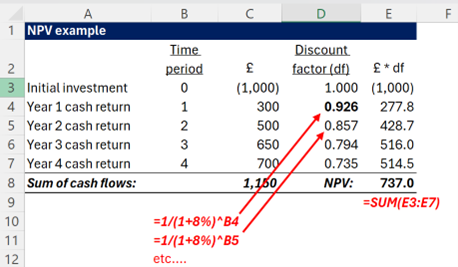
Let's look at how this calculation appears in a spreadsheet, which is how it's often done in practice.
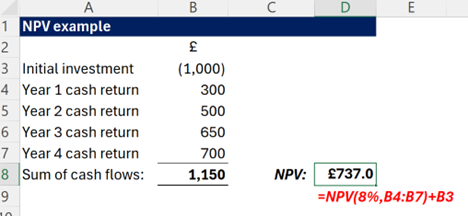
Modern spreadsheet software also has built-in functions to speed this up.
A Complete Example
To solidify your understanding, let's review one more comprehensive, text-based example.
Net Present Value (NPV): Definition, Formula, and Calculation - CLFI
This section of the CLFI article provides another clear, step-by-step numerical example.
Read through the Applied Example, starting from the section the full example. Follow the six steps, which cover: Understanding the formula. Calculating the discount factors. Discounting each cash flow. Calculating the final NPV. Interpreting the result and applying the decision rule. This will reinforce the process you saw in the video.
Conclusion
This lesson has introduced Net Present Value (NPV) as a robust tool for capital investment appraisal. By discounting all of a project's future cash flows to their present value, NPV provides a single metric that represents the project's expected contribution to firm value.
Key Takeaways:
- NPV measures value creation: It calculates the difference between the present value of future cash inflows and the initial investment.
- It accounts for the time value of money: Future cash flows are discounted to reflect that money today is more valuable than money in the future.
- The calculation is systematic: It involves identifying all cash flows, selecting a discount rate, calculating the present value of each cash flow, and summing them up.
- The decision rule is clear and powerful: Accept projects with a positive NPV, as they are expected to increase shareholder wealth. When choosing between projects, select the one with the highest positive NPV.
Unlike the payback methods, NPV considers the size and timing of all cash flows over a project's entire life, making it a far more reliable indicator of profitability.
In our next lesson, we will explore another discounted cash flow technique, the Internal Rate of Return (IRR). While NPV tells us how much value a project creates in absolute monetary terms, IRR tells us the project's expected rate of return in percentage terms. Understanding both will give you a comprehensive toolkit for project evaluation.