Introduction
In our last lesson, we examined the stark financial consequences of a company's failure, establishing that the limited liability enjoyed by shareholders shifts financial risk onto creditors. This protection is a cornerstone of the limited company structure. Now, we will build on that foundation by exploring the two main forms these companies take: the Private Limited Company (Ltd) and the Public Limited Company (PLC).
This lesson directly addresses the learning outcome of comparing the characteristics of these two company types. We will analyse their fundamental differences in ownership, capital-raising ability, and regulatory obligations. Understanding this distinction is crucial, as the choice between an Ltd and a PLC is one of the most significant strategic decisions a business can make, dictating its potential for growth and the level of control its owners can retain.
The Private Limited Company (Ltd): Control and Privacy
The vast majority of companies in the UK are private limited companies. This is the default structure for most startups, family businesses, and small to medium-sized enterprises (SMEs). Its defining feature is that its shares are held privately; they cannot be offered for sale to the general public.
To understand the core features, advantages, and disadvantages of an Ltd, let's start with a video overview.
The video "Private Limited Companies" by Bizconsesh provides a clear and concise introduction to this business structure.
Please watch the following segments: Key Features: Focus on who can be a shareholder and the critical point that shares are not sold on a stock exchange. Advantages: Note the benefits of retaining control over who becomes a shareholder and the availability of both debt and equity finance (albeit from private sources). Disadvantages: Pay attention to the limitations on raising finance and the legal requirement to publish financial accounts, which makes some information public.
As the video explains, the private limited company structure offers a balance between the formal protection of limited liability and the operational flexibility needed by smaller businesses. Let's synthesise the key characteristics:
- Ownership & Share Trading: Shares are owned by a relatively small number of private individuals or other companies. They can only be transferred privately, often requiring the approval of other shareholders.
- Raising Capital: This is the main constraint. Capital is raised from the founders' own funds, private investors (like "angel investors" or venture capitalists), and bank loans. They cannot access the huge pools of capital available on public stock markets.
- Control: The founders and initial investors typically maintain tight control over the company's direction. There is less risk of hostile takeovers or pressure from a large, dispersed body of external shareholders.
- Regulatory Burden: While Ltds must register with Companies House and file annual accounts, the requirements are less onerous than for PLCs. For example:
- There is no minimum share capital requirement.
- Only one director is needed.
- An annual audit is not required unless the company exceeds a certain size threshold (e.g., turnover above £10.2 million).
- Annual General Meetings (AGMs) are not mandatory.
The Public Limited Company (PLC): Growth and Scrutiny
When a company reaches a size where its need for capital outstrips what private markets can provide, it may consider "going public" and becoming a Public Limited Company. This transformation allows it to offer shares to the general public on a stock exchange, like the London Stock Exchange.
The following video discusses the fundamental differences between public and private companies, particularly from a financial market perspective. While it uses US examples like the SEC (Securities and Exchange Commission), the principles are directly applicable to the UK's FCA (Financial Conduct Authority).
The Difference Between Public and Private Companies
This video from Charles Schwab, "The Difference Between Public and Private Companies," clearly explains the transition to becoming a public entity.
Watch the entire video, paying close attention to: The definition of public versus private ownership at the beginning. The significant differences in financial disclosure requirements. The process of becoming public through an Initial Public Offering (IPO) and the reasons a company might choose this path, as well as the risks involved.
Becoming a PLC is a transformative event. It unlocks vast potential for growth but comes at a significant cost in terms of control and compliance.
- Ownership & Share Trading: Shares are freely transferable and can be bought and sold by anyone on a public stock exchange.
- Raising Capital: This is the primary advantage. A PLC can raise substantial amounts of capital by issuing shares to the public through an IPO and subsequent share issues.
- Control: The original owners' control is diluted as ownership spreads among thousands of public shareholders. The company becomes more vulnerable to takeover bids and must answer to its shareholders, who can vote on key decisions.
- Regulatory Burden: The compliance requirements are far stricter, designed to protect public investors.
- In the UK, a PLC must have a minimum share capital of £50,000, of which at least 25% (£12,500) must be paid up.
- It must have at least two directors and a qualified company secretary.
- It is subject to stringent rules from regulators like the FCA and the London Stock Exchange.
- It must publish detailed, audited financial statements and hold an AGM for shareholders.
Head-to-Head Comparison
To consolidate these points, let's review a detailed comparison of the features of PLCs and Ltds.
What's the Difference Between Public & Private Limited Company
This article from ANNA Money provides an excellent, UK-focused breakdown of both company types.
Please read the following sections: First, review the section defining PLCs and their key characteristics. Next, read the section defining Ltds and their corresponding characteristics. Focus on how the requirements for capital, directors, and reporting differ between the two.
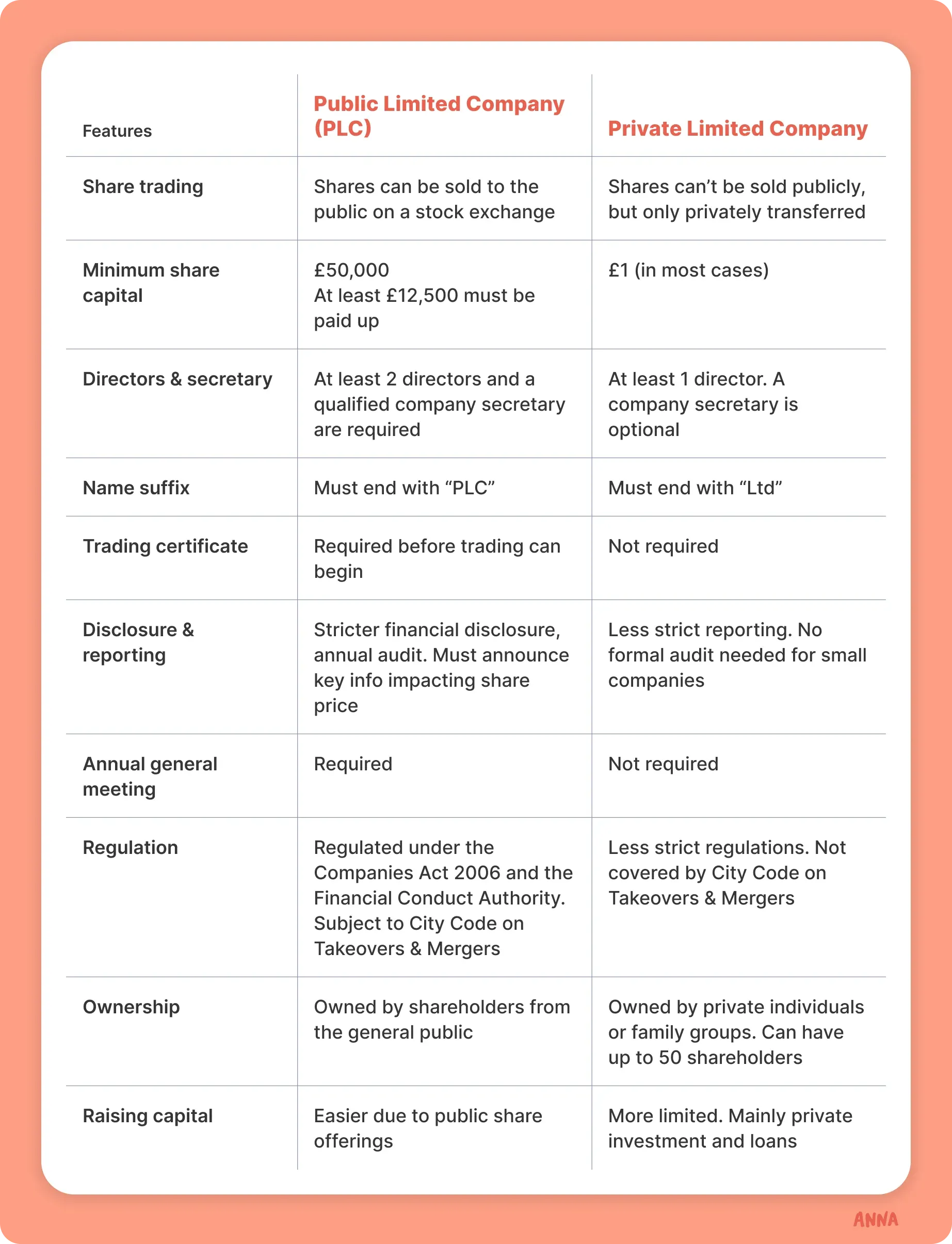
The differences discussed in the article are neatly summarised in the table below. This provides a clear, at-a-glance reference for the key distinctions that you are expected to know for the CB1 exam.
Practical Application: An Exam-Style Question
Let's apply this knowledge to a typical exam scenario. This type of question tests your ability to recommend a business structure based on its financing needs.
[PDF] Objective Based Assessment - CB1 Specimen Examination
This is an official specimen exam paper from the Institute and Faculty of Actuaries.
Focus on Question 13. Read the scenario carefully and decide which of the four options is the only appropriate structure.
Analysis of the Question:
The business has three key considerations, but one is decisive:
- They want limited liability. This rules out a sole tradership or a standard partnership, but leaves LLP, Ltd, and PLC as possibilities.
- They need to raise £200 million. This is a very large sum, difficult for an Ltd to raise privately.
- They expect at least 40% of the funding (£80 million) to come from equity raised through a Stock Exchange.
This third point is the critical factor. The ability to issue shares on a stock exchange is the exclusive domain of a Public Limited Company (PLC). Therefore, despite the complexities, a PLC is the only structure that meets their stated funding requirements.
Conclusion
We have now clearly distinguished between the two main types of limited companies. The choice is fundamentally a trade-off between control and capital.
Key Takeaways:
- Private Limited Companies (Ltds) offer limited liability with greater privacy, tighter control for the owners, and a lower regulatory burden. Their ability to raise capital is constrained to private sources.
- Public Limited Companies (PLCs) have unparalleled access to capital from the public via stock exchanges, enabling significant growth and expansion. This comes at the cost of diluted owner control, intense public scrutiny, and a heavy compliance and reporting burden.
- The decision to become a PLC is driven by a need for capital that cannot be met by private means, as illustrated in the exam question.
In our previous lesson, we saw the consequences of company failure. In this lesson, we've defined the main types of companies. In our next session, we will bring these themes together by examining the precise priority of claims in a company liquidation, detailing the "pecking order" for how different creditors and shareholders are paid when a company is wound up.