Introduction
Welcome to the first lesson of our new module on business taxation. In our previous module, we concluded by examining the consequences of corporate failure, specifically the strict hierarchy of payments in a liquidation. That process highlighted how legal and financial structures allocate risk. Now, we shift our focus from the internal financial structure of a company to a powerful external force that shapes its decisions: taxation.
This lesson addresses the fundamental principles of taxation. We will begin by distinguishing between the two primary categories of taxes—direct and indirect—and then explore their economic effects on businesses, consumers, and the economy as a whole. Understanding this distinction is crucial, as it forms the basis for all the specific tax calculations we will undertake in the lessons that follow.
What are Taxes and How are They Classified?
At its core, a tax is a compulsory payment levied by a government on individuals or companies to fund public spending on services like healthcare, education, and infrastructure. While their primary purpose is to raise revenue, governments also use taxes to influence economic behaviour—for instance, by taxing tobacco to discourage smoking or offering tax breaks to encourage investment.
Taxes are broadly categorized into two main types: direct and indirect. The distinction is fundamental to understanding who pays the tax and who bears its economic cost.
TAX BASICS: a Beginner's Guide to Everything
This short clip from the video "TAX BASICS: a Beginner's Guide to Everything" by Accounting Stuff provides a clear and concise definition of direct and indirect taxes.
Please watch from the definition. The key idea is whether the tax is paid straight to the government by the person or entity it is levied on, or if it can be passed on to someone else.
To build on this, let's formalise the definitions:
- Direct Taxes are levied on the income, profits, or wealth of an individual or company. The person or entity that is taxed pays the government directly. The burden is not intended to be shifted.
- Indirect Taxes are levied on expenditure—that is, on the production or sale of goods and services. A business typically collects the tax from the consumer and then pays it to the government. The tax is "indirect" because the end consumer, not the collector, ultimately bears the cost.
The following resource from Yale's Budget Lab provides another clear definition and examples.
Modeling the Revenue and Distributional Implications of a Value ...
This article offers a precise definition used in economic policy analysis.
Please read the section under the heading "Background," specifically the paragraph that starts with "Taxes are often categorized...". This reinforces the distinction and provides a list of common examples for each category.
To summarise, here are the main types of taxes that fall into each category, many of which we will calculate in later lessons:
| Direct Taxes (on income & wealth) | Indirect Taxes (on expenditure) |
|---|---|
| Personal Income Tax: On an individual's earnings. | Value-Added Tax (VAT): On the 'value added' at each stage of production. |
| Corporation Tax: On a company's profits. | Sales Tax: A one-time tax on the final sale to the consumer. |
| Capital Gains Tax: On the profit from selling an asset. | Excise Duties: On specific goods like fuel, alcohol, and tobacco. |
| Property Tax: On the ownership of land and buildings. | Tariffs (Customs Duties): On imported goods. |
| Inheritance Tax: On the value of a deceased person's estate. | |
| Payroll Tax / National Insurance: On wages to fund social security. |
The Economic Effects of Indirect Taxes: Tax Incidence
A key economic effect of any tax is its incidence, which refers to who ultimately bears the economic burden. For direct taxes, the statutory payer and the economic bearer are usually the same person or company. For indirect taxes, it's more complex. While a business may collect VAT from a customer and remit it to the government (the statutory incidence), the economic incidence falls on whoever's purchasing power is ultimately reduced.
An indirect tax is viewed by a business as an increase in its costs of production. This causes the market supply curve to shift inwards (or upwards).
AS-Level Economics Video 14 Indirect Taxes and Subsidies
The video "AS-Level Economics Video 14 Indirect Taxes and Subsidies" by pajholden explains this crucial concept.
Watch the section from this timestamp. Focus on the core idea that an indirect tax is treated as a cost, causing an inward shift of the supply curve. Observe how this leads to a higher price for consumers and a lower effective price received by producers.
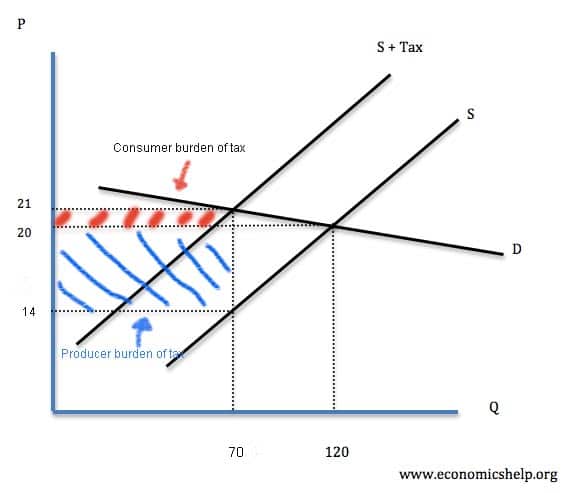
The result of this supply curve shift is a new, higher equilibrium price. However, the price increase for the consumer is typically less than the full amount of the tax. The tax revenue is therefore split between the consumer and the producer.
- Consumer Burden: The portion of the tax paid by the consumer through a higher price ().
- Producer Burden: The portion of the tax absorbed by the producer through a lower effective price received ().
This diagram shows how the total tax revenue collected by the government is composed of these two burdens.
The Role of Elasticity
What determines the split of the tax burden? The answer lies in the relative price elasticities of demand and supply. Elasticity measures how responsive quantity demanded or supplied is to a change in price.
The fundamental rule of tax incidence is: The more inelastic side of the market bears a larger share of the tax burden.
- If demand is inelastic (consumers are not very responsive to price changes, e.g., for necessities like gasoline), they will continue to buy the product even at a higher price. Producers can pass most of the tax on to them.
- If demand is elastic (consumers are very responsive to price changes, e.g., for luxury items with many substitutes), they will significantly reduce their purchases if the price rises. Producers must absorb most of the tax to avoid losing all their customers.
The same logic applies to the elasticity of supply.
AS-Level Economics Video 14 Indirect Taxes and Subsidies
The same video provides excellent visual explanations of how elasticity affects tax incidence.
Please watch from this segment. It shows two scenarios: one where demand is more elastic than supply (producer pays more) and one where demand is more inelastic than supply (consumer pays more).
Given your background as a statistician, you'll appreciate that this graphical intuition can be expressed with mathematical precision. The fraction of the tax that is passed on to consumers () can be directly related to the price elasticity of supply () and demand ().
Where:
- is the price consumers pay.
- is the tax per unit.
- is the price elasticity of supply (usually positive).
- is the price elasticity of demand (usually negative).
Notice that if demand becomes perfectly inelastic (), the fraction becomes , meaning 100% of the tax is passed on to consumers. Conversely, if demand is perfectly elastic (), the fraction approaches 0, and producers bear the entire burden.
Numerical Application of Tax Incidence
Let's apply these concepts to a concrete example, which aligns with your preference for numerical problems.
Public Economics (ECON 131) Section #3: Tax Incidence ...
This document provides a worked problem demonstrating how to calculate tax incidence.
Please read the problem under section 1.3.1 Gruber, Ch.19, Q.2 (modified). Follow the solution steps to see how to: Find the pre-tax equilibrium by setting demand equal to supply. Find the post-tax equilibrium. Note how the tax ($2) creates a wedge between the price the consumer pays (P) and the price the producer receives (P-2). Calculate the respective burdens on the consumer and producer. After that, read the brief problem and solution in section 1.3.2. It demonstrates a critical point: the economic incidence is the same regardless of whether the law requires the buyer or the seller to pay the tax.
As the example shows, even though the tax was $2.00, the price for consumers only rose by $1.33 (from $7.00 to $8.33). The remaining $0.67 was absorbed by the producer, whose net receipt per unit fell from $7.00 to $6.33 ($8.33 - $2.00). In this case, consumers bear approximately two-thirds of the burden because their demand is less elastic than the producers' supply.
Progressive, Regressive, and Proportional Taxes
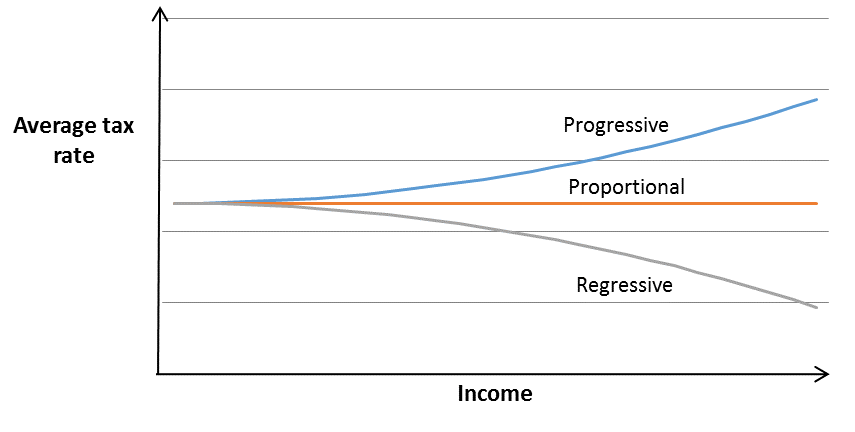
Finally, taxes can be classified by their effect on income distribution. This is determined by comparing the average tax rate (total tax paid / total income) across different income levels.
- Progressive Tax: The average tax rate increases as income increases. Higher earners pay a larger percentage of their income in tax. (e.g., UK income tax).
- Proportional Tax: The average tax rate is the same for all income levels. (e.g., a "flat tax").
- Regressive Tax: The average tax rate decreases as income increases. Lower earners pay a larger percentage of their income in tax.
Indirect taxes like VAT and excise duties are often considered regressive. This is because lower-income households tend to spend a larger proportion of their income on goods and services, whereas higher-income households save more. Consequently, the tax paid on consumption represents a larger fraction of a low-income person's earnings compared to a high-income person's.
TAX BASICS: a Beginner's Guide to Everything
The "TAX BASICS" video explains these concepts and gives a clear reason why consumption taxes are considered regressive.
First, watch the initial overview from the start for the definitions of these three tax types. Then, jump to the segment on sales tax from this timestamp for the explanation of why it is considered regressive.
Conclusion
In this lesson, we have laid the groundwork for our study of taxation. We have distinguished between taxes levied on income and wealth (direct) and those levied on expenditure (indirect), and we have explored their powerful economic effects.
Key Takeaways:
- Direct taxes are paid by the person or company they are levied on (e.g., corporation tax, income tax). Indirect taxes are collected by an intermediary and paid by the end consumer (e.g., VAT, excise duties).
- The economic incidence (who bears the burden) of an indirect tax depends on the relative price elasticities of supply and demand.
- The more inelastic (less price-sensitive) side of the market will bear a larger portion of the tax burden.
- Taxes can be progressive, proportional, or regressive, depending on how the average tax rate changes with income. Indirect taxes on consumption are generally regressive.
We have now established the "what" and "why" of taxation. In our next lesson, we will move firmly into the "how," starting with the most important direct tax for a company. We will learn to calculate corporate tax liability, taking into account taxable profits, capital allowances, and loss relief—a highly practical and examinable topic.