Introduction
In our previous lesson, we established the fundamental distinction between direct and indirect taxes and explored their economic effects. We identified Corporation Tax as the primary direct tax levied on a company's profits. Now, we move from the theoretical framework to the practical application, addressing a core skill for your CB1 exam.
This lesson is dedicated to calculating a company's corporation tax liability. We will construct the calculation step-by-step, starting from a company's accounting profit and making a series of adjustments to arrive at the final tax figure. Specifically, we will cover how to:
- Adjust accounting profit for tax purposes to determine taxable profits.
- Calculate and deduct capital allowances, the tax-equivalent of depreciation.
- Apply the rules for loss relief if a company is not profitable.
- Apply the correct tax rates to the final profit figure.
This process is highly structured and relies on a standard pro-forma, which you will find essential for tackling exam questions efficiently.
From Accounting Profit to Taxable Profit
The first crucial concept is that the profit figure shown in a company's financial statements (its accounting profit) is not the same as the profit figure used to calculate tax. The tax authorities, HMRC, have specific rules about what income is taxable and what expenses are deductible. We begin with the company's operating profit and make a series of standard adjustments to arrive at its trading profit.
The general formula is:
Operating Profit + Disallowable Expenses - Non-Trading Income - Capital Allowances = Trading Profit
To understand the components of this adjustment, let's review an overview of the entire process.
How is Corporation Tax Calculated in a Corporation Tax Return?
This article from Easy Digital Filing provides a clear, step-by-step guide to the corporation tax calculation, which will serve as our roadmap for this lesson.
Please read through the article from the beginning to the end. Focus on understanding the purpose of each step in the example calculation: Start with the overview and the simplified formula. Understand why disallowable expenses, like depreciation, are added back. See how capital allowances provide tax relief for assets. Note how losses can be used to reduce taxable income. Finally, observe how the applicable tax rate is applied to the final figure.
The most common disallowable expense you will encounter is depreciation. As an accounting estimate, it is not allowed for tax purposes and must be "added back" to the profit. In its place, the tax system provides a specific deduction called a capital allowance.
Capital Allowances: The Tax Version of Depreciation
Capital allowances are the mechanism by which companies get tax relief on their expenditure on certain assets, primarily plant and machinery. Instead of deducting the accounting depreciation charge, you deduct a calculated capital allowance.
There are several types of allowances, but the main ones you need to know are:
- Annual Investment Allowance (AIA): This allows a 100% deduction on the first £1 million of qualifying expenditure in a 12-month period. It's a powerful incentive for investment.
- Written Down Allowances (WDA): For expenditure that exceeds the AIA limit or doesn't qualify (like most cars), a percentage deduction is given each year on a reducing balance basis. The main rate is 18%, and a special rate of 6% applies to certain 'long-life' assets or high-emission cars.
- First Year Allowances (FYA): A 100% allowance is sometimes available for specific assets the government wants to promote, such as new and unused electric cars.
The following video provides an excellent introduction and, crucially, a detailed worked example showing how to lay out a capital allowance computation.
Chapter 5 Capital Allowances (part 1) - ACCA TX-UK Taxation (FA 2023)
The video "Chapter 5 Capital Allowances (part 1)" from OpenTuition explains the concept and mechanics of calculating these allowances.
First, watch the introduction from the beginning to understand why capital allowances exist. Next, watch the segment from this timestamp which defines AIA, WDA, and the special rules for cars. Finally, and most importantly, carefully follow the detailed worked example from this point. Pay close attention to the pro-forma layout with columns for AIA, Main Pool, and Allowances. This structure is key to solving problems correctly. Notice how the AIA limit and WDA rates are time-apportioned for the short 3-month period.
Calculating the Tax: Rates and Marginal Relief
Once you have calculated the company's Taxable Total Profits (TTP)—which is the trading profit plus any other taxable income like property income or chargeable gains—you can calculate the tax liability.
For the financial year 2023 (which applies to exams in 2024), the rates are:
- 19% (Small Profits Rate) for companies with augmented profits up to £50,000.
- 25% (Main Rate) for companies with augmented profits over £250,000.
For companies with augmented profits between £50,000 and £250,000, the tax is calculated at the 25% main rate, but this is then reduced by a Marginal Relief. This mechanism provides a gradual transition between the 19% and 25% rates.
Augmented profits are the company's Taxable Total Profits plus any dividends received from non-group companies. This figure is used only to determine the applicable tax rate. The tax itself is calculated on the TTP.
This video walks through the rules and provides numerical examples for each scenario.
Chapter 15 Corporation tax (part 1) - ACCA TX-UK Taxation (FA 2023)
This clip from "Chapter 15 Corporation tax (part 1)" by OpenTuition explains the rates, thresholds, and the crucial calculation for Marginal Relief.
Watch from this section to understand the two main rates, the profit thresholds, and how they are adjusted for short accounting periods or associated companies. The next section, from this point, introduces the formula for Marginal Relief. It's important to note the structure of this formula. Finally, watch the worked examples from this timestamp. The video works through four scenarios: profits below the lower limit, above the upper limit, in the margin without dividends, and in the margin with dividends. These are precisely the types of calculations you can expect.
The formula for marginal relief is:
While it looks complex, the video shows it's a procedural calculation. The key is to calculate tax at 25% on the TTP and then subtract the relief you've calculated.
Trading Loss Relief
What happens if, after making all the adjustments, the company has a trading loss? Instead of paying tax, the company can claim relief for this loss to reduce its tax bill in other periods. The main options are:
- Current Year Claim: The trading loss can be offset against the company's total profits (including non-trading income and capital gains) of the same accounting period.
- Carry-Back Claim: The loss can be carried back and set against the total profits of the preceding 12 months.
- Carry-Forward Claim: Any unused loss is automatically carried forward and must be set against the future trading profits of the same trade.
The GOV.UK website provides a clear explanation of these rules.
Work out and claim relief from Corporation Tax trading losses
This official guidance clearly explains the primary ways a company can use its trading losses.
Read the following sections: Trading losses: Note the instruction to start with the accounts profit and make tax adjustments. Carry forward a trading loss: This explains how unused losses are used against future profits. Carry a trading loss back: This section explains the carry-back rule and includes a simple numerical example of offsetting a loss against prior year profits.
A Comprehensive Example
Let's tie all these elements together by analysing a standard corporation tax computation. This example shows how the adjustments we've discussed flow into one another to produce the final tax liability.
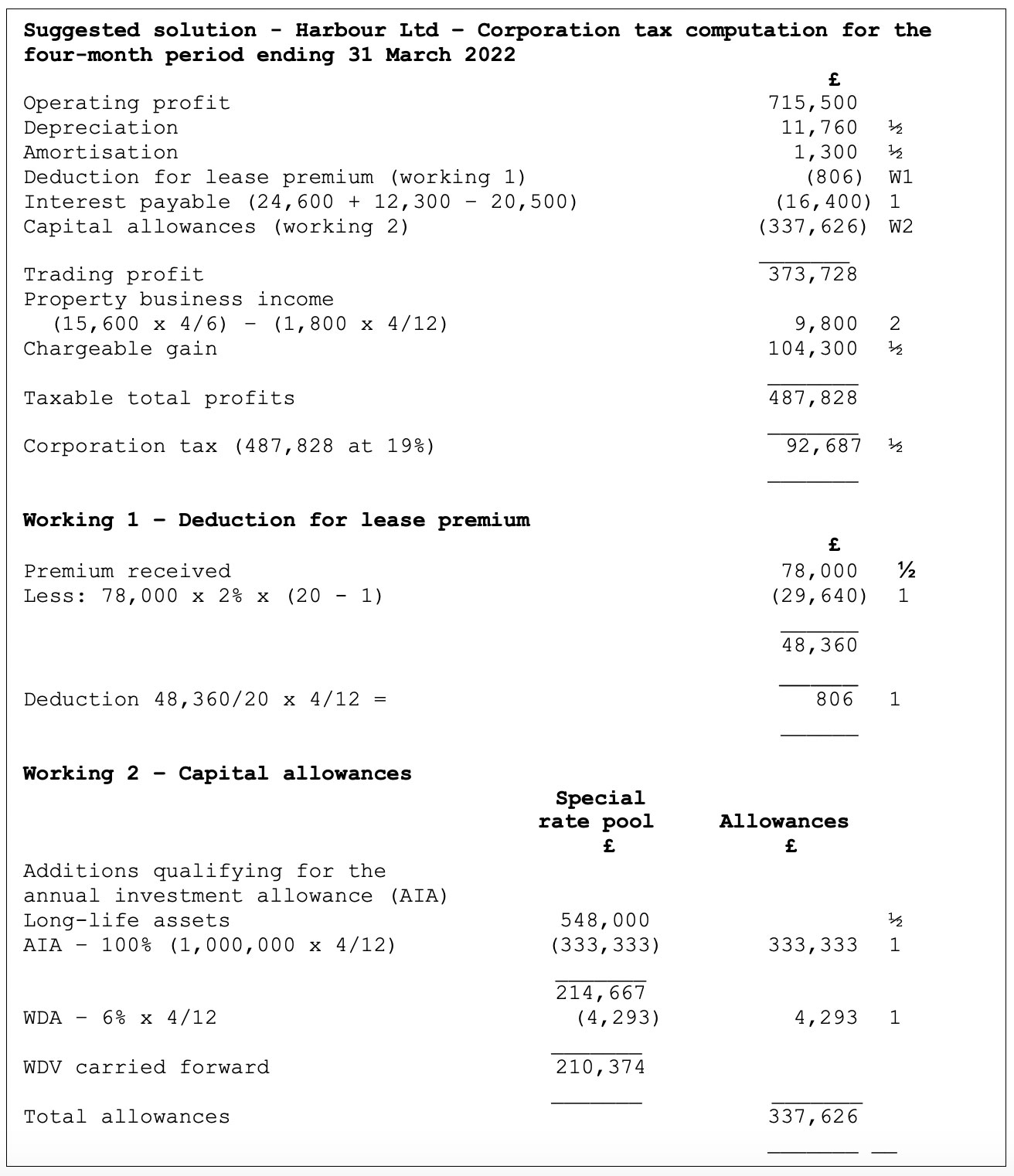
Let's break down this computation:
- Start with Operating Profit: The calculation begins with the accounting profit of £715,500.
- Adjust for Disallowable Items: Depreciation (£11,760) and Amortisation (£1,300) are added back as they are not tax-deductible.
- Deduct specific reliefs: A deduction for a lease premium is calculated in "Working 1" and subtracted.
- Deduct Capital Allowances: "Working 2" shows the calculation for capital allowances (£337,626), which is then subtracted. Notice how it uses the Annual Investment Allowance (AIA) and a Written Down Allowance (WDA).
- Arrive at Trading Profit: After these adjustments, we get the Trading Profit of £373,728.
- Add Other Income: Property income and a chargeable gain are added to the trading profit.
- Calculate Taxable Total Profits (TTP): The final TTP is £487,828.
- Calculate Corporation Tax: Since the TTP (£487,828) is above the upper limit of £250,000, the main rate of 25% would apply in the current tax regime (the example uses an older 19% rate, but the principle is the same). The calculation shown is £487,828 at 19% = £92,687.
This single image encapsulates the entire process you have learned in this lesson.
Conclusion
In this lesson, we have moved from tax theory to the practical mechanics of calculating UK corporation tax. You have learned the structured process required to determine a company's tax liability, a core competency for your CB1 exam.
Key Takeaways:
- Corporation tax is calculated on Taxable Total Profits (TTP), not accounting profit.
- The standard computation starts with operating profit, adds back disallowable expenses (like depreciation), and subtracts capital allowances.
- Capital allowances (AIA, WDA) are the tax system's way of giving relief for expenditure on assets.
- The final TTP is taxed at either 19% or 25%, with marginal relief available for profits between £50,000 and £250,000. The applicable rate is determined by a company's augmented profits.
- If a company makes a trading loss, it can be relieved by setting it against other profits in the current year, carrying it back to the previous year, or carrying it forward against future profits.
Having covered the main tax for companies, our next lesson will shift focus to individuals. We will learn how to calculate income tax liability, applying personal allowances and the progressive tax bands that apply to personal earnings.