Introduction
In our last lesson, we focused on the taxation of companies, learning how to calculate corporation tax liability by adjusting accounting profits. We will now shift our attention from the corporate entity to the individual. This lesson addresses a fundamental aspect of personal finance and a key topic for your CB1 exam: calculating an individual's income tax liability.
Your preference for practical, numerical examples will be central to our approach. We will methodically build the calculation, starting with the basic principles of tax-free allowances and progressing through the different tax rates. By the end of this lesson, you will be able to compute the income tax due for an individual at various earning levels, including the important adjustments for high earners.
The Core Framework: Personal Allowance and Tax Bands
The UK income tax system is built on two core concepts: a tax-free Personal Allowance and a series of progressive tax bands. This means that you can earn a certain amount completely free of tax, and the income you earn above that threshold is taxed at increasing rates.
To get a clear and simple overview of how this works in practice, let's start with a short video from financial journalist Martin Lewis.
Martin Lewis: A beginner's guide to how income tax works
This video, "A beginner's guide to how income tax works," provides an excellent, non-technical introduction to the key concepts.
Please watch the first two minutes of the video. Focus on the explanation of the Personal Allowance from the beginning. Note how tax is only paid on the income above this allowance. Then, watch the next section on tax bands, from this timestamp, which introduces the 20% and 40% rates.
As the video explains, most individuals have a Personal Allowance, which is the amount of income they can receive before any income tax is due. Any income above this is your taxable income. This taxable income is then taxed in slices, or bands, at different rates.
For our calculations, we will use the tax rules for the 2025/26 tax year, which are commonly used for illustrative purposes in financial exams. The principles remain the same even if the specific numbers change in a given year.
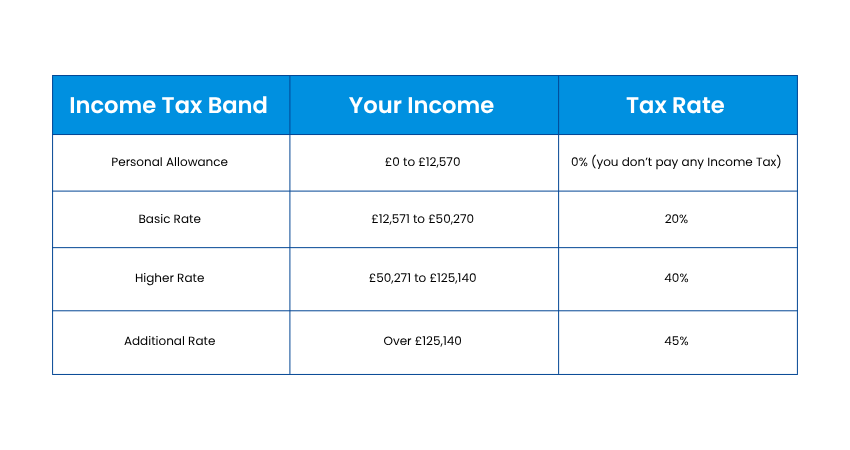
Let's formalise the process with a detailed guide.
UK Income Tax 2026: Bands, Rates & Allowances Guide
This guide from UW Accountancy provides the specific figures we will use and lays out the step-by-step calculation method with clear examples.
First, read these two sections to solidify the definitions: Personal Allowance: Read the section about the Personal Allowance. Note the standard allowance is £12,570. Income Tax Bands: Read the section on tax bands. This formalises the concept of taxing income in successive brackets. Then, carefully study the first two worked examples to see the calculation in action: Example 2: Gross Income £30,000: This example shows a straightforward case where all taxable income falls within the basic rate band. Example 3: Gross Income £60,000: This example demonstrates how to handle income that crosses from the basic rate into the higher rate band.
Let's summarise the calculation process for an individual earning £60,000, as shown in Example 3:
- Determine Gross Income: £60,000
- Subtract Personal Allowance: £60,000 - £12,570 = £47,430 (This is the Taxable Income).
- Apply Tax Bands to Taxable Income:
- The first £37,700 of taxable income is in the Basic Rate band.
- Tax at 20%: £37,700 × 0.20 = £7,540
- The remaining taxable income is £47,430 - £37,700 = £9,730. This portion falls into the Higher Rate band.
- Tax at 40%: £9,730 × 0.40 = £3,892
- The first £37,700 of taxable income is in the Basic Rate band.
- Sum the Tax: £7,540 + £3,892 = £11,432
This layered calculation is the fundamental mechanic of the UK's progressive income tax system.
The Complication: Tapering Personal Allowance for High Earners
As Martin Lewis hinted, "something funny happens" for high earners. When an individual's income exceeds £100,000, their tax-free Personal Allowance begins to be reduced or "tapered".
The rule is: The Personal Allowance is reduced by £1 for every £2 of adjusted net income above £100,000.
This creates a high marginal tax rate in the income bracket between £100,000 and £125,140, because for every extra pound earned, the individual is not only paying 40% tax on it but is also losing some of their tax-free allowance.
Let's return to the Martin Lewis video to hear his explanation of this "60% tax trap".
Martin Lewis: A beginner's guide to how income tax works
This segment explains the personal allowance taper and its surprising effect on the marginal tax rate.
Please watch from this timestamp. Listen for the explanation of why the effective tax rate becomes 60% in this income bracket.
Now, let's see how this is applied in a full calculation. We will use the same guide as before, which provides a perfect worked example.
UK Income Tax 2026: Bands, Rates & Allowances Guide
This guide will now show us how to perform the calculation when the personal allowance is tapered.
Carefully read and follow the calculations in these two final examples: Example 4: Gross Income £115,000: This example shows the two-step process: first calculate the reduced personal allowance, and then calculate the tax liability. Example 5: Gross Income £160,000: This example illustrates the scenario where the personal allowance is completely lost, and the income falls into the Additional Rate band.
Let's break down the calculation for the £115,000 income from Example 4:
-
Calculate the Reduced Personal Allowance:
- Income over £100,000: £115,000 - £100,000 = £15,000
- Reduction amount: £15,000 / 2 = £7,500
- New Personal Allowance: £12,570 - £7,500 = £5,070
-
Calculate Taxable Income:
- £115,000 - £5,070 (New PA) = £109,930
-
Apply Tax Bands:
- Basic Rate: £37,700 × 0.20 = £7,540
- Higher Rate: (£109,930 - £37,700) × 0.40 = £72,230 × 0.40 = £28,892
-
Sum the Tax:
- £7,540 + £28,892 = £36,432
By an income of £125,140, the entire Personal Allowance is tapered away to zero. For any income above this level (up to the additional rate threshold), the individual simply has no Personal Allowance. Example 5, with an income of £160,000, shows a calculation where the PA is £0 and the income is high enough to be taxed across all three bands: Basic (20%), Higher (40%), and Additional (45%).
This structured, step-by-step process is the key to correctly answering any income tax calculation question.
Conclusion
In this lesson, we have constructed the complete process for calculating an individual's income tax liability in the UK. We moved from the foundational concepts of a tax-free Personal Allowance and progressive tax bands to the practical application across different income levels, including the crucial tapering rule for high earners.
Key Takeaways:
- Income tax is calculated on taxable income, which is gross income minus the applicable Personal Allowance.
- Taxable income is taxed in successive bands or "slices" at increasing rates (20%, 40%, 45%).
- For incomes above £100,000, the Personal Allowance is tapered, reducing by £1 for every £2 of income over the threshold.
- The allowance is reduced to zero for incomes of £125,140 or more.
- The calculation is a systematic process: 1. Determine the correct Personal Allowance. 2. Calculate taxable income. 3. Apply the tax bands progressively to the taxable income. 4. Sum the tax from each band.
We have now covered the two main pillars of direct taxation in the UK: corporation tax for companies and income tax for individuals. In our next lesson, we will explore another important personal tax: Capital Gains Tax, which applies not to income, but to the profits made from selling or disposing of assets.