Welcome to the next lesson in our Business Taxation module. In our previous session, we mastered the calculation of an individual's income tax liability, navigating through personal allowances and the various tax bands. Today, we shift our focus from tax on income to tax on gains. We will be exploring Capital Gains Tax (CGT), the tax you pay on the profit when you sell or 'dispose of' an asset that has increased in value.
This lesson is designed to equip you with the skills to calculate CGT, a key requirement for your CB1 exam. True to your preference for practical application, we will centre our learning on a clear, step-by-step computational framework and a detailed worked example. We will also address a specific and often misunderstood element mentioned in the syllabus: the indexation allowance, clarifying exactly when and how it applies.
1. The Framework for Calculating Capital Gains Tax
At its heart, Capital Gains Tax is a tax on the profit—the "gain"—you make when you dispose of an asset. The basic calculation is straightforward: you subtract the original cost of the asset from the proceeds you receive when you sell it. However, the full calculation involves several additional steps, including deducting specific costs, allowances, and any losses.
Let's begin with a video that provides an excellent overview of the entire process for calculating CGT on a property sale in the UK.
Capital Gains Tax when you sell a property - how to calculate it (UK)
This video from Sarah Harkness, titled "Capital Gains Tax when you sell a property - how to calculate it (UK)," clearly outlines the stages of a CGT computation.
Please watch the section from 00:49 to 03:07. As you watch, focus on the sequence of deductions from the sale proceeds.
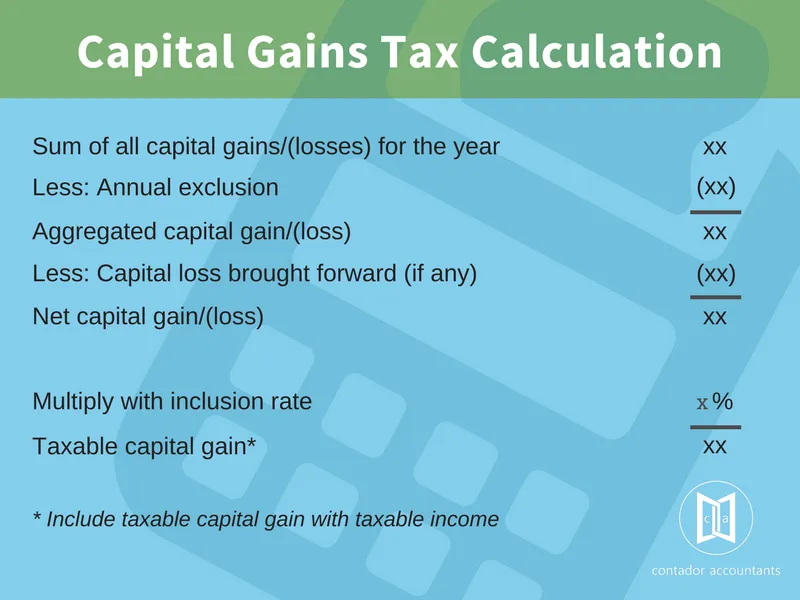
As the video explains, the calculation follows a logical sequence. We can summarise it in five key steps:
- Calculate the Initial Gain: Subtract the 'allowable costs' from the disposal proceeds. Allowable costs include the original acquisition cost and any incidental costs of buying or selling (e.g., stamp duty, legal fees).
- Deduct Allowable Losses: You can deduct any capital losses from the same tax year or losses carried forward from previous years. A key rule is that losses must be offset against gains before the annual exemption is applied.
- Apply the Annual Exempt Amount (AEA): Each individual has a tax-free allowance for capital gains each year. For the 2025/26 tax year, this is £3,000.
- Determine the Taxable Gain: This is the amount of the gain remaining after deducting losses and the AEA.
- Apply the Correct Tax Rate: The rate of CGT depends on two factors: (a) your income tax band, and (b) the type of asset you sold.
This general structure can be visualised as follows, although note the UK uses specific terms like "Annual Exempt Amount" rather than "Annual exclusion".
2. A Worked Example: CGT on a Property Sale
Now, let's put this framework into practice with a numerical example. We'll continue with the same video, which walks through a detailed scenario involving a jointly owned property. Following the video, we will refine the calculation using the most current tax rates.
Capital Gains Tax when you sell a property - how to calculate it (UK)
This segment of the video provides a clear, step-by-step worked example that brings all the elements of the calculation together.
Please watch the detailed example from 03:07 to 07:10. Pay close attention to how the total gain is split between the joint owners and how each owner's tax liability is calculated separately.
The example in the video is excellent because it demonstrates several key principles:
- Joint Ownership: For jointly owned assets, the gain is typically split equally between the owners.
- Reliefs: The availability of reliefs, like Private Residence Relief (PPR), can significantly reduce the chargeable gain.
- Individual Calculation: Each owner uses their own Annual Exempt Amount and is taxed at their own marginal rate.
Let's break down the final calculation from the video and update it with the 2025/26 tax rates. The presenter correctly arrives at a net taxable gain of £17,000 for each partner after all deductions and the £3,000 AEA.
Now, we determine the tax. The CGT rate depends on whether the taxable gain, when added to the individual's income, falls into the basic or higher rate income tax band.

Using the rates from the table for residential property:
- The basic rate for CGT is 18%.
- The higher rate for CGT is 24%. (Note: The video uses the previous higher rate of 28%. We will use the current 24%.)
Let's calculate the tax for the two partners in the video's example:
-
Partner 1 (Basic-rate taxpayer): Their taxable gain of £17,000 is taxed at the basic rate.
- Tax due = £17,000 × 18% = £3,060
-
Partner 2 (Higher-rate taxpayer): Their income already places them in the higher tax bracket, so their entire taxable gain is taxed at the higher rate.
- Tax due = £17,000 × 24% = £4,080
This step-by-step process—from calculating the initial gain to applying the correct, income-dependent tax rate—is the fundamental skill required for your exam.
3. The Special Case: Indexation Allowance
The learning outcome specifically requires you to be able to calculate CGT "including indexation allowance." This is a crucial area where precision is needed, as the rules have changed significantly over time.
First, what is the principle behind indexation? Over a long period, the value of an asset may rise simply due to general price inflation. Indexation is a mechanism that adjusts the original cost of an asset upwards to account for this inflation, ensuring that tax is only paid on the real gain in value, not the inflationary part.
To grasp the concept, watch the beginning of this short video. Note that this video is from an Indian context and uses a different inflation index (CII), but it explains the 'why' of indexation very well.
What is Indexation & how it works? | All about indexation benefit
This video from Zerodha Varsity, titled "What is Indexation & how it works?", provides a simple and effective explanation of the concept of adjusting for inflation.
Watch the introductory section from the beginning to 02:11. Focus on the story of the watch to understand how adjusting the purchase price for inflation reduces the taxable gain.
Now for the critical point for your UK-based exam: Indexation allowance is no longer available to individuals. It was abolished for individuals for disposals made on or after 6 April 2008.
However, indexation allowance is still available to companies for their capital gains, which are subject to Corporation Tax. The allowance was frozen, meaning it can only be calculated up to the inflation level in December 2017.
The following resource explains this distinction clearly and shows how the calculation works for companies.
Indexation Allowance (Companies) | Capital Gains Tax - GoFile
This article from GoFile clarifies the current rules for indexation allowance and provides a corporate calculation example.
First, read the "Key facts" section to confirm who can claim the allowance. Specifically, note the first point: who can claim. Also, read the FAQ answer that reinforces this: Can individuals claim? Next, study the calculation method and the worked example for a company. Focus on these parts: The three-step formula: the formula. This uses the Retail Prices Index (RPI). The worked example: the example. Follow how the indexation factor is calculated using the RPI for the acquisition month and the frozen RPI for December 2017, and how this is used to find the final indexed gain.
Let's review the calculation for a company from the GoFile article:
- Unindexed Gain: £240,000
- Indexation Factor Calculation:
- RPI at disposal (frozen): 278.1 (Dec 2017)
- RPI at acquisition: 191.6 (Apr 2005)
- Factor = (278.1 - 191.6) / 191.6 = 0.451
- Indexation Allowance:
- Original Cost (£200,000) × Factor (0.451) = £90,200
- Chargeable Gain (for Corporation Tax):
- Unindexed Gain (£240,000) - Indexation Allowance (£90,200) = £149,800
For your exam, it is vital to remember this distinction: if you are asked to calculate CGT for an individual, you do not use indexation. If the question involves a company disposing of an asset, you must calculate and apply the indexation allowance (frozen at Dec 2017).
Conclusion
In this lesson, we have detailed the methodology for calculating Capital Gains Tax. We established the five-step process for individuals and applied it through a practical example, demonstrating how to use the Annual Exempt Amount and determine the correct tax rate based on income levels.
Key Takeaways:
- An individual's CGT liability is found by calculating the gain, deducting losses and the Annual Exempt Amount (£3,000 for 2025/26), and then applying the relevant tax rate (e.g., 18%/24% for residential property).
- The applicable CGT rate depends on the individual's income tax band and the type of asset sold.
- Indexation Allowance is a form of inflation relief that is only available to companies, not individuals.
- For companies, the indexation allowance calculation is based on the RPI and is frozen at the index level of December 2017.
Having now covered taxes on corporate profits, personal income, and capital gains, we are building a robust understanding of the UK tax landscape. In our next lesson, we will turn our attention to a different type of tax entirely: Value Added Tax (VAT), which is a tax on consumption rather than on income or profit.