Introduction
In our last lesson, we explored the ethical challenges that arise within a company's structure, focusing on the pressures individuals face and the frameworks for making sound decisions. We saw that corporate governance isn't just about rules, but about human behaviour. Now, we shift our focus from the internal conduct of a business to its fundamental legal identity. The choice of business structure is one of the first and most critical decisions an entrepreneur makes, shaping everything from personal risk to tax obligations and the ability to grow.
This lesson directly addresses a core component of your CB1 syllabus by comparing the four main types of business ownership in the UK: sole traders, partnerships, limited liability partnerships (LLPs), and limited companies. We will dissect these structures through the crucial lenses of liability, taxation, and financing characteristics. Given your preference for practical application, we will ground our comparison in numerical examples, focusing particularly on the tax implications of choosing one structure over another.
The Four Main Business Structures: An Overview
Before diving into the details, it's helpful to see the landscape of business structures as a spectrum. At one end, the business and the owner are legally the same. At the other, the business is a completely separate legal person.
This table provides a concise, high-level comparison of the four main structures you need to know.

To get a feel for how these structures work in practice, let's watch a brief overview.
Types of Business Ownership Explained | Sole Traders, Partnerships, LTD, PLC and Franchise
The video "Types of Business Ownership Explained" by Two Teachers offers a clear and straightforward introduction to the most common business types.
Please watch the following segments to familiarise yourself with the basic definitions and characteristics of each structure: Sole Traders: Pay attention to the concept of unlimited liability. Partnerships: Note how liability is shared among partners. Private Limited Companies: Focus on the idea of a separate legal entity and limited liability.
As you can see, the defining difference revolves around liability. This determines the extent to which an owner's personal assets (like their home or car) are at risk if the business fails. Let's now explore the most common and important comparison in greater detail: the sole trader versus the limited company.
Sole Trader vs. Limited Company: The Core Trade-Off
For most new businesses, the initial choice is between operating as a sole trader or incorporating as a limited company. This decision involves a trade-off between simplicity and protection. A sole trader structure is simple and private, while a limited company offers liability protection and greater credibility but comes with more administrative complexity.
The following video provides an excellent breakdown of the pros, cons, and crucial tax differences. The numerical example towards the end is particularly relevant for your exam preparation.
Sole Trader vs. Limited Company - Which One is BETTER To Save Tax As A UK Business In 2025
This video, "Sole Trader vs. Limited Company" by accountant Josh Thomas, gets straight to the practical financial differences that will be key for your CB1 exam.
Watch these sections carefully: Pros and Cons of a Sole Trader: Focus on unlimited liability, privacy, and how tax works. Pros and Cons of a Limited Company: Note the points on limited liability, credibility, and the different ways to extract funds (salary vs. dividend). Practical Example: This is a worked example comparing the tax paid on £75,000 of profit under both structures. Pay close attention to the calculation steps and the concept of "retained profit" in the company.
A Numerical Look at Taxation
Let's solidify the tax comparison with another clear, side-by-side calculation. The fundamental difference is this:
- A sole trader's profits are treated as their personal income. They pay Income Tax and National Insurance Contributions (NICs) on these profits.
- A limited company first pays Corporation Tax on its profits. The owners (shareholders) then pay personal tax (Income Tax and possibly NICs) on the money they extract, either as a salary or as dividends.
This "double-layer" of tax for a company can, paradoxically, be more efficient, especially at higher profit levels. This is because Corporation Tax rates can be lower than higher-rate Income Tax, and dividends are taxed differently from salary.
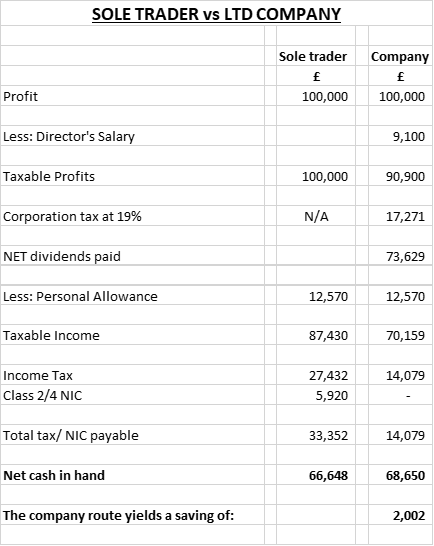
Let's break down the company side of this calculation:
- Profit: The company makes a profit of £100,000.
- Director's Salary: The owner pays themselves a small, tax-efficient salary of £9,100. This is a deductible expense for the company, reducing its taxable profit.
- Taxable Profits: The company's taxable profit is now £100,000 - £9,100 = £90,900.
- Corporation Tax: The company pays Corporation Tax at 19% on this profit: £90,900 * 0.19 = £17,271.
- NET dividends paid: The remaining profit after tax (£90,900 - £17,271 = £73,629) is available to be paid out as dividends.
- Personal Tax: The owner's personal taxable income is the sum of their salary and dividends, less their Personal Allowance. The table shows the final Income Tax calculation on this amount.
- Result: In this specific scenario, the company route results in a tax saving of £2,002.
This ability to plan the mix of salary and dividends is a key advantage of the limited company structure.
Partnerships: Sharing the Burden
An ordinary partnership is essentially a sole trader structure for two or more people. The key features are:
- Liability: Partners typically have unlimited liability, just like a sole trader. Furthermore, it is "joint and several," meaning each partner can be held responsible for the entire debt of the business, not just their "share."
- Taxation: The partnership itself does not pay tax. Profits are split between the partners according to their partnership agreement, and each partner pays Income Tax and NICs on their share.
- Financing: Similar to a sole trader, but with the potential to raise more capital from the combined resources of the partners.
The greatest risk is the unlimited liability, which exposes all partners' personal assets. This led to the creation of a hybrid structure: the LLP.
The Hybrid Model: Limited Liability Partnership (LLP)
An LLP offers the best of both worlds for many professional service firms. It combines the operational flexibility and tax treatment of a partnership with the liability protection of a limited company.
- Liability: Partners (or "members") have limited liability. Their personal assets are protected from the business's debts. Their liability is limited to any capital they have agreed to contribute.
- Taxation: The LLP is "tax transparent." It pays no tax itself. Profits are distributed to members, who are then individually responsible for paying Income Tax and NICs on their share.
- Financing & Administration: An LLP must be registered at Companies House and file annual accounts, much like a limited company. This increases administrative burden compared to an ordinary partnership but enhances its credibility.
Summary of Key Differences
The resource below provides an exhaustive comparison between sole traders and limited companies. While you don't need to memorise every point, it's an excellent reference for the key distinctions required by the syllabus.
Sole trader v. limited company: Key tax & legal differences
This detailed guide from Ross Martin is structured as a comparative table, making it easy to see the direct differences between the two main business structures.
Focus on the rows in the table that compare the two structures on the following grounds: Legal Status and Liability: This covers the core concepts of separate legal entity and personal liability. Tax on Profits: This reinforces how profits are taxed differently. Insolvency: This explains what happens to the owners if the business fails. Accounts: Note the difference in filing requirements (public vs. private). Selling the Business: This highlights the "double tax charge" issue for companies.
The table below summarises the four structures across our three key criteria.
| Feature | Sole Trader | Partnership | Limited Liability Partnership (LLP) | Limited Company |
|---|---|---|---|---|
| Owner's Liability | Unlimited (Personal assets are at risk) | Unlimited (Joint and several liability) | Limited (Personal assets are protected) | Limited (To the value of unpaid shares) |
| Taxation of Profits | Owner pays Income Tax & NICs on all profits. | Partners pay Income Tax & NICs on their share of profits. | Members pay Income Tax & NICs on their share of profits. | Company pays Corporation Tax; owners taxed on salary/dividends. |
| Financing | Difficult to raise external finance; relies on owner. | Can pool partners' capital; still perceived as higher risk. | Better credibility than a partnership; can attract members. | Easier to raise finance via shares and loans; greater credibility. |
| Legal Status | Owner and business are the same entity. | Owners and business are the same entity. | A separate legal entity from its members. | A separate legal entity from its owners (shareholders). |
Conclusion
Today we've dismantled and compared the primary legal structures a business can adopt. We established that the choice of structure creates a fundamental trade-off between simplicity and protection, with significant consequences for an owner's personal financial risk, tax bill, and ability to fund the business's growth.
Key Takeaways:
- The core distinction between business structures is liability. Sole traders and ordinary partners have unlimited liability, while LLP members and company shareholders have limited liability.
- Taxation differs significantly. Unincorporated businesses (sole traders, partnerships) are taxed via the owners' personal tax returns. Incorporated businesses (companies) create a two-layer system: Corporation Tax on profits, followed by personal tax on extracted funds (salaries/dividends).
- Incorporated structures (LLPs and limited companies) generally have greater credibility and more options for raising finance, but at the cost of increased administrative complexity and public disclosure of their accounts.
In our next lesson, we will put the concept of limited liability under the microscope. We will analyse a numerical scenario to see exactly what "limited liability" means for creditors when a company fails, giving you a practical application of the legal theory we've covered today.