Introduction
In our last lesson, we explored the core principles of corporate governance, establishing it as the essential framework for aligning the interests of a company's owners and its managers. We saw how mechanisms like a strong board and independent directors are the practical application of principles like transparency and accountability.
Today, we will build directly on that foundation by examining the specific roles and responsibilities of the board of directors and its key committees. Our focus will be squarely on their financial oversight duties, connecting the abstract structure of governance to the tangible work of safeguarding a company's financial health. Understanding this chain of command is critical for grasping how a company is truly controlled and monitored, a key area of knowledge for your CB1 exam.
1. The Board of Directors: Ultimate Responsibility
Every company is headed by a board of directors, which is collectively responsible for the long-term success and sustainability of the business. Think of the board not as managers, but as the primary stewards acting on behalf of the shareholders. They set the overall direction and ensure the executive team stays on course.
The UK Corporate Governance Code, an influential global standard, provides a clear summary of the board's duties.
[PDF] UK Corporate Governance Code (the “Code”) Main Principles
This document outlines the best practices for UK-listed companies. We'll focus on the sections defining the board's primary role and the division of labour at the top.
Please read the following sections: Under "A LEADERSHIP", read the principle and bullet points for A1 The Role of the Board. Note how it explicitly mentions setting the budget and overseeing risk control. Next, read the principle and bullet points for A2 Division of Responsibilities. This explains the crucial separation of power between running the board and running the company.
As the Code highlights, the board's financial responsibilities are significant. They include:
- Setting and reviewing the group's long-term objectives, commercial strategy, business plan, and annual budget.
- Overseeing the group's operations, management, governance, and risk control issues.
- Approving major capital projects.
To discharge these duties effectively, the board is typically composed of two types of directors:
- Executive Directors: These are senior, full-time employees of the company, such as the Chief Executive Officer (CEO) and the Chief Financial Officer (CFO). They are responsible for the day-to-day management of the business.
- Non-Executive Directors (NEDs): These are independent outsiders who are not employees. Their role is to provide objective criticism and a broader perspective. They challenge the executive directors' proposals and monitor their performance, acting as a crucial check and balance. The independence of NEDs is the cornerstone of their effectiveness.
A fundamental principle of good governance is the clear separation of the roles of Chairman and CEO. The Chairman leads the board meetings and ensures it operates effectively, while the CEO is responsible for implementing the company's strategy. This division prevents any single individual from having unfettered power.
2. Board Committees: The Specialists
While the full board has ultimate responsibility, it cannot be expected to scrutinize every detail in all areas. To manage the workload and bring specialist focus to critical functions, the board delegates specific tasks to smaller subcommittees. The following video explains the rationale for this structure and introduces the most common committees.
SBL Topic Explainer: Governance and Board Committees
This video, "SBL Topic Explainer: Governance and Board Committees" from ACCA Student Study Resources, provides a clear overview of why committees exist and what they do.
Please watch the following segments: First, watch from this section on why board committees are formed. It highlights reasons like time constraints and the need for specialist expertise. Then, watch the overview of the main committees: Remuneration, Nominations, Risk, and Audit. Pay close attention to the description of the Audit Committee.
The three most important committees for corporate governance are the Audit, Remuneration, and Nomination committees. Let's examine their specific financial oversight responsibilities.
The Audit Committee: The Financial Watchdog
This is arguably the most critical committee for ensuring financial integrity. Its role is so central that it warrants a dedicated look.
This video from Edspira, titled "The Audit Committee," gives a concise and practical explanation of the committee's composition and duties.
Please watch the full video. The first part, on composition, explains that the committee is a subset of the board, composed entirely of independent non-executive directors, with at least one designated "financial expert." The second part, on its role, details its key responsibilities, particularly its relationship with the external auditors.
To summarize the Audit Committee's key financial oversight functions:
- Composition: Comprised solely of independent NEDs to ensure objectivity. At least one member must have recent and relevant financial experience (e.g., a qualified accountant).
- Financial Reporting: They review the company's financial statements (annual and interim reports) to ensure they are fair, balanced, and understandable before they are presented to the full board.
- Internal Controls: They are responsible for reviewing the effectiveness of the company's internal financial controls and risk management systems.
- External Auditors: This is a crucial relationship. The Audit Committee:
- Hires, determines the pay for, and, if necessary, fires the external audit firm.
- Oversees the external audit process, acting as the main point of contact.
- Mediates any disputes between management and the auditors.
- Whistleblowing: They establish and oversee procedures for employees to report concerns about financial improprieties confidentially.
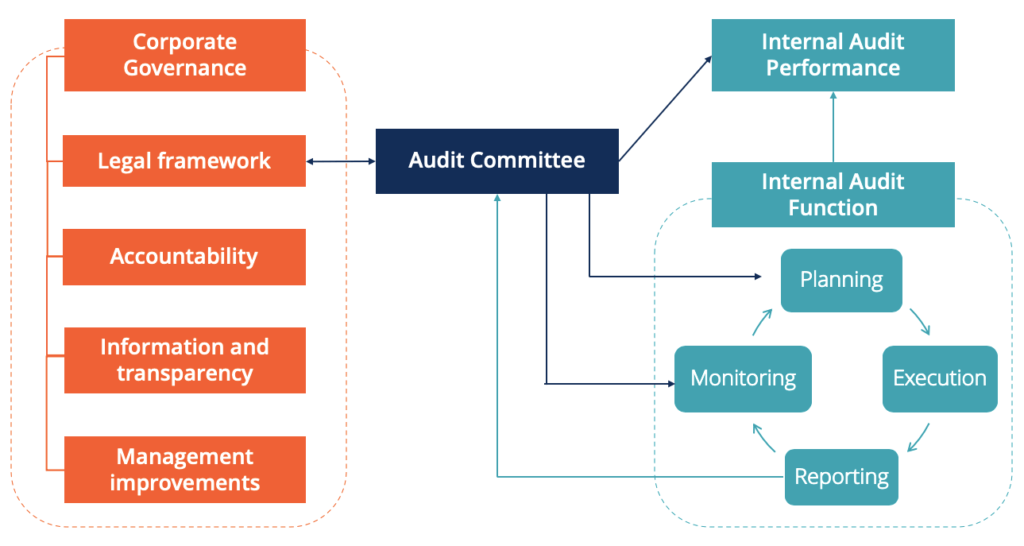
The following diagram illustrates the central role of the Audit Committee. It acts as the bridge between the broader corporate governance framework and the practical internal audit function, which involves planning, executing, and monitoring the company's controls.
The Remuneration Committee
This committee's role is to solve the principal-agent problem at its source: executive pay.
- Composition: Comprised entirely of independent NEDs.
- Financial Responsibility: It designs the remuneration policy and sets the specific pay packages for executive directors and other senior managers. Their primary goal is to create compensation structures (salary, bonuses, long-term incentives like share options) that align the financial interests of executives with the long-term success of the company and the interests of shareholders. No director is involved in deciding their own pay.
The Nomination Committee
While its link to finance is less direct, its function is foundational to the entire governance structure.
- Composition: A majority of members should be independent NEDs.
- Responsibility: It leads the process for board appointments. This involves identifying and nominating candidates for the board to ensure it has the right balance of skills, experience, and independence. By ensuring there are competent and independent individuals—including those with financial expertise—on the board and its committees, it underpins the effectiveness of all financial oversight.
3. Responsibilities in Practice
Let's test this understanding with a few questions, similar to what you might encounter in your CB1 exam. These scenarios help connect the roles we've discussed to practical situations.
[PDF] Objective Based Assessment - CB1 Specimen Examination
This specimen paper gives a feel for how these concepts are tested. Don't worry about getting the "right" answer; focus on the reasoning behind the options.
Consider the following questions: Read Question 4. Think about why a balance between executives and non-executives is important. Which options link to the roles we just discussed? (Hint: Consider the composition of the committees). Now, look at Question 59. The "working capital cycle" (WCC) is a measure of operational efficiency that we will cover later. For now, just know that a significant increase can be a red flag. Notice that the Board is the body concerned about this financial metric. Which of the options reflect legitimate board-level concerns and actions versus inappropriate ones?
In the first question, options B ("sufficient non-executives to staff board committees") and E ("Non-executives can be mutually supportive") are the correct choices. Committee composition rules require a pool of independent NEDs, and their ability to act as a cohesive, challenging group is vital for effective oversight.
In the second question, the board's concern about an increased WCC demonstrates their oversight of operational and financial performance. An increase suggests inefficiency (Option B), can reduce profitability (Option C), and is particularly concerning if it's due to unsold inventory (Option E). These are the correct statements, reflecting the board's duty to scrutinise performance. Option F, altering the figures, would be fraudulent.
Conclusion
In this lesson, we have dissected the structure of corporate oversight, clarifying the distinct but interconnected roles of the board and its key committees.
Key Takeaways:
- The Board of Directors holds ultimate responsibility for a company's long-term success, including setting strategy, approving budgets, and overseeing risk management.
- A clear division exists between Executive Directors (managers) and Non-Executive Directors (monitors), whose independence is vital.
- The Audit Committee, composed of independent NEDs, is the cornerstone of financial oversight. It scrutinizes financial reporting, reviews internal controls, and manages the relationship with external auditors.
- The Remuneration Committee aligns the financial interests of executives and shareholders by setting performance-related pay.
- The Nomination Committee ensures the board has the necessary skills and independence to perform its oversight functions effectively.
We have now established both the principles of governance and the structure through which they are applied. In our next lesson, we will explore the human element by analysing common ethical dilemmas that arise in business finance, putting these structures and responsibilities to the test in complex scenarios.