Introduction
In our last lesson, we established that the separation of ownership and control in a company creates the principal-agent problem. We saw how the differing interests of managers (agents) and shareholders (principals) lead to real financial costs. You may have noticed parallels here with your own research into personal relationships; just as trust, clear expectations, and aligned interests are vital for stability in a relationship network, a company needs a formal system to ensure its various parties work together towards a common goal.
This is precisely where corporate governance comes in. This lesson moves from the problem to the solution. We will define corporate governance and explore its core principles. More importantly, we'll examine how these principles are put into practice through the structure of the board of directors and its committees. To make this tangible, we will investigate high-profile corporate scandals to see the catastrophic financial consequences that occur when these principles are ignored.
By the end of this lesson, you will be able to describe the key principles of corporate governance and identify how they are applied—or fail to be applied—in real-world companies.
1. What is Corporate Governance?
At its core, corporate governance is the system of rules, practices, and processes by which a company is directed and controlled. Its primary goal is to solve the principal-agent problem by aligning the interests of management with those of shareholders and other stakeholders, thereby ensuring the long-term success and sustainability of the business.
The following video provides an excellent introduction, recapping the agency problem and outlining the fundamental purpose and approaches of corporate governance.
The basics of Corporate Governance
This video from Practice Tests Academy, "The basics of Corporate Governance," clearly explains why governance is needed and the different forms it can take.
Please watch the first two sections: The opening segment, "Why we need it?", serves as a quick recap of the principal-agent problem we discussed in the last lesson. Next, focus on the section from "Corporate governance is fairly big picture". Pay close attention to the distinction between a rules-based approach (like the Sarbanes-Oxley Act in the US) and a principles-based approach (like the UK's "comply or explain" model).
As the video explains, while different jurisdictions have different legal frameworks, the underlying goal is the same: to create a structure of accountability. The principles-based approach, common in the UK and many other countries, offers flexibility but relies on investor scrutiny to be effective. It requires companies to state publicly whether they adhere to a set of best-practice principles and, if not, to explain why.
2. The Core Principles of Corporate Governance
While specific codes vary, they are all built on a handful of fundamental principles designed to foster trust and accountability. The image below provides a simple, memorable summary of these core ideas.
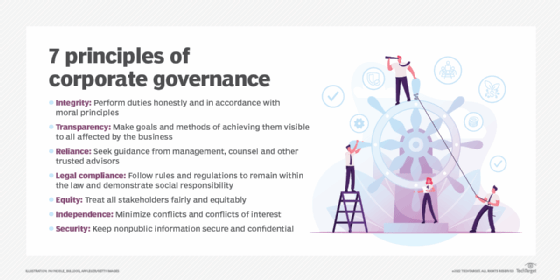
These general ideas are often formalized into pillars within national governance codes. For instance, the UK Corporate Governance Code, which is highly influential globally, groups these concepts into five main areas:
- Board Leadership and Company Purpose: Establishing a clear purpose and ensuring the board is effective and responsible for the company's long-term success. (Relates to Integrity, Legal Compliance)
- Division of Responsibilities: Ensuring a clear division of responsibilities at the head of the company to prevent any one individual from having unfettered power. (Relates to Independence)
- Composition, Succession, and Evaluation: Ensuring the board has the right mix of skills, experience, and independence to function effectively. (Relates to Equity, Independence)
- Audit, Risk, and Internal Control: Maintaining robust systems to manage risk and ensure the integrity of financial and narrative reporting. (Relates to Transparency, Security)
- Remuneration: Designing executive pay structures that are transparent and aligned with long-term shareholder interests. (Relates to the core of the agency problem)
Think of these principles as the inputs to a system. When implemented correctly, they should lead to better firm performance, as illustrated by the conceptual framework below.

3. Principles in Practice: Board Structures and Committees
Principles are abstract; their real value comes from their implementation. Corporate governance achieves this primarily through the structure and operation of the board of directors. The board acts as the primary monitoring mechanism on behalf of shareholders.
Let's return to the video "The basics of Corporate Governance" to see how these principles translate into specific, practical structures.
The basics of Corporate Governance
This part of the video explains the specific mechanisms used to implement governance principles.
Please watch the following two segments: The section on best practices details the key roles and structures. Focus on understanding the purpose of: Non-Executive Directors (NEDs): Why should at least half the board be independent? Separation of Chairperson and CEO: Why is this crucial to avoid concentration of power? Board Subcommittees: What are the specific functions of the Audit, Nomination, and Remuneration committees? Finally, watch the summary from the five main areas corporate governance codes focus on. This neatly recaps the key themes.
To summarize the key mechanisms:
- Non-Executive Directors (NEDs) are independent outsiders who bring scrutiny and an external perspective. Their presence is meant to challenge the executive team and ensure decisions are made in the best interest of shareholders, not just management.
- Separating the roles of Chairperson (who runs the board) and CEO (who runs the company) is a cornerstone of good governance. It prevents an excessive concentration of power and ensures that the person running the company is held accountable by an independent leader of the board.
- Subcommittees allow for detailed oversight in critical areas:
- The Audit Committee, composed of independent NEDs, oversees financial reporting, internal controls, and the relationship with external auditors. This directly addresses the principle of Transparency.
- The Remuneration Committee, also composed of NEDs, sets the pay for executive directors. This is a direct attempt to solve the agency problem by designing incentive schemes that align management's interests with those of shareholders.
- The Nomination Committee leads the process for board appointments, ensuring the board maintains an appropriate balance of skills and independence.
4. When Principles Fail: Lessons from Corporate Scandals
The importance of these principles is most starkly illustrated when they are broken. Studying major corporate failures provides powerful, practical lessons on why governance matters. The financial consequences of these failures are immense.
The following resource provides several detailed case studies. By examining what went wrong, we can see the direct link between governance failures and value destruction.
Corporate Governance Failures: Case Studies and Lessons Learned
This article from the Directors' Institute offers a sharp analysis of some of history's most significant governance scandals. It reveals common patterns of failure that serve as crucial learning points.
Please read the following case studies, focusing on how specific governance principles were violated: The Lehman Brothers Collapse: Start with the introduction to the case. Then, read the section on Lehman's governance structure. As you read, identify how failures in Risk Management, Remuneration, and Board of Directors' oversight contributed to the collapse. Note how the compensation plan encouraged extreme risk-taking, a classic example of misaligned incentives. The Volkswagen Emissions Scandal ("Dieselgate"): Read the section titled A Detailed Analysis. Focus on the "Lessons Learned" at the end of this case. Connect each lesson—such as Lack of Transparency and Weak Board Oversight—to the principles we discussed earlier. This is a powerful example of how a failure of ethical leadership and transparency can have multi-billion-dollar consequences.
These cases are not just historical footnotes; they are cautionary tales that have directly shaped the governance codes in place today. The Lehman Brothers collapse highlighted the systemic risks of misaligned remuneration and inadequate risk oversight. The Volkswagen scandal revealed that even the most reputable companies can fail when a culture of deception overrides ethical leadership and transparent reporting.
Conclusion
In this lesson, we have moved from the 'why' of governance—the principal-agent problem—to the 'what' and 'how'. We've seen that corporate governance is the framework of accountability designed to align the interests of managers and shareholders.
Key Takeaways:
- Corporate governance is the system for directing and controlling a company to ensure accountability, fairness, and transparency.
- The core principles include accountability, transparency, independence, and fairness, which are implemented through formal codes, often on a "comply or explain" basis.
- In practice, these principles are applied through a strong, independent board of directors, the separation of the Chair/CEO roles, and specialized subcommittees (Audit, Remuneration, Nomination).
- Real-world scandals like Lehman Brothers and Volkswagen demonstrate that ignoring these principles leads to catastrophic failures, destroying shareholder value and eroding public trust.
Having established the principles of good governance, our next lesson will drill down into the specifics. We will take a closer look at the composition of the board of directors and the precise roles and financial responsibilities of its key committees.