Introduction
In our previous lesson, we explored how to calculate a portfolio's expected return and its risk, measured by standard deviation. We saw that risk and return are the fundamental dimensions of any investment. This leads to a critical question for financial markets: how is information about these dimensions, and any other relevant facts, reflected in the prices of assets? Are markets a chaotic mess where skilled analysts can easily find bargains, or are they ruthlessly efficient information-processing machines?
This lesson introduces the Efficient Market Hypothesis (EMH), a cornerstone theory in finance that provides a framework for answering this question. We will discuss the three distinct forms of the EMH—weak, semi-strong, and strong—and explore their profound implications for investment strategy. Understanding this hypothesis is crucial, as it challenges the very idea of being able to consistently "beat the market."
1. The Core Idea: Information and Prices
At its heart, the Efficient Market Hypothesis, developed by Nobel laureate Eugene Fama, posits that a market is "efficient" if asset prices fully reflect all available information. From your perspective as a statistician, you can think of the market price at any moment as the best possible estimate of an asset's true value, conditional on the set of available information.
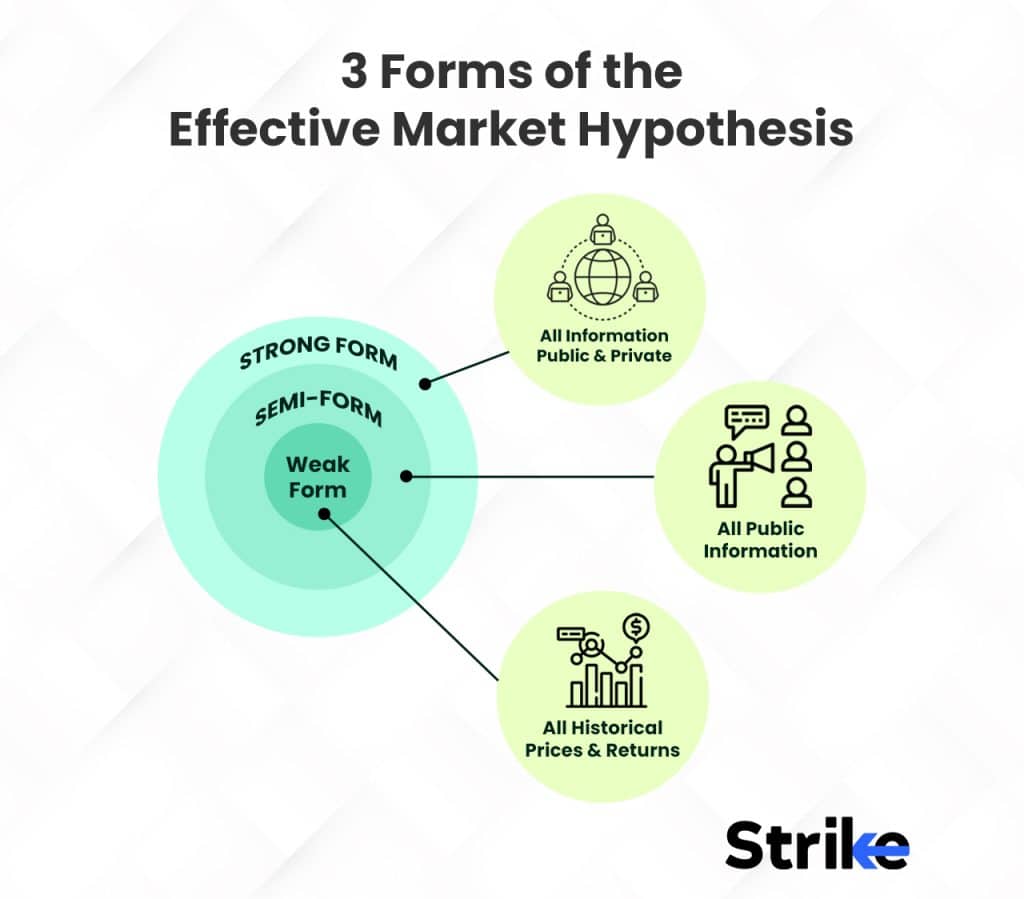
When new, unexpected information arrives, rational investors react, and the price adjusts almost instantaneously to a new equilibrium. The debate around the EMH centers on what, exactly, constitutes "all available information." This is where the three forms of the hypothesis come into play, representing progressively larger sets of information.
The following diagram provides a clear visual of this hierarchy.
Let's now examine each of these forms in detail.
2. The Three Forms of Market Efficiency
We will explore each form by first getting a conceptual overview from a video, and then grounding it in the precise definitions you'll need for your CB1 exam.
The Different Types of Market Efficiency: Weak Form, Semi-Strong Form and Strong Form
To begin, watch the first part of the video "The Different Types of Market Efficiency" by David Hillier. He provides a clear, conversational explanation of each form.
Weak Form: Watch from the start for the definition and implications of weak-form efficiency. Semi-Strong Form: Continue watching from this section to understand how this form expands the information set to all public data. Strong Form: Finally, watch from this last part for the most comprehensive, and controversial, form of efficiency.
Now, let's solidify these concepts with the formal definitions and implications, which are crucial for your exam preparation.
[PDF] The Efficient Markets Hypothesis - Actuarial Education
Please read the section "The three forms of the Efficient Markets Hypothesis" from this sample chapter of the CM2 Course Notes provided by Actuarial Education. This text provides the kind of detail and phrasing you can expect in your exam.
Focus on the descriptions of the three forms, starting from the detailed breakdown. For each form—weak, semi-strong, and strong—pay close attention to: What specific type of information is incorporated into the price. What specific type of investment analysis technique is rendered ineffective if that form of the EMH holds.
To bring this all together, here is a summary of the implications for different investment strategies:
-
Weak-Form Efficiency: Prices reflect all past trading data (prices, volume).
- Implication: Technical Analysis (or chartism), which seeks to predict future prices by studying past patterns, should not be able to generate consistent, excess risk-adjusted returns. If a predictable pattern existed, traders would exploit it immediately, causing the pattern to vanish.
-
Semi-Strong Form Efficiency: Prices reflect all publicly available information. This includes past trading data, but also company financial statements, news reports, economic forecasts, and analyst reports.
- Implication: Fundamental Analysis, which uses public information to determine a stock's "intrinsic value," should also not be able to consistently generate excess returns. By the time you read an earnings report and decide to trade, the market price has already adjusted to that information.
-
Strong-Form Efficiency: Prices reflect all information, both public and private (insider information).
- Implication: No one, not even company insiders with privileged information, can consistently generate excess returns. The existence of laws against insider trading—and the evidence that such trading can be profitable—is the strongest argument against markets being strong-form efficient.
The relationship is nested: if a market is strong-form efficient, it must also be semi-strong and weak-form efficient. The following table neatly summarizes this hierarchy.
Forms of Market Efficiency | CFA Level 1 - AnalystPrep
This short resource from AnalystPrep provides a very useful summary table.
Please examine the table under the "Summary" heading that begins with the header and ends with the checkmarks for the strong form. This provides a crystal-clear overview of the information sets.
3. Implications for Investment Management: Active vs. Passive
The EMH has profound consequences for the investment management industry. If markets are largely efficient (at least in the semi-strong sense), then what is the point of paying active fund managers high fees to conduct extensive research and pick stocks?
According to the EMH, it would be extremely difficult for these managers to consistently outperform the market average on a risk-adjusted basis. This gives rise to the argument for passive investment management.
[PDF] The Efficient Markets Hypothesis - Actuarial Education
Let's return to the ActEd course notes to explore this key implication.
Read the section titled Active versus passive. This discussion directly connects the theory of market efficiency to the practical choice between different investment styles.
A passive strategy, such as buying a fund that simply tracks a market index like the S&P 500, does not try to beat the market. Instead, it aims to match the market's performance while minimizing costs. The logic is simple: if you can't beat the market, you might as well join it as cheaply as possible.
4. Practice Question: Applying the EMH
To ensure you can apply these concepts as required in your exam, let's work through a typical problem.
[PDF] The Efficient Markets Hypothesis - Actuarial Education
Here is an excellent practice question from the ActEd notes that tests your understanding in a practical scenario.
Read Question 1.4 which starts with the setup. Before looking at the solution, think about each of the four members (Anna, Brian, Cathy, Dennis) and consider: What type of information is their strategy based on? Which form(s) of market efficiency would make their strategy useless? After you have formulated your own answers, study the detailed solution for Question 1.4. Compare it with your own reasoning.
This exercise is a perfect example of how the CB1 exam will test your ability to connect the theoretical forms of the EMH to practical investment decisions.
5. Efficiency and Randomness
A common point of confusion is the relationship between market efficiency and the seemingly random movement of stock prices. It's tempting to think that if prices are random, the market must be chaotic and inefficient. The EMH argues the exact opposite.
This is a concept that your background in probability theory will help you appreciate. A market is efficient because prices follow a "random walk." Price changes are random because they are driven by the arrival of new, unpredictable information. If information arrived in a predictable pattern, its effect would already be in the price!
The Different Types of Market Efficiency: Weak Form, Semi-Strong Form and Strong Form
The David Hillier video you watched earlier has an excellent segment addressing this and other misconceptions.
Please watch from this point, where the presenter explains why unpredictable news leads to unpredictable—and therefore random—price movements in an efficient market.
This also clarifies that even in an efficient market, investment analysis is not useless. As we saw in our last lesson, understanding the risk (standard deviation) and expected return of assets is vital for constructing a portfolio that matches an investor's risk tolerance, even if you can't find "mispriced" securities.
Conclusion
In this lesson, we have dissected the Efficient Market Hypothesis, a theory that fundamentally shapes our understanding of financial markets. We've moved beyond simple calculations of risk and return to question how information is incorporated into prices.
Key Takeaways:
- The Efficient Market Hypothesis (EMH) states that asset prices fully reflect all available information.
- Weak-form efficiency implies prices reflect all past trading data, rendering technical analysis ineffective.
- Semi-strong form efficiency implies prices reflect all public information, making it difficult for fundamental analysis to consistently beat the market.
- Strong-form efficiency implies prices reflect all public and private information, meaning even insiders cannot gain an edge. This form is generally not considered to hold true.
- A major implication of the EMH is the debate between active investment management (trying to beat the market) and passive investment management (tracking the market), with the EMH providing strong support for the latter.
- In an efficient market, price movements are random because they respond to the random arrival of new information.
In our next lesson, we will shift from the theoretical properties of markets to their practical structure. We will explore the roles of financial intermediaries and the different types of financial markets that channel funds from savers to borrowers, forming the plumbing of the financial system.