Introduction
Welcome to our next lesson. In our previous session, we examined the Efficient Market Hypothesis, a theory explaining how financial markets process information to set asset prices. We concluded that even in an efficient market, there's a vital system at play connecting those with capital to those who need it. Today, we will explore the architecture of that system.
This lesson focuses on the practical mechanics of how money moves through an economy. You will learn to identify the crucial functions of financial intermediaries and financial markets, and we'll use real-world examples to see how they channel funds from savers to borrowers. This provides the institutional context for all the financial concepts we will discuss in this course.
1. The Financial System: A Bridge for Capital
At its core, the financial system exists to solve a fundamental economic problem: how to transfer money from people who have surplus funds (we'll call them lender-savers) to people who have a shortage of funds but have productive uses for them (borrower-spenders). These players can be households, companies, or governments.
There are two primary routes for this transfer, as illustrated in the diagram below.
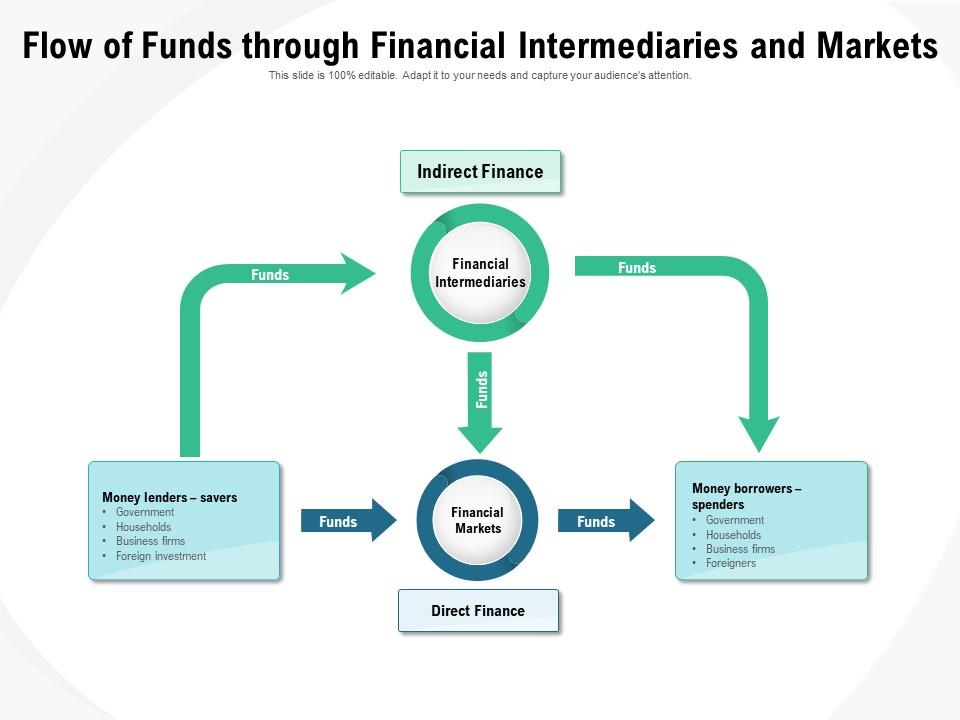
We will explore both of these pathways, starting with the most straightforward route: direct finance.
2. Direct Finance: The Role of Financial Markets
In direct finance, borrowers raise funds directly from savers by selling them securities (financial instruments) in what are known as financial markets.
To understand why this is so critical for the economy, let's explore the basic function and structure of these markets.
An Overview of the Financial System
This excerpt from Frederic Mishkin's textbook, "The Economics of Money, Banking, and Financial Markets," provides a foundational explanation of financial markets.
First, read the section under the heading "FUNCTION OF FINANCIAL MARKETS." Pay attention to the example of Carl the Carpenter, which illustrates how markets create economic efficiency by connecting savers with entrepreneurs. Next, read the section "STRUCTURE OF FINANCIAL MARKETS," which starts just after. This part introduces essential terminology for your CB1 exam. As you read, focus on understanding the distinction between: Debt vs. Equity: The two main ways a firm can raise funds. Primary vs. Secondary markets: Where new securities are sold versus where existing securities are traded. This is a critical concept. Money vs. Capital markets: The difference based on the maturity of the securities.
In essence, financial markets create a space where a company like Tesla can issue bonds (debt) or new shares of stock (equity) directly to investors who want to provide capital in exchange for future returns. The primary market is for these initial sales (like an IPO), while the secondary market (like the New York Stock Exchange) is for subsequent trading between investors.
However, direct finance has its challenges. How does an individual saver find a creditworthy company to invest in? How can they afford to hire a lawyer to write a contract for a small loan? This is where indirect finance becomes indispensable.
3. Indirect Finance: The Vital Role of Financial Intermediaries
The second, and much larger, pathway for funds is indirect finance, which relies on financial intermediaries. These are institutions that stand between savers and borrowers. They borrow from savers and, in turn, lend to borrowers.
Think of it this way: you don't lend your savings directly to a stranger who wants to start a business. Instead, you deposit your money in a bank. The bank then pools your funds with those of other depositors and makes a loan to the business owner. The bank is the intermediary.
But why are they so important? Intermediaries perform three crucial functions that direct finance cannot easily accomplish.
An Overview of the Financial System
Let's return to the Mishkin textbook to understand the core functions of intermediaries.
Please read the section titled "FUNCTION OF FINANCIAL INTERMEDIARIES". This section is key to the learning outcome. Focus on the three main benefits they provide: Transaction Costs: How they use economies of scale to make finance cheaper. Risk Sharing: How they use diversification to turn risky assets into safer ones for savers. Asymmetric Information: How they solve the problems of Adverse Selection and Moral Hazard.
The issue of asymmetric information is where your background in statistics is particularly relevant.
- Adverse Selection is a pre-contract problem. It occurs when the borrowers most likely to seek loans are also the riskiest ones. From a statistical perspective, it's a sampling bias problem: the pool of loan applicants is not a random, representative sample of the general population's creditworthiness. Intermediaries develop expertise in screening applicants to mitigate this bias.
- Moral Hazard is a post-contract problem. It's the risk that a borrower will engage in riskier behavior after receiving a loan, because the downside is borne by the lender. Here, the conditional probability of default changes once the loan is granted. Intermediaries specialize in monitoring borrowers to reduce this hazard.
Just as a social researcher might study how platforms or trusted friends facilitate relationships by vetting potential partners and reducing uncertainty, financial intermediaries act as trusted "matchmakers" in the world of capital.
4. Types of Intermediaries and How They Channel Funds
Now that we understand why intermediaries exist, let's look at the different types and the specific roles they play. We will watch a video that breaks down the key players.
Financial Intermediaries Role in the Financial Markets | Essentials of Investments | CFA
This video from Farhat Lectures gives a great overview of the main types of financial intermediaries and their functions.
First, watch the introduction to the three main players—households, firms, and governments—to set the scene. Next, see why intermediaries are needed and how they solve the problems of direct investment. This reinforces the concepts from the textbook. Then, explore the different types of intermediaries and their roles: Commercial Banks: The classic example of taking deposits and making loans. Investment Companies: Such as mutual funds, which pool funds to create diversified portfolios. Investment Bankers: Who specialize in helping firms issue new securities in the primary market. Venture Capital: Which provides funding for startup companies. As you watch, notice how the advantages mentioned in the video, such as pooling resources and diversification, directly correspond to the functions of reducing transaction costs and risk sharing we discussed earlier.
The diagram below provides another example, showing how two different types of intermediaries—the Farm Credit System and Commercial Banks—channel funds from investors/depositors to a specific type of borrower, in this case, farmers.

Conclusion
In this lesson, we mapped the "plumbing" of the financial system. We saw that capital flows from those with a surplus to those with a deficit through two main channels: directly via financial markets and indirectly via financial intermediaries.
Key Takeaways:
- The financial system's primary function is to channel funds from lender-savers to borrower-spenders.
- Direct Finance occurs in financial markets, which are structured into primary/secondary, debt/equity, and money/capital markets.
- Indirect Finance uses financial intermediaries, which are essential for the economy because they:
- Reduce transaction costs through economies of scale.
- Enable risk sharing through pooling and diversification.
- Solve asymmetric information problems (adverse selection and moral hazard).
- Major intermediaries like commercial banks, investment companies, and investment banks each play a specialized role in this process.
In our next lesson, we will move from the external financial system to the internal workings of a company. We will introduce the principal-agent problem, a core conflict that arises when the owners of a firm are not the same people who manage it, and see how this shapes the principles of corporate governance.