Introduction
In our last lesson, we focused on the mechanics of valuation, learning how to calculate the present value of various streams of cash flows like annuities and perpetuities. We now possess the tools to bring any future cash amount back to its equivalent value today. This lesson is the crucial next step: applying these valuation skills to a core business finance activity—making investment decisions.
We will introduce the Net Present Value (NPV) rule, one of the most important concepts in capital budgeting. By the end of this lesson, you will be able to apply NPV to determine whether a single project is financially viable and, just as importantly, to compare different investment opportunities to decide which one creates the most value. This directly addresses your goal of mastering capital project appraisal for the CB1 exam.
1. Defining Net Present Value (NPV)
At its heart, Net Present Value is a method for determining the profitability of an investment by considering all its associated cash flows over time. The "net" in NPV signifies that we are looking at the sum of all cash flows, both inflows (money received) and outflows (money spent). The most significant outflow is typically the initial investment required to start the project.
The core idea is to translate all these future cash flows into today's terms and sum them up. The result is a single number that represents the total value the project is expected to add or subtract from the firm, measured in today's currency.
The formal definition and the underlying principle of the time value of money are summarized well in the following article from Wall Street Prep.
Net Present Value (NPV) | Formula + Calculator - Wall Street Prep
Please read the first two sections of this article.
Read the sections "What is NPV?" and "How to Calculate Net Present Value (NPV)". This will provide you with a concise definition of NPV and reinforce the concept of discounting future cash flows, which we covered previously.
The general formula for NPV is the sum of all discounted cash flows:
Where:
- is the cash flow in period .
- is the discount rate per period.
- is the total number of periods.
- is the cash flow at time 0, which is almost always the initial investment and thus a negative value.
2. The NPV Decision Rule
Once the NPV is calculated, it provides a clear criterion for making an investment decision. This rule is fundamental to capital budgeting.
- If NPV > 0: The project is expected to generate returns that exceed its costs, including the required rate of return (the discount rate). It creates value for the company. You should accept the project.
- If NPV < 0: The project is expected to generate returns that are less than its costs. It destroys value. You should reject the project.
- If NPV = 0: The project is expected to earn a return exactly equal to the discount rate. It neither creates nor destroys value. The company is indifferent, though in practice, such projects are often rejected as they offer no additional value for the risk taken.
Essentially, a positive NPV signifies that the investment is more profitable than the next best alternative with similar risk (which is represented by the discount rate).
3. Calculating and Comparing NPV: A Worked Example
The most effective way to understand NPV is to work through a numerical example. The following video provides a detailed, step-by-step walkthrough of how to calculate the NPV for two separate projects and then use those results to make a decision. This aligns perfectly with your preference for practical, calculation-based learning.
#4 Net Present Value (NPV) - Investment Decision - Financial Management ~ B.COM / BBA / CMA
Watch these segments from the video "#4 Net Present Value (NPV) - Investment Decision" from Saheb Academy. It's a comprehensive guide to the entire NPV process.
First, watch the introduction to the NPV technique from the start. This sets the context. Next, watch the explanation of time value of money and the discounting formula from this section. This will be a useful recap. Then, watch the detailed walkthrough of the NPV calculation for Project X and Project Y, from the format and full example. Pay close attention to how the table is constructed. Finally, watch the conclusion where the two projects are compared from the decision segment.
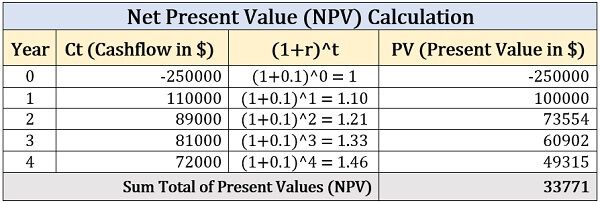
As you saw in the video, the calculation is methodical. For each project, you:
- List the cash flows for each year, starting with the initial investment at Year 0 (as a negative number).
- Determine the discount factor for each year using the formula .
- Calculate the present value of each cash flow by multiplying the cash flow by its corresponding discount factor.
- Sum all the present values to get the final Net Present Value.
The image below illustrates this standard tabular format for an NPV calculation.
Comparing Mutually Exclusive Projects
The video example also highlights a critical application of NPV: choosing between mutually exclusive projects. These are projects where you can only choose one, not both (e.g., building one of two different types of factory on the same piece of land).
The rule is simple: if both projects have a positive NPV, choose the one with the higher NPV.
In the video's example:
- NPV of Project X = 8,454
- NPV of Project Y = 9,456
Both projects are profitable (NPV > 0). However, since Project Y has a higher NPV, it is the superior investment because it is expected to add more value to the firm.
4. NPV for Irregular Cash Flows and Calculator Use
In the previous lesson and in the ACTEX manual, we touched upon using a financial calculator's cash flow worksheet. This function is essentially a dedicated NPV calculator and is the most efficient way to tackle these problems in an exam setting, especially when cash flows are not a simple annuity.
Let's revisit this practical skill, drawing on the ACTEX study manual.
Please review Section 2.7 from the ACTEX manual.
Focus on the part that demonstrates using the Cash Flow worksheet. This section shows how to enter an irregular series of payments (CF0, C01, C02, etc.) and then use the NPV function to compute the present value at a given interest rate. This is precisely the procedure for calculating NPV.
To perform an NPV calculation on a BA II Plus calculator, you would:
- Press the
CFkey to enter the Cash Flow worksheet. - Enter the initial investment as
CF0. Remember to make it negative. PressENTER. - Scroll down and enter the cash flow for the first period,
C01. PressENTER. - Scroll down to
F01. This is the frequency of that cash flow. If it's a single payment, leave it as 1 and scroll down. - Repeat steps 3 and 4 for all subsequent cash flows.
- Press the
NPVkey. It will ask for the interest rate,I. Enter the discount rate as a percentage (e.g., 10 for 10%) and pressENTER. - Scroll down to NPV and press
CPT(compute). The calculator will display the Net Present Value.
Mastering this calculator function is a key practical skill for the CB1 exam.
Conclusion
Today we've transformed a mechanical calculation—present value—into a powerful decision-making tool. Net Present Value provides a clear, quantitative basis for evaluating and comparing investment opportunities.
Key Takeaways:
- Net Present Value (NPV) is the sum of the present values of all cash flows (inflows and outflows) associated with a project.
- The NPV decision rule is to accept projects with a positive NPV and reject those with a negative NPV.
- When comparing mutually exclusive projects, the one with the highest positive NPV should be chosen.
- While NPV can be calculated manually in a table, using a financial calculator's cash flow worksheet is the most efficient method for exam purposes.
Your background in statistics gives you an appreciation for the fact that the cash flows we used today are forecasts, or expected values, subject to uncertainty. So far, we've focused only on the expected return of a project via its NPV. In our next lesson, we will start to formally address the other side of the coin: risk. We'll learn how to quantify the risk of an investment using standard deviation, laying the foundation for understanding the fundamental risk-return tradeoff in finance.