Introduction
In our previous lesson, we established the fundamental principle of the time value of money, focusing on calculating the present and future values of single cash amounts. We saw how discounting and compounding allow us to move a single sum of money across time. Now, we will build directly on that foundation to handle a more common financial scenario: a series of multiple cash flows over time.
This lesson will equip you with the tools to value streams of regular payments. We will cover three essential concepts:
- Annuities: A finite series of equal payments.
- Perpetuities: An infinite series of equal payments.
- Growing Perpetuities: An infinite series of payments that grow at a constant rate.
Mastering these calculations is crucial for valuing assets like bonds, loans, and stocks, and it provides the mechanical skills you'll need for the capital project appraisal topics we'll cover later in the course.
1. Valuing Annuities
An annuity is a sequence of fixed-size cash flows occurring at regular intervals over a specific number of periods. Common examples include mortgage payments, car loan installments, and regular pension income.
While you could find the present value (PV) of an annuity by discounting each cash flow individually and summing them up (as we learned in the last lesson), this would be incredibly tedious for a long series of payments. Fortunately, there's a more elegant and efficient way.
The video below introduces the concept of an annuity and demonstrates how a simple formula, or "annuity factor," can be used to find the present value of the entire stream in one step.
How to Calculate Net Present Value, Annuity & Perpetuity
Please watch this segment from the "How to Calculate Net Present Value, Annuity & Perpetuity" video by Corporate Finance Institute.
Watch from the start of the section on annuities. The video explains what an annuity is and shows how to calculate its present value by both summing individual discounted cash flows and by using the more efficient annuity factor.
The formula for the present value of an ordinary annuity (where payments are made at the end of each period) is:
Where:
- = Present Value
- = Cash flow per period
- = Interest rate per period
- = Number of periods
This formula is derived from the sum of a geometric series, a concept you will be familiar with from your statistics background. We will focus on its practical application.
Example: What is the present value of receiving $1,000 at the end of each year for 5 years, if the discount rate is 6%?
This means you would be indifferent between receiving $4,212.36 today and receiving $1,000 every year for the next five years, given a 6% interest rate.
The following reading provides a more formal presentation of the annuity formula and introduces important terminology. It also includes calculator notes, which are extremely useful for speeding up calculations in the CB1 exam.
Please read Section 2.2 from the ACTEX Learning study manual.
Focus on the formula for a_n (the present value of a unit annuity-immediate) in the section "Annuity-Immediate Calculations". Pay close attention to the worked examples and the "Calculator Note," as using your calculator's Time Value of Money (TVM) functions will be a significant time-saver.
Annuity Due
A small but important variation is the annuity due, where payments occur at the beginning of each period (e.g., rent payments). Since each payment is received one period earlier, it has more time to earn interest. The present value of an annuity due is therefore higher than that of an ordinary annuity by a factor of .
2. Valuing Perpetuities
What if the stream of payments never ends? This is called a perpetuity. While seemingly abstract, this concept is used to value assets with very long-term, stable cash flows, such as certain types of preferred stock or historical government bonds called "consols."

The formula for the present value of a perpetuity is remarkably simple:
Where:
- = Cash flow per period
- = Interest rate per period
The intuition behind this formula is straightforward. If you deposit an amount into a bank account that pays interest at a rate of , it will generate interest of each period. You could withdraw this interest payment every period forever, without ever touching the original principal.
The next video explains this concept very clearly.
Basic Financial Math 2: Annuities and Perpetuities
Watch this clip from "Basic Financial Math 2: Annuities and Perpetuities" by BurkeyAcademy.
Watch from the start of the perpetuity section. The video introduces the formula, provides a numerical example, and gives an excellent intuitive explanation for why the formula works.
Example: An endowment needs to fund a scholarship of $5,000 every year, forever. If the endowment can earn a reliable 5% return, how much principal is needed?
A one-time donation of $100,000 would be sufficient to fund the scholarship in perpetuity.
Deferred Perpetuities
Sometimes a perpetuity begins at a future date. This is known as a deferred perpetuity.
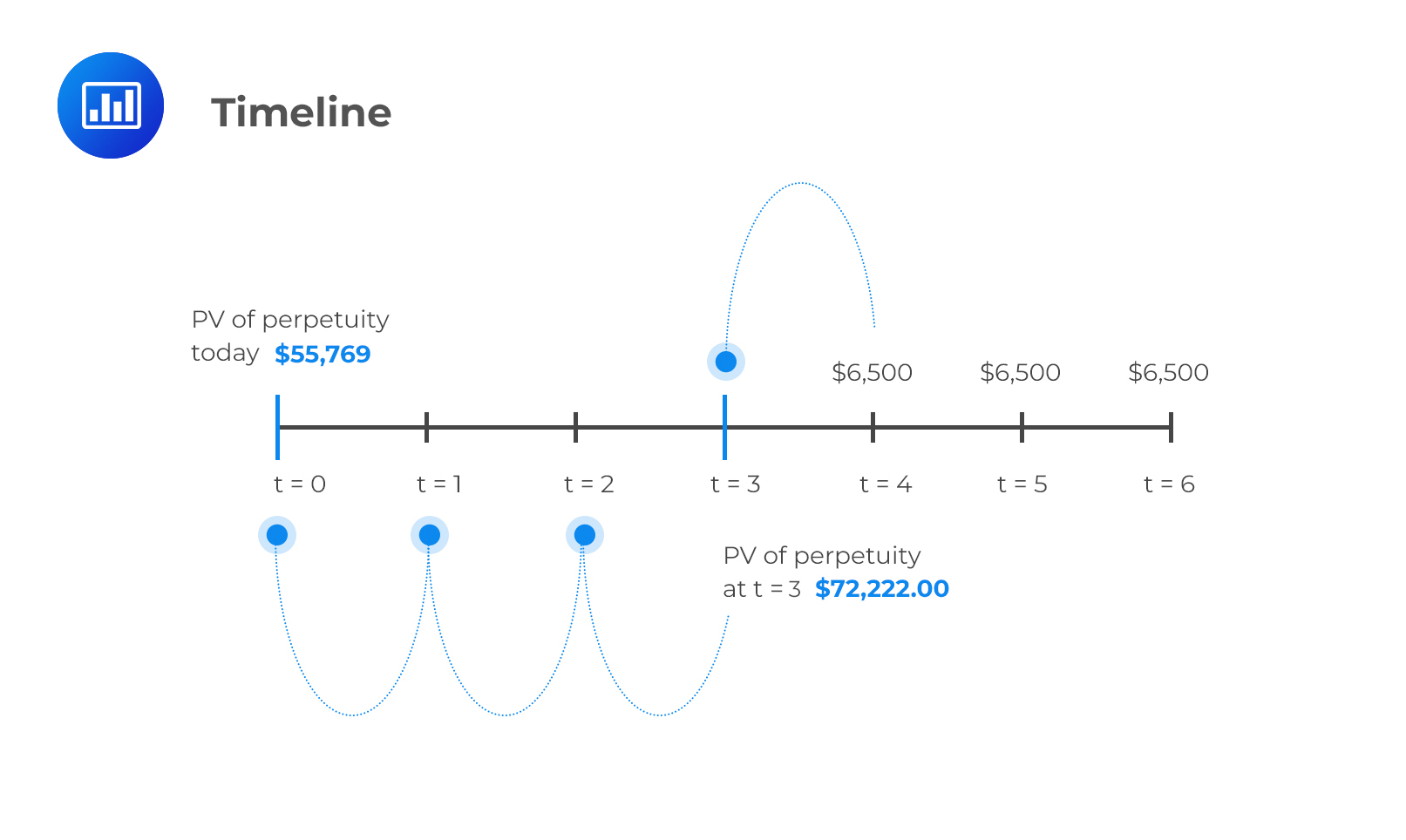
To find the present value of a deferred perpetuity, we use a two-step process that combines what you've learned:
- Calculate the present value of the perpetuity as of the start of its payments (e.g., at time ). This gives you a single lump-sum value at that future date.
- Discount this single lump sum back to today () using the standard present value formula from our first lesson.
This two-step discounting process is a common technique in financial valuation.
3. Valuing Growing Perpetuities
Our final variation is the growing perpetuity, an infinite stream of cash flows that grows at a constant rate, . This model is famously used in stock valuation as the Gordon Growth Model, where a company's dividends are expected to grow indefinitely.
The formula for the present value of a growing perpetuity is:
Where:
- = Cash flow at the end of the first period
- = Discount rate
- = Constant growth rate
A crucial condition for this formula to be valid is that the discount rate must be greater than the growth rate (). If the cash flows were to grow faster than the rate at which we discount them, the present value would be infinite.
This final video clip explains the formula and provides a practical stock valuation example.
How to Calculate Net Present Value, Annuity & Perpetuity
Please watch the final segment from the Corporate Finance Institute video on growing perpetuities.
Watch the short section from the beginning of the growing perpetuity segment. It introduces the formula and demonstrates its application in valuing a dividend-paying stock.
Example: A company's stock is expected to pay a dividend of $2.00 next year (). The dividend is forecast to grow at a steady 4% per year () forever. If your required rate of return for this stock is 10% (), what is the present value of all future dividends?
According to this model, you would be willing to pay $33.33 for the stock today.
For a deeper dive into the formulas for growing cash flows, including the growing annuity (a finite stream of growing payments), the following resource is excellent.
Skim Section 2.11 from the ACTEX manual.
Focus on the formulas presented, particularly for a geometric annuity-immediate. You can find the main formula in the text here. Also, note the formula for a growing perpetuity-immediate, here, which confirms the formula we just discussed (for a payment of 1). Don't worry about memorizing all the derivations; focus on seeing how the core formulas are structured.
Conclusion
In this lesson, we have moved from valuing single cash flows to valuing entire streams of them. These tools are indispensable in finance, forming the quantitative backbone for many valuation and investment decisions.
Key Takeaways:
- An annuity is a finite stream of equal payments. Its present value can be found efficiently with the annuity formula.
- A perpetuity is an infinite stream of equal payments. Its present value is calculated with the simple formula .
- A growing perpetuity is an infinite stream of payments growing at a constant rate . Its present value is given by , but only if .
- The timing of cash flows is critical. Distinguishing between an ordinary annuity (end-of-period payments) and an annuity due (beginning-of-period payments) is essential for accurate valuation.
The skills you've developed today are direct inputs for our next topic. In the following lesson, we will learn how to apply these present value calculations to make investment decisions by using the Net Present Value (NPV) rule to compare projects and choose the one that creates the most value.